Check patentability & draft patents in minutes with Patsnap Eureka AI!

Process for synthesis of polyalphaolefin

A technology for olefins and olefin monomers, which is applied in chemical instruments and methods, hydrocarbons, lubricating compositions, etc., and can solve the problems of wasting water and complicated washing methods.

Inactive Publication Date: 2012-07-11
CHEMTURA CORP
View PDF4 Cites 0 Cited by
  • Summary
  • Abstract
  • Description
  • Claims
  • Application Information

AI Technical Summary

Problems solved by technology

However, this water washing method is too complicated and uses additional steps, such as decanting, filtering and drying, and also wastes a lot of water
its difficult to run on a continuous basis

Method used

the structure of the environmentally friendly knitted fabric provided by the present invention; figure 2 Flow chart of the yarn wrapping machine for environmentally friendly knitted fabrics and storage devices; image 3 Is the parameter map of the yarn covering machine
View more

Image

Smart Image Click on the blue labels to locate them in the text.
Viewing Examples
Smart Image
  • Process for synthesis of polyalphaolefin
  • Process for synthesis of polyalphaolefin
  • Process for synthesis of polyalphaolefin

Examples

Experimental program
Comparison scheme
Effect test

Embodiment 1

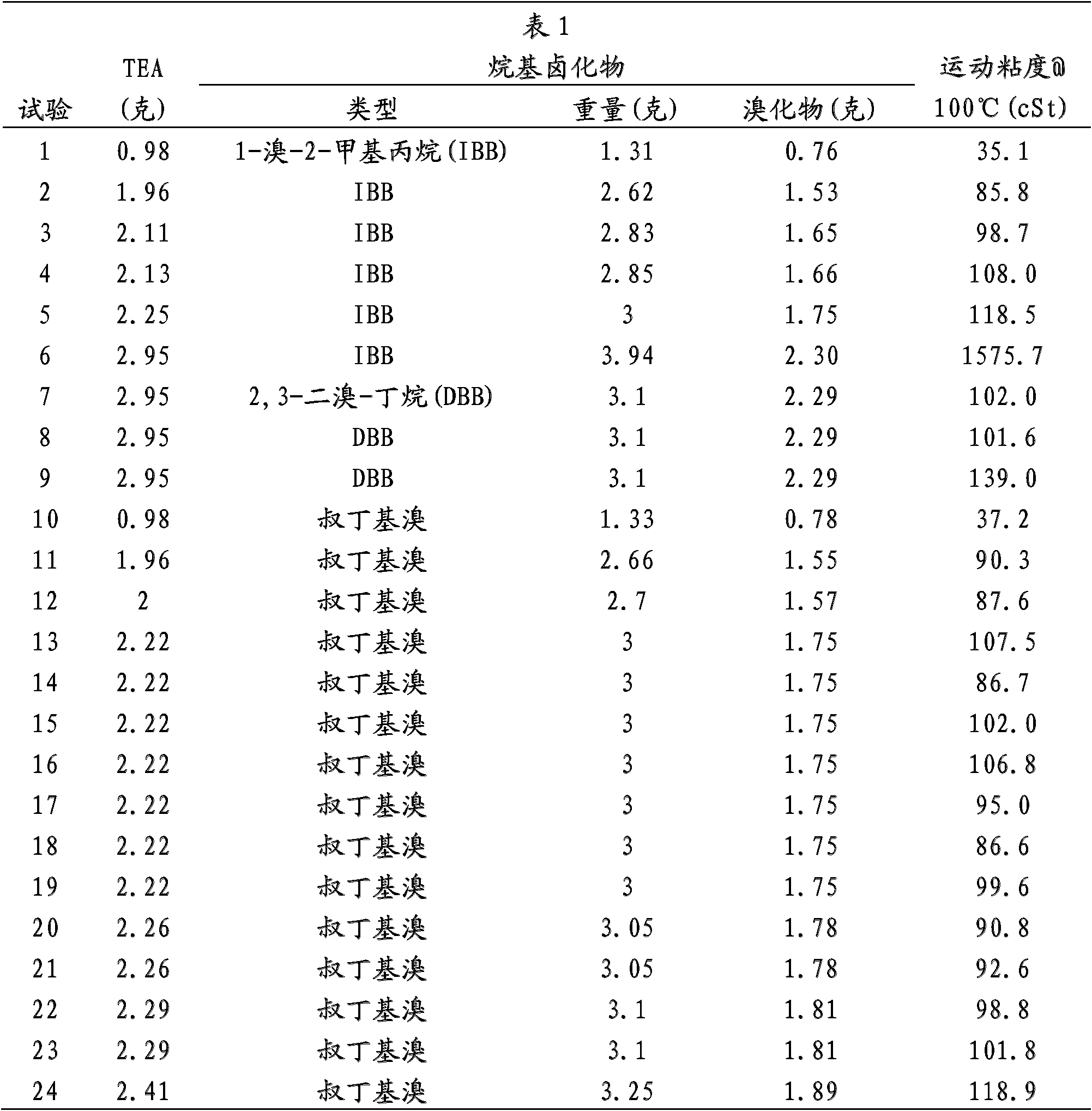
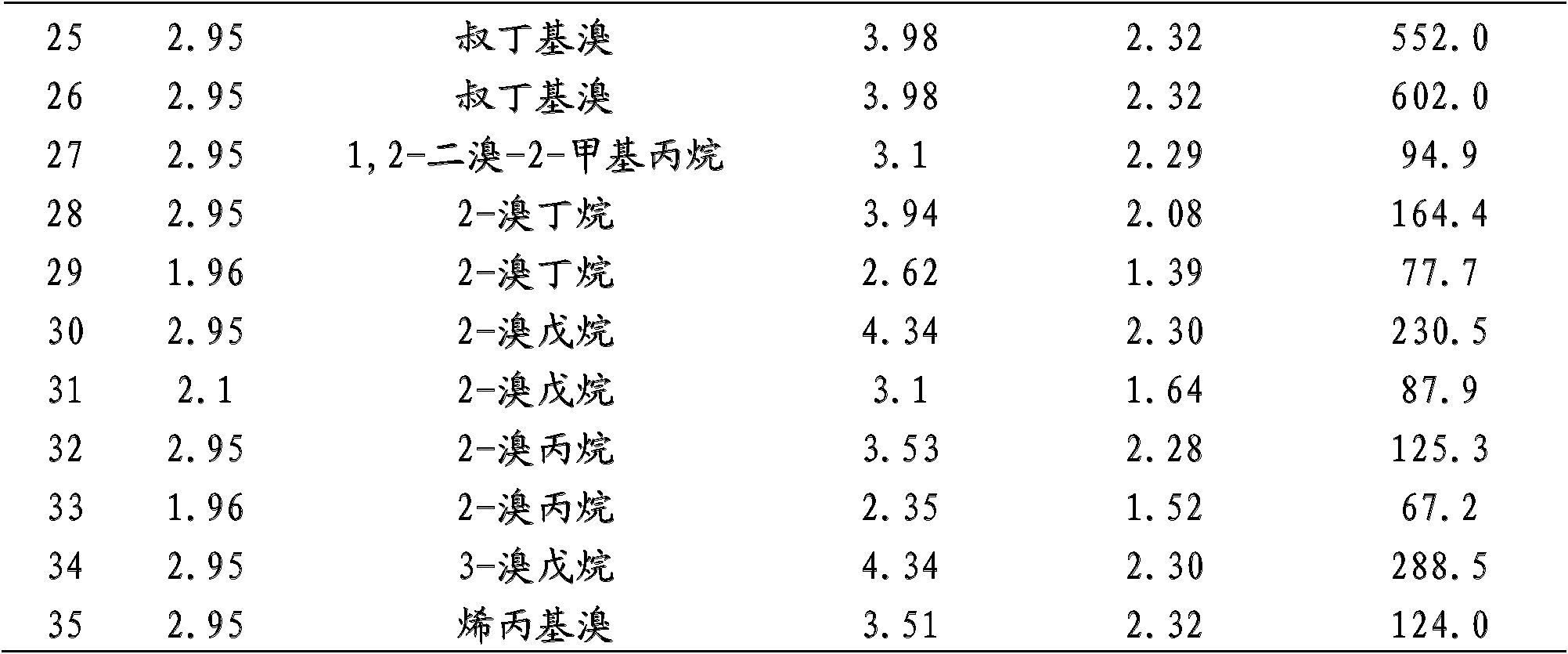
[0035] Polymerization of 1-decene in a continuous reactor. The reaction temperature was 40°C and the residence time was 2.8 hours. The mixed feed rate of TEA prediluted in decene and alkyl halide prediluted in decene was 6.0 g / min. The TEA used was a solution containing 25 wt% TEA and 75% decene. The molar ratio of bromide to aluminum for each run 1-37 in Table 1 was 3.3:1 and the weight amounts indicated in Table 1 were used. The gram numbers provided in Table 1 are based on 100 grams of decene. Table 1 shows the viscosities of the PAO products produced.

[0036]

[0037]

[0038] Trials 1-6 correspond to exemplary embodiments of the present invention. In comparing the amount of bromide equivalents from Run 6 with Runs 7, 8, 9, 24, 25, 27, 30, 32, 34 and 36, Run 6 surprisingly and unexpectedly produced greater Viscosity of any one of tests 7, 8, 9, 24, 25, 27, 30, 32, 34 and 36 of halides. Thus, 1-halo-2-methylpropanes, such as 1-bromo-2-alkylpropanes (IBB), use l...

Embodiment 2

[0040] 150 g of crude polydecene material prepared according to Experiment 5 was diluted with 50 g of decene and treated with 5 g of CaO (20 mesh) in a beaker with magnetic stirring at 50° C. for 15 minutes. The crude material was filtered with a 10 micron asbestos pressure filter using 20-80 psi nitrogen pressure to reduce the levels of aluminum and bromine in the polydecene material.

the structure of the environmentally friendly knitted fabric provided by the present invention; figure 2 Flow chart of the yarn wrapping machine for environmentally friendly knitted fabrics and storage devices; image 3 Is the parameter map of the yarn covering machine
Login to View More

PUM

PropertyMeasurementUnit
kinematic viscosityaaaaaaaaaa
Login to View More

Abstract

A process for reducing the level of residual catalyst comprising one or more 1-halo-2-methylpropanes and a Group 13 metal catalyst from a crude polyolefins product, the process comprising contacting the crude organic product with a solid adsorbent in an adsorbent system. Also provided is a co-catalyst system for polymerizing alpha olefins.

Description

[0001] Cross References to Related Applications [0002] This application claims priority to US Application 12 / 577,580, filed October 12, 2009, the entire disclosure of which is hereby incorporated by reference. field of invention [0003] The present invention generally relates to a process for the synthesis of polyalphaolefins in the presence of a Group 13 metal catalyst and a 1-halo-2-methylpropane catalyst system. The present invention also relates to a process for removing residual catalyst components (ie, metals and halides) from crude polyalphaolefin products. Background of the invention [0004] In organic synthesis, catalysts are usually dissolved in the crude organic products produced and cannot be removed by simple filtration. These catalysts and cocatalysts comprise at least one of alkyl halides, alkoxy halides, metal halides, metal oxyhalides, metal alkyls, metal alkoxides, boron compounds and metal complexes used alone or in any combination compounds, Friedel...

Claims

the structure of the environmentally friendly knitted fabric provided by the present invention; figure 2 Flow chart of the yarn wrapping machine for environmentally friendly knitted fabrics and storage devices; image 3 Is the parameter map of the yarn covering machine
Login to View More

Application Information

Patent Timeline
no application Login to View More
Patent Type & Authority Applications(China)
IPC IPC(8): C08F10/14C07C2/30C10M107/10
CPCC08F110/14C08F10/00C10N2230/02C08F6/02C08F10/14C10M2205/0285C10M107/10C10N2220/022C10N2020/02C10N2030/02C08L23/18C08F4/52C08F4/44C08F2/00C08F4/64C08F6/06
Inventor V·科索沃J·R·法比安D·C·科诺莱斯M·寇恩W·A·瑟灵
Owner CHEMTURA CORP
Features
  • R&D
  • Intellectual Property
  • Life Sciences
  • Materials
  • Tech Scout
Why Patsnap Eureka
  • Unparalleled Data Quality
  • Higher Quality Content
  • 60% Fewer Hallucinations
Social media
Patsnap Eureka Blog
Learn More