Check patentability & draft patents in minutes with Patsnap Eureka AI!

Method and device for detecting heavy metal ion in water

A technology for heavy metal ions and detection materials, applied in measurement devices, instruments, scientific instruments, etc., can solve problems such as increasing the complexity of experimental operations, and achieve low-cost effects

Inactive Publication Date: 2012-07-25
SONY CORP
View PDF3 Cites 4 Cited by
  • Summary
  • Abstract
  • Description
  • Claims
  • Application Information

AI Technical Summary

Problems solved by technology

However, the heavy metal chromogenic agent not only has a chelation reaction with heavy metal ions, other ions such as Ca 2+ (This application is also sometimes referred to as Ca(II)), Mg 2+ (This application is also sometimes referred to as Mg(II)) or Fe 3+ / Fe 2+ (This application is sometimes also referred to as Fe(III) / Fe(II)) and other metal ions can also undergo complexation reactions with it, so when detecting heavy metal ions such as Cd(II), Pb(II) and Hg(II), It is necessary to use a variety of masking agents to prevent the reaction between dithizone and non-heavy metal ions in the system, which increases the complexity of the experimental operation

Method used

the structure of the environmentally friendly knitted fabric provided by the present invention; figure 2 Flow chart of the yarn wrapping machine for environmentally friendly knitted fabrics and storage devices; image 3 Is the parameter map of the yarn covering machine
View more

Image

Smart Image Click on the blue labels to locate them in the text.
Viewing Examples
Smart Image
  • Method and device for detecting heavy metal ion in water
  • Method and device for detecting heavy metal ion in water
  • Method and device for detecting heavy metal ion in water

Examples

Experimental program
Comparison scheme
Effect test

preparation example Construction

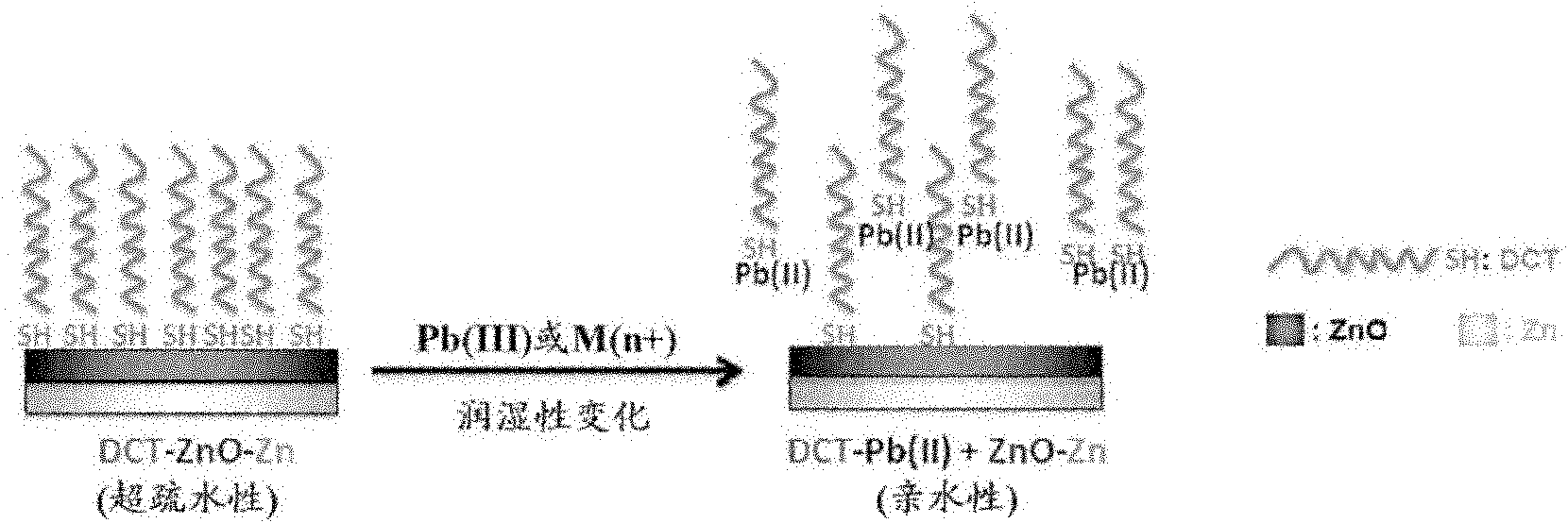
[0120] The preparation of the detection material of the present application may include: a first step, providing a material comprising a hydrophilic layer and an optional substrate (wherein the hydrophilic layer at least partially covers the optional substrate); second step, A hydrophobic layer that at least partially covers the hydrophilic layer is formed by the long-chain compound, wherein the long-chain compound is selected from long-chain thiols, long-chain aliphatic acids, and combinations thereof to obtain the detection material of the present application, wherein covering The region with the hydrophobic layer is called the detection region, and the initial contact angle between the surface of the detection region and water is greater than or equal to about 120°, preferably greater than or equal to about 150°.

[0121] In one embodiment, a material comprising a hydrophilic layer and a substrate is provided, wherein the hydrophilic layer at least partially covers the subst...

Embodiment 1

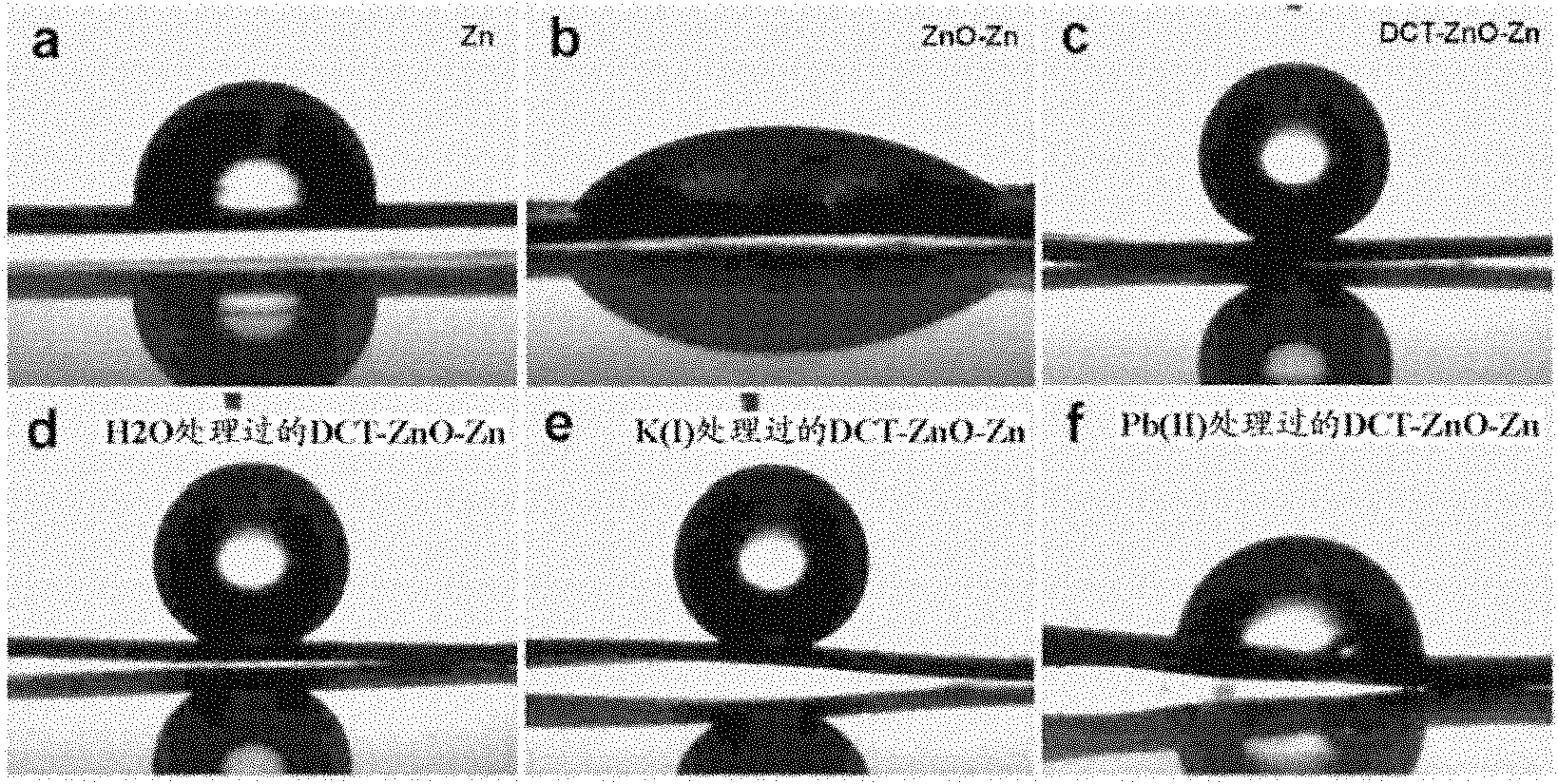
[0178] The superhydrophobic zinc flakes were prepared by the following steps: Zinc flakes were oxidized in 8% (v / v) N,N-dimethylacetamide-water solution at 65°C for 72h, taken out and cleaned with deionized water, and then placed at room temperature It is immersed in a 5mMDCT solution (the solvent is ethanol) for 24 hours, and self-assembled to obtain a superhydrophobic zinc sheet (DCT-ZnO-Zn). The entire surface of the superhydrophobic zinc sheet can be a detection area.

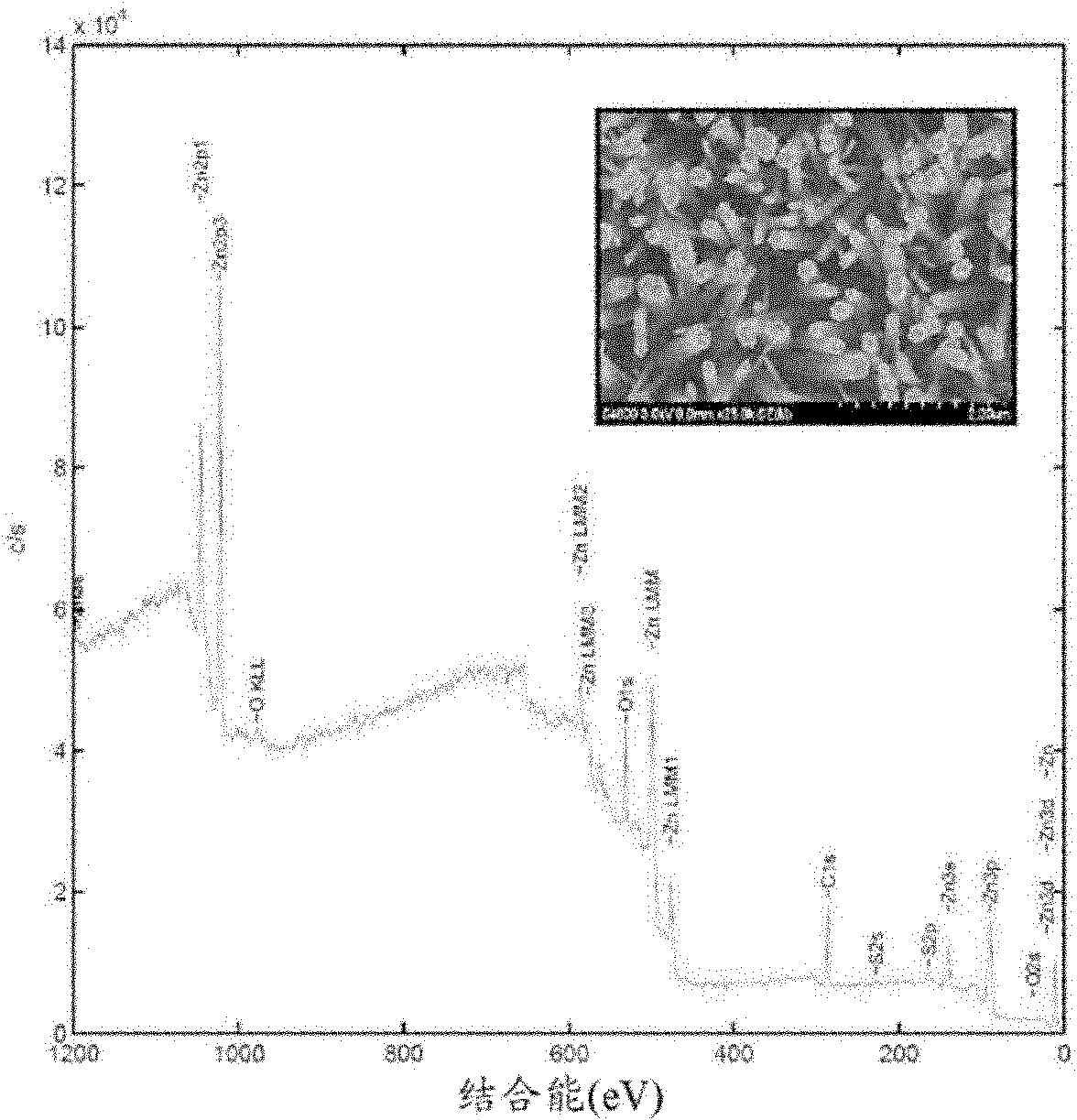
[0179] During the above preparation process, the obtained material can be analyzed by scanning electron microscopy (SEM) and X-ray photoelectron spectroscopy (XPS). figure 2 SEM images of the formed ZnO nanolayers and XPS spectra of superhydrophobic zinc flakes after oxidation of zinc flakes in 8% N,N-dimethylacetamide-water solution are described. As a result, the oxidized Zn surface appears as an array of highly oriented and closely packed hexagonal ZnO crystalline nanorods. After self-assembly of n-do...

Embodiment 2

[0188] As mentioned above, adding organic substances to the aqueous solution to be tested, and / or carrying out electrical treatment can shorten the detection time, lower the minimum detection limit and increase the detection speed.

[0189] In this example, the detection of heavy metal ions in aqueous solution using the superhydrophobic zinc sheet DCT-ZnO-Zn prepared in Example 1 was investigated under the condition of adding ethanol (EtOH) and / or energizing treatment.

[0190] In this example, 5% volume (based on the volume of the aqueous solution to be tested) of EtOH was added to the aqueous solution to be tested as a water-soluble solubilizer. The energization treatment can be performed as follows: the superhydrophobic zinc sheet acts as the working electrode, the Pt wire acts as the counter electrode and the Ag / AgCl electrode acts as the reference electrode, and a negative voltage (-3V) is applied to the superhydrophobic zinc sheet.

[0191] In addition, for better observ...

the structure of the environmentally friendly knitted fabric provided by the present invention; figure 2 Flow chart of the yarn wrapping machine for environmentally friendly knitted fabrics and storage devices; image 3 Is the parameter map of the yarn covering machine
Login to View More

PUM

PropertyMeasurementUnit
diameteraaaaaaaaaa
thicknessaaaaaaaaaa
thicknessaaaaaaaaaa
Login to View More

Abstract

The invention discloses a method and a device for detecting heavy metal ion in water. The method comprises (1) providing detecting material including hydrophilic layer at least partially covered by hydrophobic layer, wherein the hydrophobic layer is selected from long-chain compound such as long-chain thiol, long-chain fatty acid and combination thereof, the region covered by the hydrophobic layer is taken as detection region, and initial contact angle between the detection region surface and water is not less than about 120 degrees; (2) contacting the detection region with to-be-detected aqueous solution; (3) judging whether hydrophobic-hydrophilic change occurs at detection region surface after contact; and (4) accordingly determining whether heavy metal ion exists in the to-be-detected aqueous solution.

Description

technical field [0001] The invention relates to a method and a device for detecting heavy metal ions in water. More specifically, the present invention relates to a method for detecting lead (Pb), mercury (Hg), cadmium (Cd), or other types of heavy metal ions in aqueous solution using detection materials, and a device for detecting heavy metal ions in water based on the method. technical background [0002] A certain concentration of heavy metal ions can lead to heavy metal poisoning, and heavy metal poisoning can make people sick or poison the human body, such as nervous system dysfunction, changes in blood components, heart and lung diseases, and so on. In recent years, some analytical methods and separation techniques have been developed to identify heavy metal pollution. [0003] At present, various methods are widely used to quantitatively detect trace or even trace amounts of heavy metal ions, these methods include, for example, atomic absorption spectrometry, inducti...

Claims

the structure of the environmentally friendly knitted fabric provided by the present invention; figure 2 Flow chart of the yarn wrapping machine for environmentally friendly knitted fabrics and storage devices; image 3 Is the parameter map of the yarn covering machine
Login to View More

Application Information

Patent Timeline
no application Login to View More
Patent Type & Authority Applications(China)
IPC IPC(8): G01N13/00
CPCG01N13/02G01N33/1813
Inventor 张晓科梶浦尚志李勇明
Owner SONY CORP
Features
  • R&D
  • Intellectual Property
  • Life Sciences
  • Materials
  • Tech Scout
Why Patsnap Eureka
  • Unparalleled Data Quality
  • Higher Quality Content
  • 60% Fewer Hallucinations
Social media
Patsnap Eureka Blog
Learn More