

Dry film photoresist containing adhesive additive and plasticizer
A technology of plasticizers and additives, applied in the field of dry film photoresist, can solve problems such as difficult control of adhesion
- Summary
- Abstract
- Description
- Claims
- Application Information
AI Technical Summary
Problems solved by technology
Method used
Image

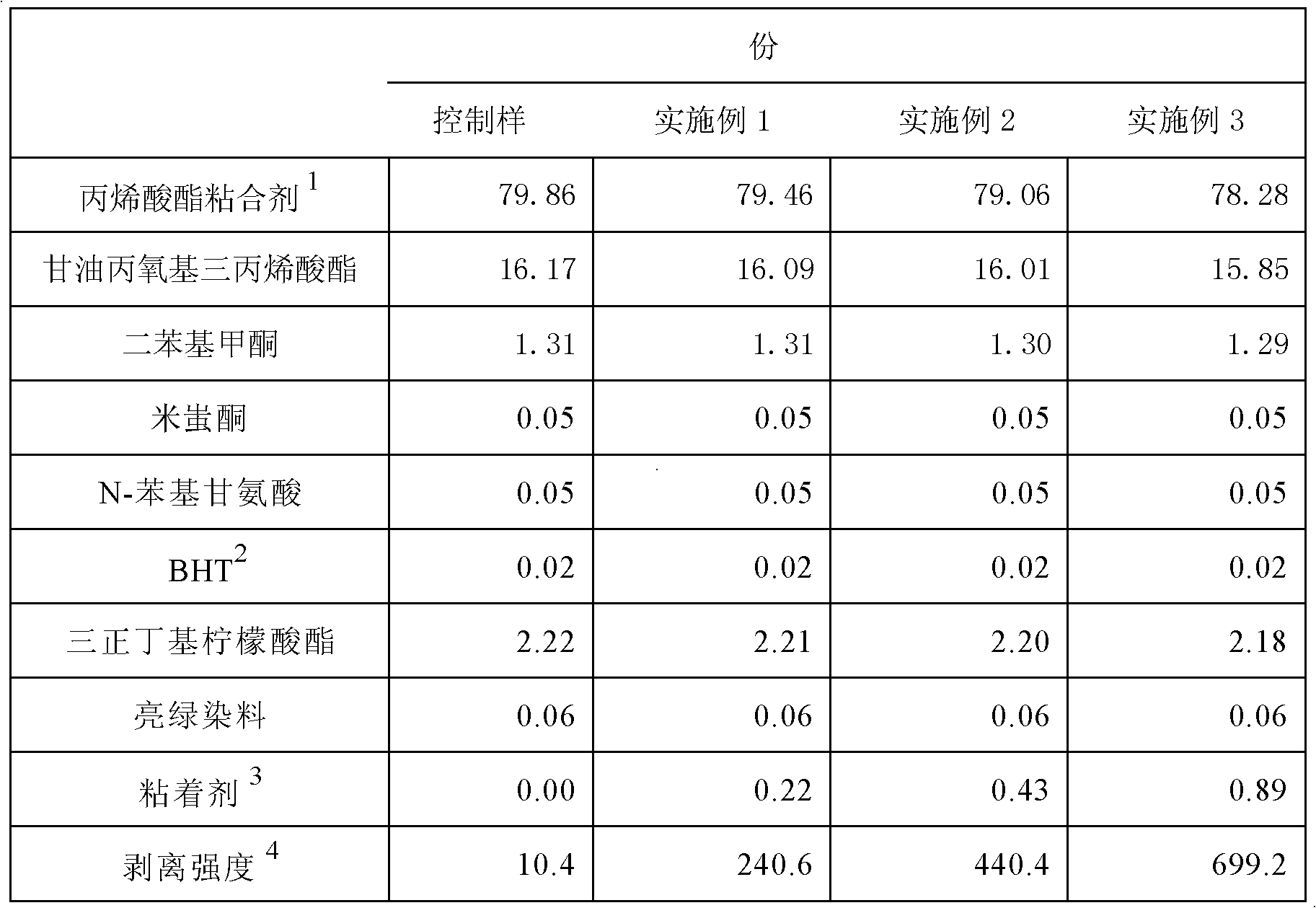
Examples
Embodiment 1-3
[0026] These illustrations show the effect of carboxyl-modified vinyl chloride / ethylene acetate polymer concentration on the adhesion of the photopolymerizable components to polyester films. The photopolymerizable combinations in the preparation examples were prepared according to the formulations in Table 1. , the preparation of this component is to stir all the substances in a screw mixer for one hour. Then coat a liquid layer with a thickness of about 38.1um on a 23.4um polyester film, and the sample is placed in a fume hood for 4-18 hours to The solvent was evaporated and the sample was then hot pressed onto a copper foil epoxy / fiberglass substrate. The photoresist was cut into 1-inch strips with a razor blade. The peel strength was not measured. The measurement was performed by a peel test at 180°C. The instrument was INSTRON, with a load of 0.9kg. Each sample was measured at least 10 times, as listed in the report. The peel strength is the average of 10 test results. For...
Embodiment 4
[0035] Polyurethane in the present invention is prepared according to the following formula:
[0036] Table 2
[0037]
molecular weight
quantity%
Moore
polypropylene glycol 1
195
29.28
0.0294
block segment copolymer 2
996
42.63
0.0428
Dimonomethylolpropionic acid
67
2.37
0.0353
toluene diisocyanate
87.1
14.07
0.1615
144
3.88
0.0269
[0038] 1. The weight average molecular weight is 2000, poly G55-53, produced by olin Chemical Company.
[0039] 2. The weight average molecular weight is 2000, poly G20-56, produced by olin Chemical Company, prepared from the reaction of ethylene oxide and polypropylene glycol.
[0040] The mixture of polypropylene diester, block copolymer and bishydroxycarboxylic acid was heated to about 60°C, dried with nitrogen for 12 hours, 0.015% dioctyltin bis(sulfide) dioc...
Embodiment 5
[0042] This example shows the preparation steps of the dry film of the photopolymerizable component of the present invention, which is the use method of using the polyurethane in Example 4 as a plasticizer, and the dry film is made of a photoresist in The interlayer in the polyester carrier film and the polyethylene cover film is rolled into a cylindrical shape, and the photopolymerizable component is prepared by the following parts: 77 parts of acrylate polymer (31% solid content), which is prepared by using 13% ethyl acetate Base acrylate, 65% methacrylic acid formic acid, 22% methacrylic acid, in solvent butanone, using AIBN (azobisisobutyronitrile) as initiator, polymerized at 60℃-65℃. 0.23 parts of adhesive (molecular weight 22000, partially hydrolyzed, hydroxyl modified vinyl chloride / vinyl ester copolymer, of which about 90% vinyl chloride, about 4% vinyl acetate, 2.3% hydroxyl content, name UCAR VAGD, by UMION CARBIDE produced by the company). 3% Methoxylated bispheno...
PUM
 Login to View More
 Abstract
Description
Claims
Application Information
 Login to View More