
Solvent-free, non-yellowing polyurethane adhesive for sports fields
A technology for polyurethane adhesives and sports venues, applied in the direction of polyurea/polyurethane adhesives, adhesive types, non-polymer adhesive additives, etc., can solve low reactivity, poor strength, adhesive storage Reduced stability and other issues, to achieve the effects of excellent mechanical properties, good storage stability, and simple preparation methods
- Summary
- Abstract
- Description
- Claims
- Application Information
AI Technical Summary
Problems solved by technology
Method used
Image

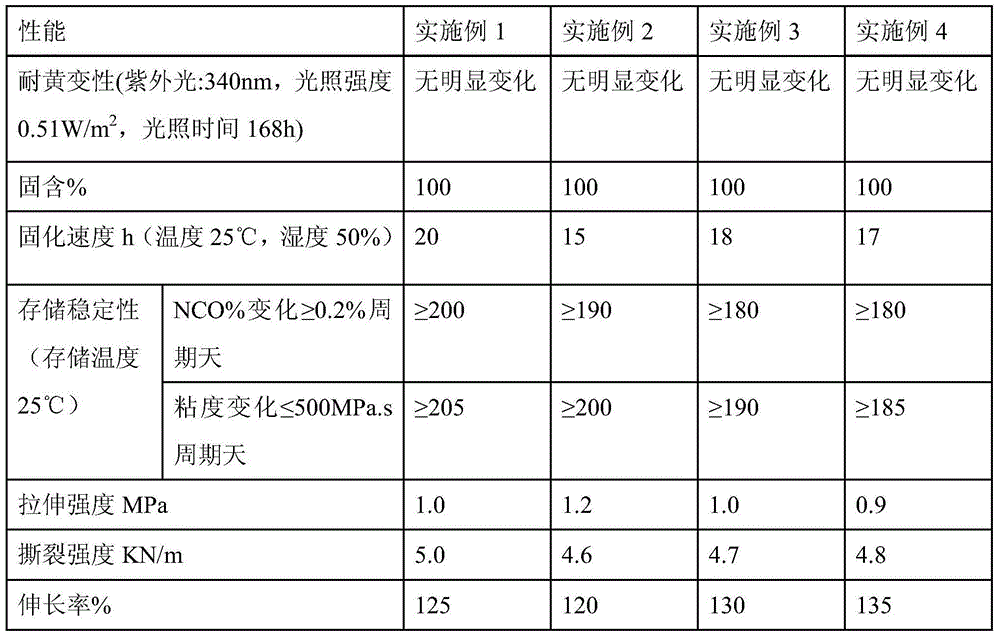
Examples
Embodiment 1
[0021] The polyolefin polyol (with H 2 o 2 As an initiator, 1,2 propylene glycol is used as a solvent, and butadiene is subjected to free radical polymerization, the molecular weight is 1000, and the functionality is 2) 25 grams, polyolefin polyol (in the form of H 2 o 2 As an initiator, 1,2 propylene glycol is used as a solvent, butadiene is subjected to free radical polymerization, the molecular weight is 2000, and the functionality is 2) 15 grams, 30 grams of castor oil are added to the reaction kettle at room temperature, and stirred at 97 ° C. Dehydration and degassing at a pressure of -0.095MPa for 2.5 hours. When the water mass fraction is less than 0.05%, cool down to 88°C and add 20 grams of 1,4-cyclohexane diisocyanate and 5 grams of cyclohexane dimethylene diisocyanate. React at 85°C for 2.5 hours, add 1 g of isooctyl 3,5-tert-butyl-4-hydroxyphenylpropionate, bis(2,2,6,6-tetramethyl-4-piperidinyl) sebacic acid 3 grams of ester, 0.8 grams of bismuth isooctanoate, ...
Embodiment 2
[0024] The polyolefin polyol (with H 2 o 2 As an initiator, 1,2 propylene glycol is used as a solvent, butadiene undergoes free radical polymerization, the molecular weight is 1000, and the functionality is 2) 30 grams, and 30 grams of castor oil are added to a three-necked bottle at room temperature, and stirred at 95 ° C. Dehydration and degassing at -0.095MPa for 3 hours, when the water mass fraction is less than 0.05%, cool down to 90°C and add 30 grams of 1,4-cyclohexane diisocyanate, react at 80°C for 3 hours, add 3,5-tert 4 grams of isooctyl butyl-4-hydroxyphenylpropionate, 4 grams of bis(2,2,6,6-tetramethyl-4-piperidinyl) sebacate, 2 grams of bismuth isooctanoate, cooled to Bottle at 15°C.
[0025] When using, mix the glue with TPU / EPDM particles in a ratio of 1:5.
Embodiment 3
[0027] The polyolefin polyol (with H 2 o 2 As an initiator, 1,2 propylene glycol is used as a solvent, butadiene undergoes free radical polymerization, the molecular weight is 1000, and the functionality is 2) 35 grams, 25 grams of castor oil are added to a three-necked flask at room temperature, stirred at 100 ° C, ( The pressure is -0.095MPa) dehydration and degassing for 2 hours, when the water mass fraction is less than 0.05%, lower the temperature to 90°C, add 30 grams of 1,4-cyclohexane diisocyanate, 5 grams of isophorone diisocyanate, and react at 83°C After 2.7 hours, add 3 grams of isooctyl 3,5-tert-butyl-4-hydroxyphenylpropionate and 1 gram of bis(2,2,6,6-tetramethyl-4-piperidinyl) sebacate , 0.65 grams of bismuth isooctanoate, 0.35 grams of N-ethylmorpholine, cooled to 15 ° C for bottling.
[0028] When using, mix the glue with TPU / EPDM particles in a ratio of 1:7.
PUM
| Property | Measurement | Unit |
|---|---|---|
| hydroxyl value | aaaaa | aaaaa |
| Functional group degree | aaaaa | aaaaa |
Abstract
Description
Claims
Application Information
 Login to View More