
High temperature resistant oil-based drilling fluid emulsifier and preparation method thereof
An oil-based drilling fluid and emulsifier technology, applied in the field of oil drilling, can solve the problems of poor high-temperature emulsification effect, large gap, and large amount of addition, and achieves the ability to ensure emulsification stability, good emulsification, and strong high temperature resistance. Effect
- Summary
- Abstract
- Description
- Claims
- Application Information
AI Technical Summary
Problems solved by technology
Method used
Image

Examples
Embodiment 1
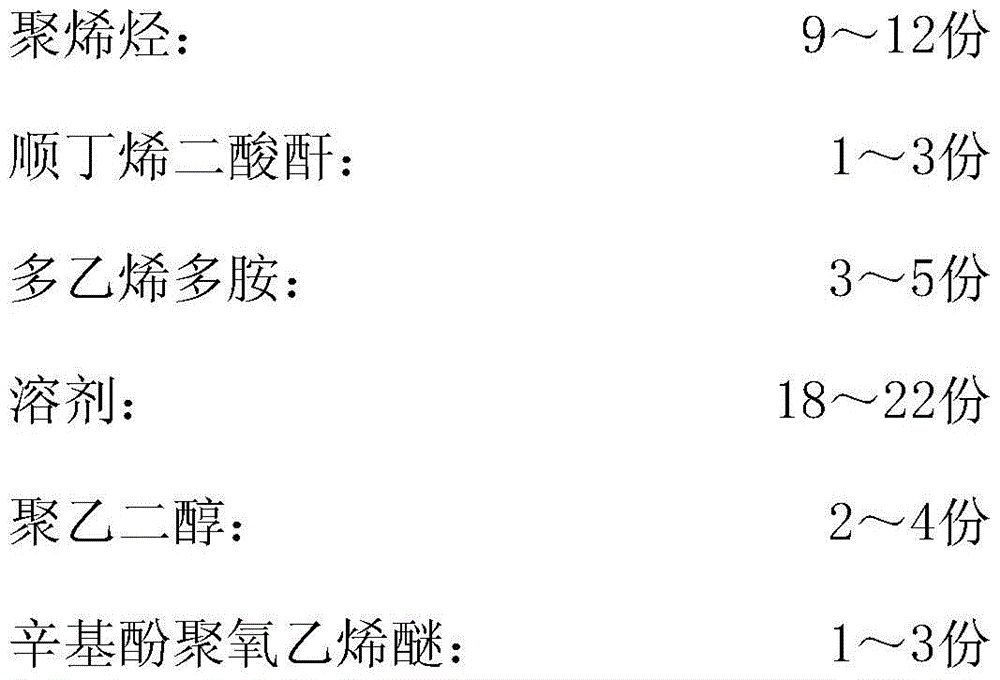
[0021] (1) Dissolve 9 parts of polyisobutylene (molecular weight 1000-1200) and 2 parts of maleic anhydride in 22 parts of solvent xylene, add to the reaction kettle, heat to 150°C, pressurize to 0.6MPa with nitrogen, Reaction 8h, obtain polyisobutylene succinic anhydride;
[0022] (2) Reduce the temperature in the reactor to room temperature and release the pressure, add 4 parts of polyethylene polyamine, raise the temperature to 110°C, and react for 6 hours under normal pressure, so that polyethylene polyamine and polyisobutylene succinic anhydride undergo condensation reaction;
[0023] (3) Heating up to 150° C. to recover the solvent by distillation under normal pressure. After the distillation is completed, the temperature is raised to 200° C. to recover unreacted reactants by distillation, and the obtained product is polyolefin succinimide, the primary product of the emulsifier;
[0024] (4) Evenly mix the primary product of the emulsifier with 4 parts of polyethylene gl...
Embodiment 2
[0026] (1) Dissolve 12 parts of polyisobutylene (molecular weight 1000-1200) and 1 part of maleic anhydride in 20 parts of solvent xylene, add to the reaction kettle, heat to 160 ° C, pressurize to 0.7 MPa with nitrogen, Reaction 10h, obtain polyisobutylene succinic anhydride;
[0027] (2) Reduce the temperature in the reactor to room temperature and release the pressure, add 3 parts of polyethylene polyamine, heat up to 120°C, and react for 5 hours under normal pressure, so that polyethylene polyamine and polyisobutylene succinic anhydride undergo condensation reaction;
[0028] (3) Heating up to 155° C. to distill and recover the solvent under normal pressure. After the distillation is completed, the temperature is raised to 205° C. to distill and recover the unreacted reactants. The product obtained is polyolefin succinimide, the primary product of the emulsifier;
[0029] (4) Uniformly mix the primary product of the emulsifier with 3 parts of polyethylene glycol and 3 part...
Embodiment 3
[0031] (1) Dissolve 10 parts of polyisobutylene (molecular weight 1000-1200) and 3 parts of maleic anhydride in 18 parts of solvent xylene, add to the reaction kettle, heat to 160 °C, pressurize to 0.5 MPa with nitrogen, Reaction 9h, obtain polyisobutylene succinic anhydride;
[0032] (2) Reduce the temperature in the reactor to room temperature and release the pressure, add 5 parts of polyethylene polyamine, raise the temperature to 130°C, and react for 4 hours under normal pressure, so that polyethylene polyamine and polyisobutylene succinic anhydride undergo condensation reaction;
[0033] (3) Heating up to 155° C. to distill and recover the solvent under normal pressure. After the distillation is completed, the temperature is raised to 205° C. to distill and recover the unreacted reactants. The product obtained is polyolefin succinimide, the primary product of the emulsifier;
[0034] (4) Evenly mix the primary product of the emulsifier with 2 parts of polyethylene glycol ...
PUM
 Login to View More
 Abstract
Description
Claims
Application Information
 Login to View More