
Lactobacillus fermentum Lee working fermenting agent product and application thereof to prevent constipation and keep healthy
A technology of working starter, Lactobacillus fermentum, applied in the field of microorganisms
- Summary
- Abstract
- Description
- Claims
- Application Information
AI Technical Summary
Problems solved by technology
Method used
Image



Examples
Embodiment 1
[0047] Example 1: Isolation, purification and preliminary identification of Lactobacillus fermentum Lee
[0048] This embodiment is carried out according to the following steps:
[0049] (1) Isolation and purification of Lactobacillus fermentum Lee
[0050] Aseptically draw 500 μL of the sample and add it to 5 mL of sterilized saline to make a uniform dilution of 1:10, and continue to make a certain proportion of dilution. Select the appropriate gradient diluent, draw 100 μL each into the MRS solid plate medium with a sterile pipette tip, and incubate at 30°C for 48-72h, observe and record the colony morphology ( figure 1 ). Use an inoculation loop (or a sterilized toothpick) to pick different colonies from the surface and inside of the plate and inoculate them in MRS liquid medium, culture them on a 300r shaker at 30°C for 24-48 hours; Ran's staining microscope ( figure 2 ), determined to be the continued activation of G+ bacteria until pure colonies were obtained (micro...
Embodiment 2
[0055] Embodiment 2: In vitro screening of Lactobacillus fermentum Lee
[0056] (1) Screening of probiotics resistant to pH 3.0 artificial gastric juice
[0057] Preparation of artificial gastric juice: 0.2% NaCl, 0.35% pepsin, adjust the pH value to 3.0 with 1M HCl, filter and sterilize with a vacuum pump in an aseptic operating table for later use.
[0058] Determination of the tolerance of probiotics to artificial gastric juice: take 5mL of the activated strain culture solution, pour it into a sterilized 10mL centrifuge tube in a sterile operating table, collect the bacteria by centrifugation at 3000r / min for 10min, add 5mL of sterilized Mix normal saline to make bacterial suspension, mix 1mL bacterial suspension with 9mL pH3.0 artificial gastric juice, shake well, place in a constant temperature shaker (37°C, 300r), and take samples at 0h and 3h respectively, Incubate at 37°C for 48h with MRS agar medium. Measure the number of viable bacteria with the plate counting meth...
Embodiment 3
[0070] Example 3: Activated carbon induced constipation experiment
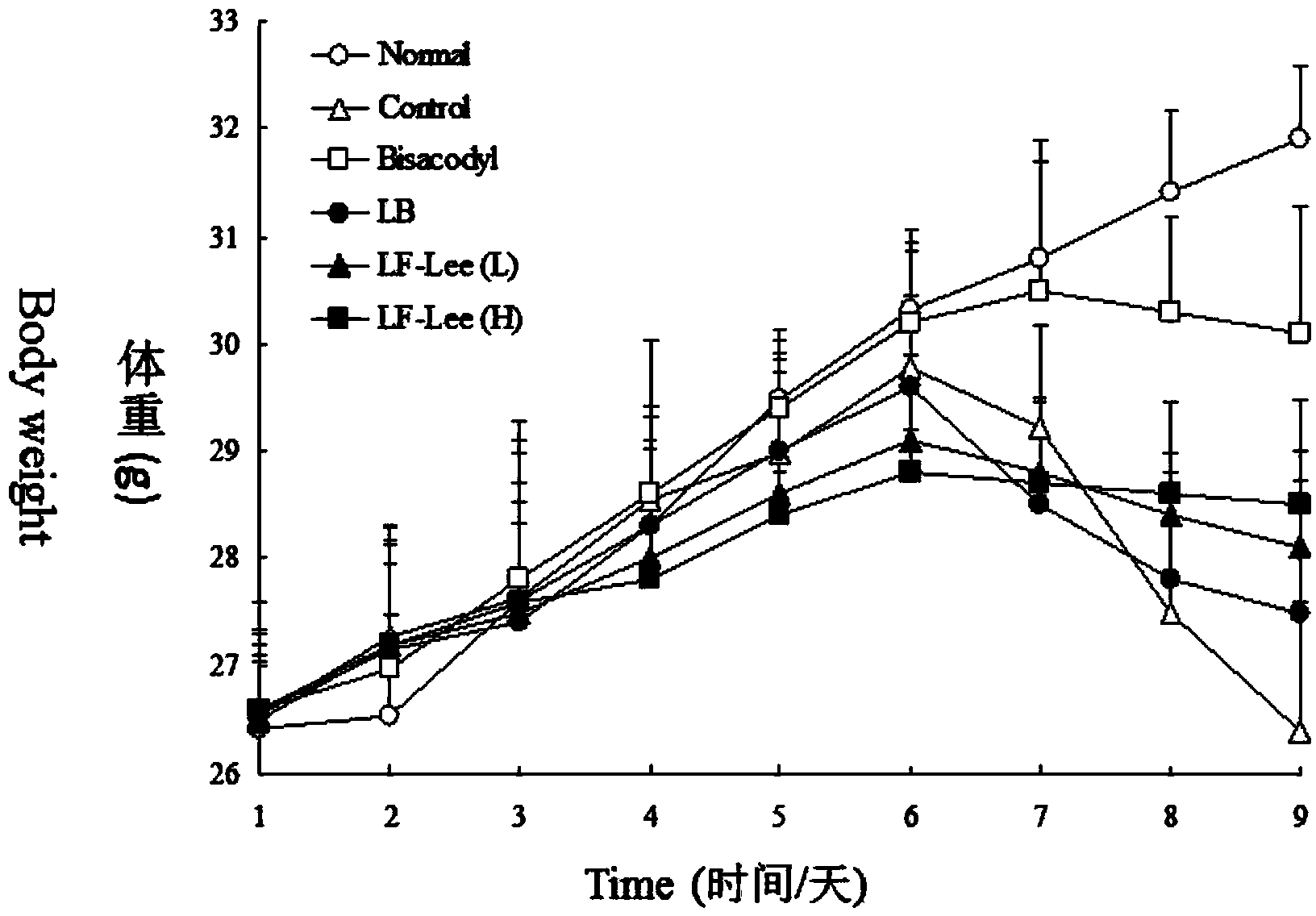
[0071]Feeding healthy Kunming mice, 6 weeks old, weighing 23±2g, 60 females. After feeding the basic diet for 5 days, the mice were randomly divided into 5 groups according to body weight, namely: normal group, constipation control group, 5% RS3 group, 10% RS3 group and 15% RS3 group, with 12 mice in each group. Raise them in stainless steel cages, keep room temperature at 24±2°C, relative humidity at 50±10%, and light-dark rotation for 12 hours (lighting at 8:00-20:00). During the whole experimental period, the normal group and the constipation control group were fed with the basal diet, and the mice in the experimental group were fed with 1.0×10 9 CFU / kg gavage probiotics. Two weeks later, at 9:00 in the morning, the mice in the other five groups except the normal group were gavaged with 10% activated carbon ice water at 2°C, 0.2 mL / mouse, once a day for 3 consecutive days. Until the last day of the expe...
PUM
 Login to View More
 Abstract
Description
Claims
Application Information
 Login to View More