
Preparation method for crosslinking type polyimide aerogel
A technology of polyimide and airgel, which is applied in the field of nanoporous material preparation, can solve the problems of high density, poor thermal stability of organic aerogels, and limited application prospects, etc., and achieve good thermal stability
- Summary
- Abstract
- Description
- Claims
- Application Information
AI Technical Summary
Problems solved by technology
Method used
Image

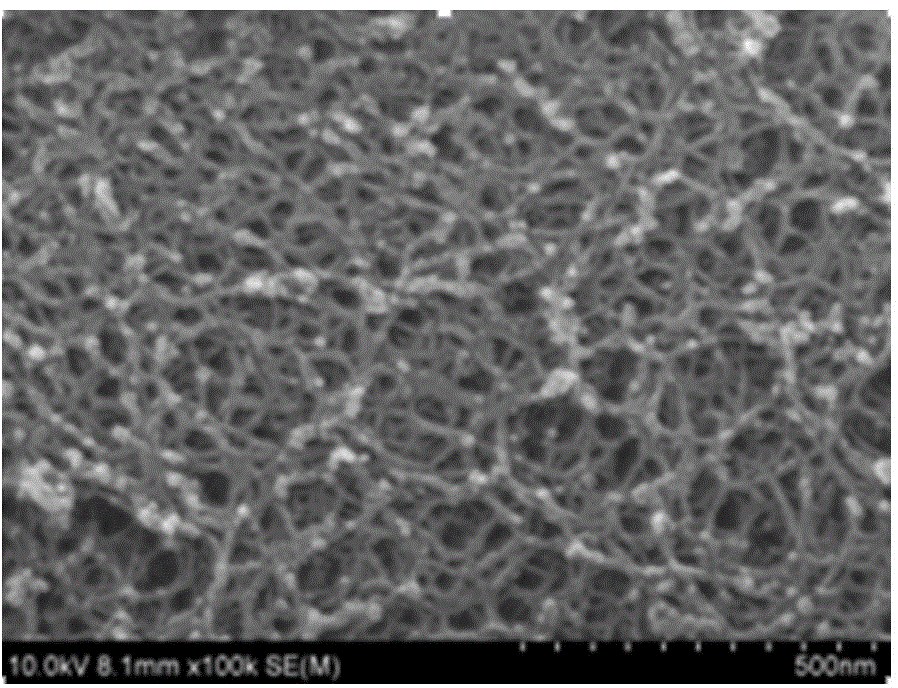
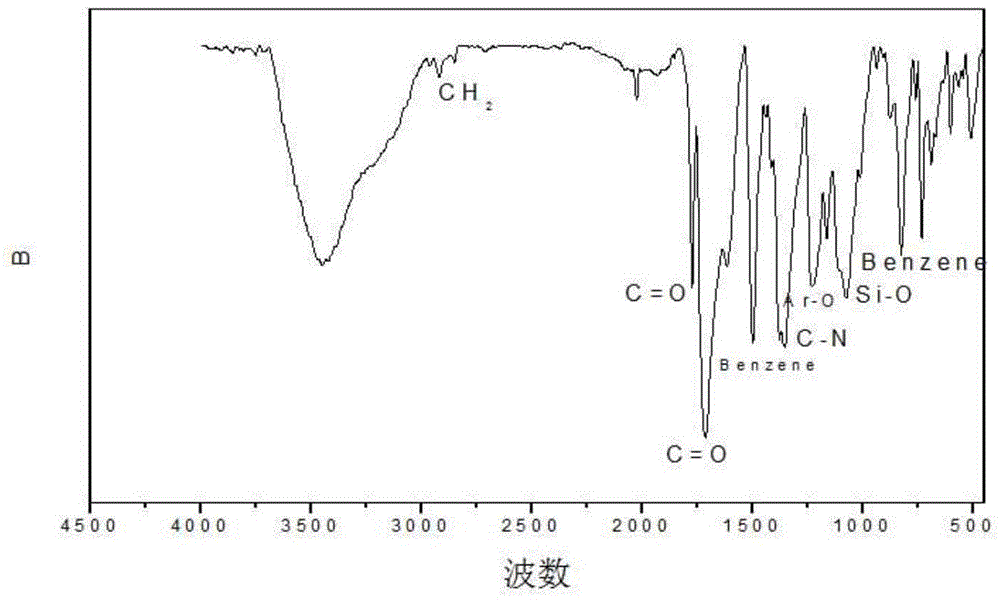
Examples
Embodiment 1
[0021] Preparation of cross-linked polyimide airgel
[0022] Diamine, dianhydride and silane coupling agent (2,2'-bis[4-(4-aminophenoxyphenyl)]propane, 3,3',4,4'-biphenyltetracarboxylic acid di Anhydride, 3-aminopropyltriethoxysilane mass ratio is 2.5:3.4:0.15) dissolved in N-methylpyrrolidone, mixed into a 48ml mixed solution, stirred rapidly, then added dehydrating agent 11.1ml (acetic anhydride, The volume ratio of pyridine is 6.5:5.6), and after rapid stirring, it gels at room temperature. After 24 hours, use pure N-methylpyrrolidone for 2 solvent replacements, with an interval of 6-10 hours each time, and then use a mixed solution of N-methylpyrrolidone and acetone for 2 solvent replacements, each time for 6-10 hours. Finally, the gel was replaced with pure acetone for 3 times of solvent, each time for 6-10h, and finally supercritical drying was carried out. The resulting density is 130mg / cm 3 , The specific surface area is 530m 2 / g of cross-linked polyimide airgel. ...
Embodiment 2
[0025] Preparation of cross-linked polyimide airgel
[0026] Diamine, dianhydride and silane coupling agent (2,2'-bis[4-(4-aminophenoxyphenyl)]propane, 3,3',4,4'-biphenyltetracarboxylic acid di Anhydride, 3-aminopropyltriethoxysilane mass ratio is 2.5:3.4:0.15) dissolved in N-methylpyrrolidone, mixed into a 35ml mixed solution, stirred rapidly, then added dehydrating agent 11.1ml (acetic anhydride, The volume ratio of pyridine is 6.5:5.6), and after rapid stirring, it gels at room temperature. After 24 hours, use pure N-methylpyrrolidone for 2 solvent replacements, with an interval of 6-10 hours each time, and then use a mixed solution of N-methylpyrrolidone and acetone for 2 solvent replacements, each time for 6-10 hours. Finally, the gel was replaced with pure acetone for 3 times of solvent, each time for 6-10h, and finally supercritical drying was carried out.
Embodiment 3
[0028] Preparation of cross-linked polyimide airgel
[0029] Diamine, dianhydride and silane coupling agent (2,2'-bis[4-(4-aminophenoxyphenyl)]propane, 3,3',4,4'-biphenyltetracarboxylic acid di Anhydride, 3-aminopropyltriethoxysilane mass ratio is 2.5:3.4:0.15) dissolved in N-methylpyrrolidone, mixed into a 70ml mixed solution, stirred rapidly, then added dehydrating agent 11.1ml (acetic anhydride, The volume ratio of pyridine is 6.5:5.6), and after rapid stirring, it gels at room temperature. After 24 hours, use pure N-methylpyrrolidone for 2 solvent replacements, with an interval of 6-10 hours each time, and then use a mixed solution of N-methylpyrrolidone and acetone for 2 solvent replacements, each time for 6-10 hours. Finally, the gel was replaced with pure acetone for 3 times of solvent, each time for 6-10h, and finally supercritical drying was carried out.
PUM
| Property | Measurement | Unit |
|---|---|---|
| density | aaaaa | aaaaa |
| density | aaaaa | aaaaa |
| specific surface area | aaaaa | aaaaa |
Abstract
Description
Claims
Application Information
 Login to View More