
Michelson Heterodyne Laser Vibrometer Based on Single Acousto-optic Modulation and Polarization Spectroscopy
A technology of Michelson heterodyne and laser vibrometer, applied in instruments, measuring devices, measuring ultrasonic/sonic/infrasonic waves, etc., can solve the problems of optical path polarization leakage, difficult adjustment of optical path, nonlinear error, etc. Solve the effect of more optical components and convenient adjustment of optical path
Patent Information
- Authority / Receiving Office
- CN · China
- Patent Type
- Patents(China)
- Current Assignee / Owner
- Publication Date
- 2017-11-10
Smart Images
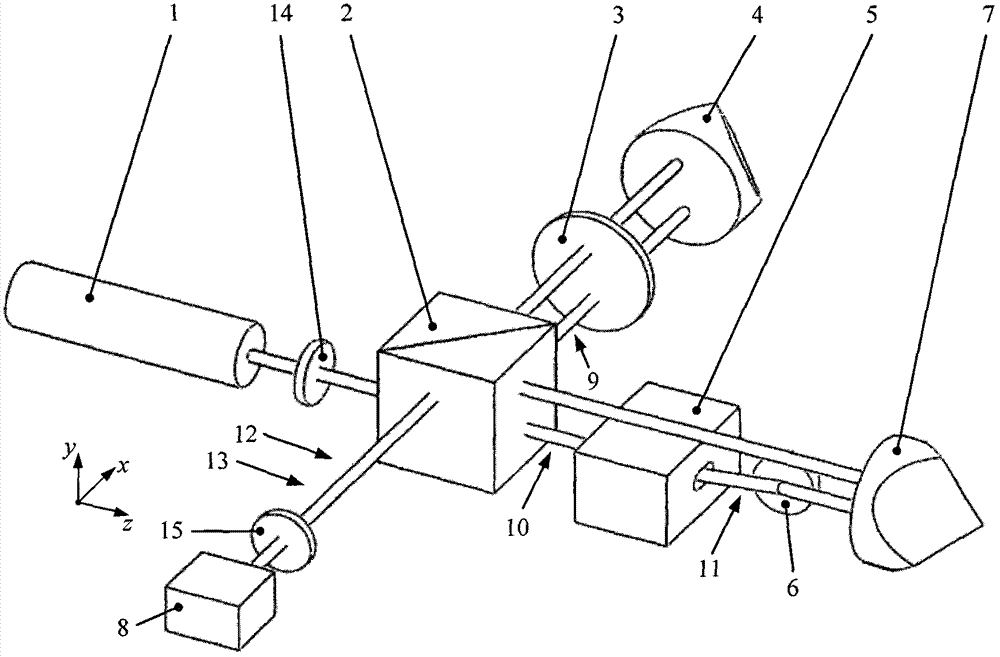
Figure 1 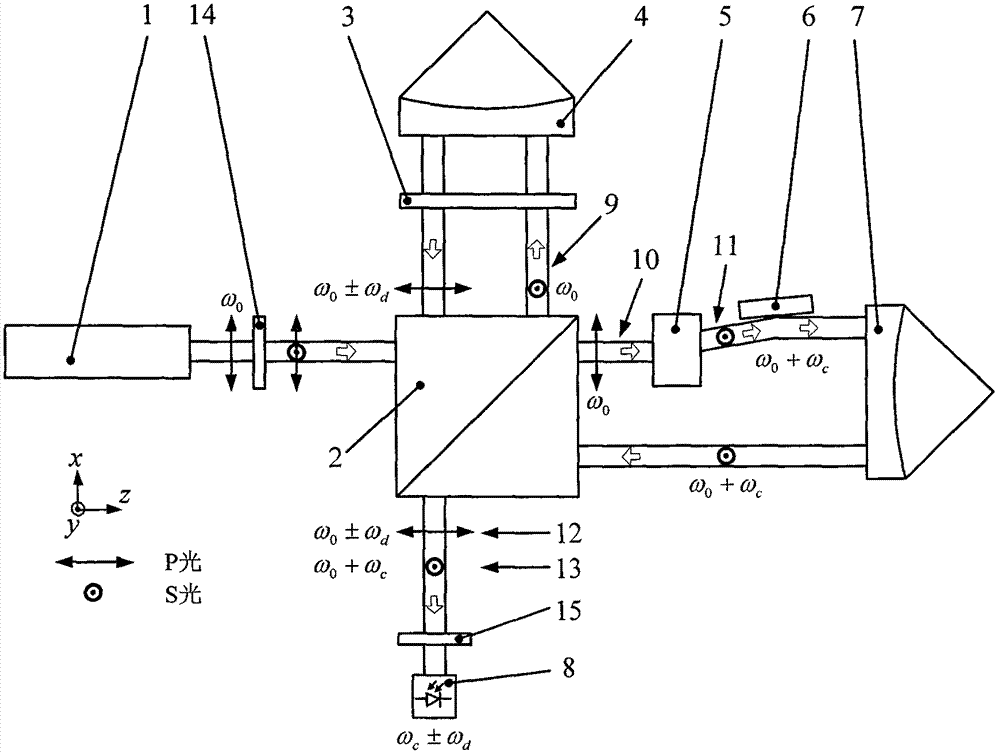
Figure 2 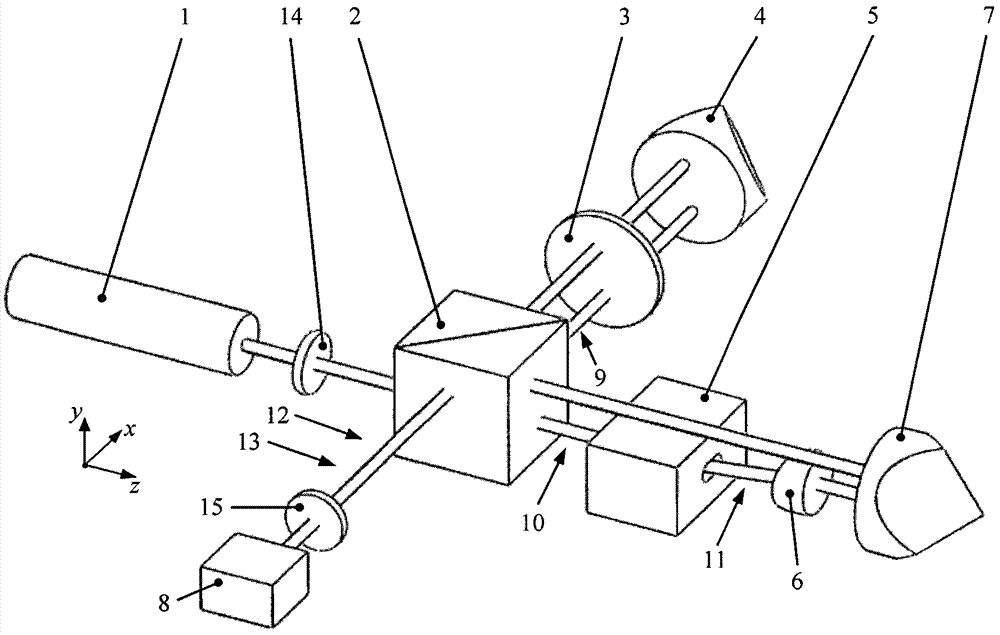
Figure 3
Abstract
Description
technical field
[0001] The invention belongs to the field of laser interferometry, and mainly relates to a Michelson heterodyne laser vibrometer based on single acousto-optic modulation and polarization splitting. Background technique
[0002] As an ultra-precision measuring instrument that can trace the vibration value to the laser wavelength, the laser vibrometer is widely used in the fields of dynamic displacement measurement, vibration measurement and monitoring, ultra-precision equipment and system integration, scientific research and experiments. Laser vibrometers based on laser interferometry can be divided into two categories, homodyne and heterodyne, according to the principle. The two have significant differences in working principle, optical path structure and technical characteristics. The homodyne measurement method uses a single-frequency laser as the light source, based on the classic or improved Michelson laser interference principle, and directly measures th...
Examples
Embodiment Construction
[0022] The specific implementation manner of the present invention will be described in detail below with reference to the accompanying drawings, and examples will be given.
[0023] A Michelson heterodyne laser vibrometer based on single acousto-optic modulation and polarization splitting, consisting of a laser 1, a half-wave plate 14, a polarization beam splitter 2, a quarter-wave plate 3, and a measuring corner cube prism 4 , an acousto-optic modulator 5, a beam deflection element 6, a reference corner cube 7, a polarizer 15, and a high-speed photodetector 8. The laser 1 emits linearly polarized light, and the polarization is adjusted by a half-wave plate 14 direction, and then split the light through the polarizing beam splitter 2, the reflected light forms the first beam 9 as the measuring light, and the transmitted light forms the second beam 10 as the reference light; the first beam 9 becomes circularly polarized after passing through the quarter-wave plate 3 The light,...