
Hydroisomerization pour-point-depressing deep-coupling process for producing low-pour-point diesel oil
A technology for hydroisomerization and isomerization pour point depressurization, which is used in hydrotreating process, petroleum industry, treatment of hydrocarbon oil, etc. It can solve the limitation of diesel fraction yield and pour point depressant effect, and reduce the service life of hydropour pour point depressant catalyst. , the problem of high reaction temperature at the outlet of the bed, to achieve the effect of good selective cracking performance, good hydrogenation saturation and ring-opening conversion, and lowering freezing point
- Summary
- Abstract
- Description
- Claims
- Application Information
AI Technical Summary
Problems solved by technology
Method used
Image

Examples
Embodiment 1
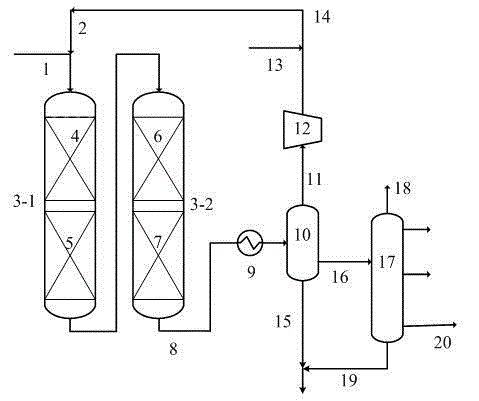
[0042] use figure 1 The process flow shown is to produce low-condensation-point diesel oil by using gradation series and mixed packing process. In embodiment 1, two hydrogenation reaction zones connected in series are included, and in the composite bed of the depreciation catalyst in each reaction zone, the mixing volume ratio of the hydrogenation modified isomerization depreciation catalyst to the hydrogenation modified isomerization depreciation catalyst is 1:2 . The hydromodified isomerization depreciation catalyst used in Example 1 is FC-14 catalyst, the hydrodepreciation catalyst is FDW-3 catalyst, and the hydrorefining catalyst is FH-UDS catalyst, all of which are Fushun Petroleum A commercial catalyst developed and produced by the Chemical Research Institute.
[0043] The operating conditions and test results are listed in Table 3.
Embodiment 2
[0045] use figure 1 The process flow shown is to produce low-condensation-point diesel oil by using gradation series and mixed packing process. In embodiment 1, two hydrogenation reaction zones connected in series are included, and in the composite depreciation catalyst bed of each reaction zone, the mixing volume ratio of the hydrogenation modified isomerization depreciation catalyst to the hydrogenation modified isomerization depreciation catalyst is 1:2 , The total amount of catalyst used is the same as that of Comparative Example 1 and Comparative Example 2. The hydromodified isomerization depreciation catalyst used in Example 2 was FC-14G catalyst, and the hydrodegradation catalyst was FDW-3 catalyst, both of which were commercial catalysts developed and produced by Fushun Petrochemical Research Institute.
[0046] The operating conditions and test results are listed in Table 3.
[0047] Table 2 Raw oil properties table.
[0048] project Raw oil source...
PUM
| Property | Measurement | Unit |
|---|---|---|
| dew point | aaaaa | aaaaa |
| dry point | aaaaa | aaaaa |
| specific surface area | aaaaa | aaaaa |
Abstract
Description
Claims
Application Information
 Login to View More