Check patentability & draft patents in minutes with Patsnap Eureka AI!

Method for producing isocyanate

一种异氰酸酯、制造方法的技术,应用在异氰酸酯的制造领域,能够解决处理繁杂、毒性强等问题,达到回收容易的效果

Active Publication Date: 2015-11-25
ASAHI KASEI KK
View PDF14 Cites 8 Cited by
  • Summary
  • Abstract
  • Description
  • Claims
  • Application Information

AI Technical Summary

Problems solved by technology

However, phosgene has various problems: it is highly toxic, its handling is complicated, and corrosion of equipment needs to be considered due to the by-production of a large amount of hydrochloric acid, etc.

Method used

the structure of the environmentally friendly knitted fabric provided by the present invention; figure 2 Flow chart of the yarn wrapping machine for environmentally friendly knitted fabrics and storage devices; image 3 Is the parameter map of the yarn covering machine
View more

Image

Smart Image Click on the blue labels to locate them in the text.
Viewing Examples
Smart Image
  • Method for producing isocyanate
  • Method for producing isocyanate
  • Method for producing isocyanate

Examples

Experimental program
Comparison scheme
Effect test

Embodiment 1

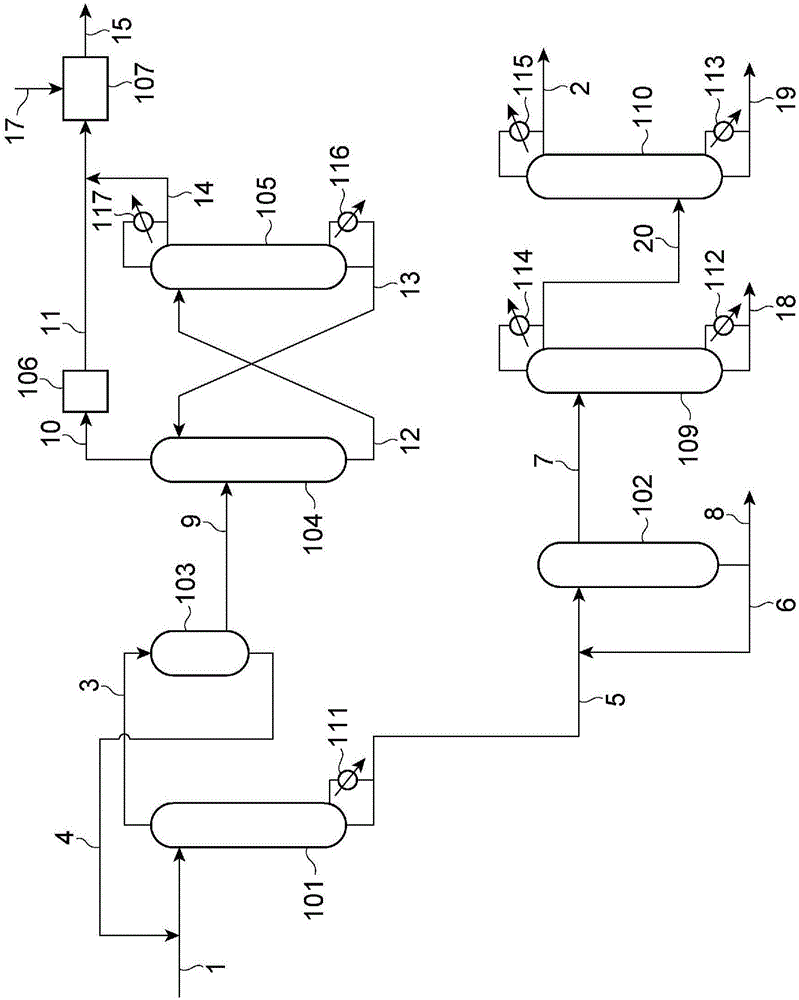
[0752] use figure 1 device shown. figure 1 The apparatus shown is an apparatus for performing a urethanization step, a step of separating a gas phase component mainly composed of ammonia, a step of manufacturing a gas-absorbing liquid, an ammonia separation step, a urea manufacturing step, and an isocyanate manufacturing step.

[0753] 7.2 kg of 1,6-hexamethylenediamine, 7.5 kg of urea (out of 7.5 kg of urea, 5.3 kg is urea produced by the urea production facility 107 described later), 4-(1,1,3, A mixture of 261.9 kg of 3-tetramethylbutyl)phenol was supplied to the continuous multi-stage distillation column 101 at about 92.2 kg / Hr. The liquid mixture of 4-(1,1,3,3-tetramethylbutyl)phenol and urea obtained in the condenser 103 was supplied from the line 4 at about 9.56 kg / Hr. The continuous multi-stage distillation column 101 is an apparatus for performing the urethanization step, and the temperature at the bottom of the column is 250° C. and the pressure at the top of the co...

Embodiment 2

[0758] (urethane process)

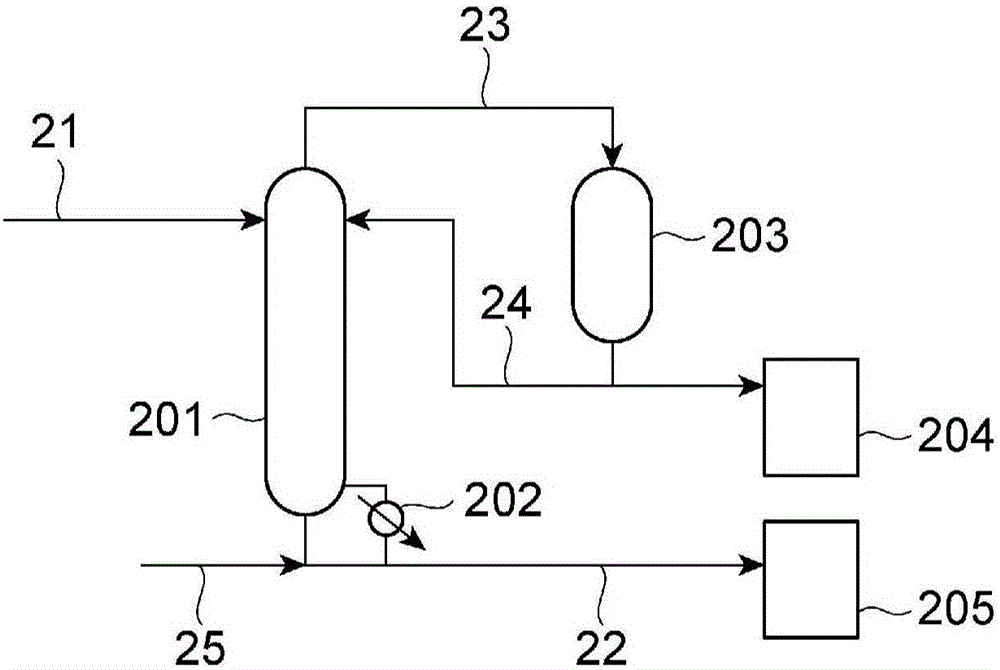
[0759] use figure 2The apparatus shown performs the urethanization process. A mixture of 11.3 kg of 1-amino-3-aminomethyl-3,5,5-trimethylcyclohexane, 15.1 kg of urea, and 220.3 kg of 1-butanol is supplied to the continuous multi-stage via line 21 at about 20 kg / Hr Distillation column 201. The mixed solution of 1-butanol and urea obtained in the condenser 203 was supplied from the line 24 at about 3.5 kg / Hr. The remaining condensed components are recovered to the storage tank 204 . The continuous multi-stage distillation column 201 is a device for performing the urethanization step, and the temperature at the bottom of the column is 220° C. and the pressure at the top of the column is 1.2 MPa by heating with the reboiler 202 . The reaction liquid is withdrawn from the bottom of the continuous multi-stage distillation column 201 and recovered to the storage tank 205 through the pipeline 22 .

[0760] (Preliminary Concentration Process)

[0761]...

Embodiment 3

[0772] (urethane process)

[0773] Use 4,4'-dicyclohexylmethanediamine 21kg instead of 1-amino-3-aminomethyl-3,5,5-trimethylcyclohexane, use urea 16.5kg, use 2,4-xylenol 250 kg was replaced with 1-butanol, and the method similar to the urethanization process of Example 2 was performed except having set the tower bottom temperature to 240 degreeC. From figure 2 The reaction liquid is extracted from the bottom of the continuous multi-stage distillation column 201, and is recovered to the storage tank 205 through the pipeline 22.

[0774] (Preliminary Concentration Process)

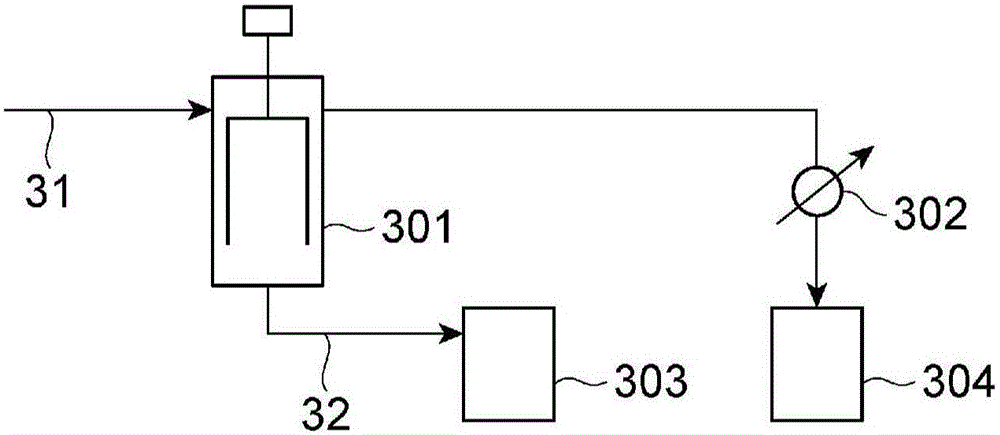
[0775] Make image 3 The jacket temperature of the thin-film evaporator 301 is 150°C, and the internal pressure is 10kPa. In addition, the same method as the preliminary concentration process of Example 2 is carried out, and the liquid is recovered from the bottom of the thin-film evaporator 301 at about 10kg / Hr. phase composition.

[0776] (Thermal decomposition process)

[0777] use Figure 4 The s...

the structure of the environmentally friendly knitted fabric provided by the present invention; figure 2 Flow chart of the yarn wrapping machine for environmentally friendly knitted fabrics and storage devices; image 3 Is the parameter map of the yarn covering machine
Login to View More

PUM

PropertyMeasurementUnit
viscosityaaaaaaaaaa
melting pointaaaaaaaaaa
rate of recoveryaaaaaaaaaa
Login to View More

Abstract

A method for producing isocyanate, said method comprising: a carbamation step for producing an N-substituted carbamate by a carbamation reaction using an organic primary amine, urea and an organic hydroxy compound, and then collecting first vapor phase components containing urea and / or a compound having carbonyl group that is derived from urea, the organic hydroxy compound and ammonia; a condensation step for condensing the first vapor phase components in a condenser; an isocyanate production step for thermally decomposing the N-substituted carbamate to produce isocyanate; an ammonia absorption step for allowing water for absorption to absorb second vapor phase components comprising ammonia as the main component, said second vapor phase components being collected as vapor components from the condenser, to give gas-absorbed water; and an ammonia diffusion step for heating the gas-absorbed water and thus separating ammonia from the gas-absorbed water.

Description

technical field [0001] The present invention relates to a method for producing isocyanates. Background technique [0002] Isocyanates are widely used industrially as raw materials for polyurethanes, polyureas, and the like. Conventionally, isocyanates are produced industrially by the reaction of amines and phosgene (phosgene method). However, phosgene has various problems in that it is highly toxic, its handling is complicated, and corrosion of equipment needs to be considered due to the by-production of a large amount of hydrochloric acid, and the like. Therefore, development of an industrial production method of isocyanate replacing this method has been desired. [0003] As a method for producing isocyanate that does not use phosgene, for example, the following method (urea method) is known: reacting amine, urea and / or N-unsubstituted carbamate with alcohol (urethanization reaction) , The obtained urethane is thermally decomposed to produce isocyanate. When this method...

Claims

the structure of the environmentally friendly knitted fabric provided by the present invention; figure 2 Flow chart of the yarn wrapping machine for environmentally friendly knitted fabrics and storage devices; image 3 Is the parameter map of the yarn covering machine
Login to View More

Application Information

Patent Timeline
no application Login to View More
Patent Type & Authority Applications(China)
IPC IPC(8): C07C263/04C07C263/20C07C265/14C07C269/04C07C271/06
CPCC07C263/04C07C269/04C07C271/52C07C271/24C07C271/56C07C265/14Y02P20/50C07C271/06C07C263/18C07C263/20C07C269/08
Inventor 篠畑雅亮竹内功次藤本直起三宅信寿
Owner ASAHI KASEI KK
Features
  • R&D
  • Intellectual Property
  • Life Sciences
  • Materials
  • Tech Scout
Why Patsnap Eureka
  • Unparalleled Data Quality
  • Higher Quality Content
  • 60% Fewer Hallucinations
Social media
Patsnap Eureka Blog
Learn More