Strontium barium niobate-based glass ceramic energy storage material and preparation method thereof
Inactive Publication Date: 2016-03-16
TONGJI UNIV
View PDF5 Cites 3 Cited by
Summary
Abstract
Description
Claims
Application Information
AI Technical Summary
This helps you quickly interpret patents by identifying the three key elements:
Problems solved by technology
Method used
Benefits of technology
Problems solved by technology
The patent obtains glass-ceramic dielectric materials with different properties by adjusting the Sr / Ba ratio. Due to its composition, the dielectric coefficient of the prepared material will be as low as 21, and the adjustment range is 21-143. The dielectric constant has a large fluctuation range and the energy storage density The highest can only reach 5.71J / cm 3 , in addition, due to more addition of B 2 o 3 The amount of grain agglomeration is more serious
Method used
the structure of the environmentally friendly knitted fabric provided by the present invention; figure 2 Flow chart of the yarn wrapping machine for environmentally friendly knitted fabrics and storage devices; image 3 Is the parameter map of the yarn covering machine
View more
Image
Smart Image Click on the blue labels to locate them in the text.
Viewing Examples
Smart Image
Click on the blue label to locate the original text in one second.
Reading with bidirectional positioning of images and text.
Smart Image
Examples
Experimental program
Comparison scheme
Effect test
Embodiment 1
[0038] The preparation method of the strontium barium niobate based glass-ceramic material with high energy storage density adopts the following steps:
[0039] 1) BaCO with a purity greater than 99.0wt% 3 , SrCO 3 , Nb 2 o 5 , SiO 2 、Al 2 o 3 , B 2 o 3 , is raw material batching, the molar percentage of each above-mentioned component is 20%, 20%, 20%, 35%, 5%, 0%, after mixing by ball milling for 15 hours, drying, and melting at 1600°C for 3 hours;
[0040] 2) Pouring the high-temperature melt obtained in step 1) into a metal mold, annealing for stress relief at 700°C for 5 hours, and then cutting to obtain glass flakes with a thickness of about 1.5 mm;
[0041] 3) The glass flakes prepared in step 2) were kept at 1120° C. for 3 hours for controlled crystallization to obtain glass ceramics.
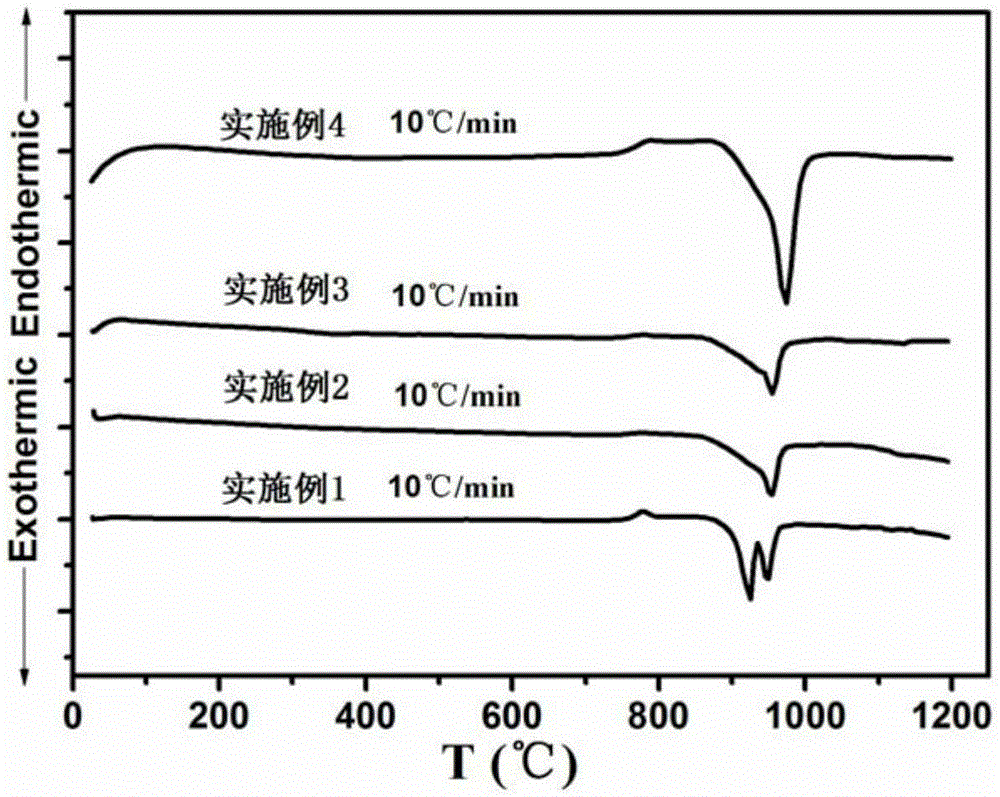
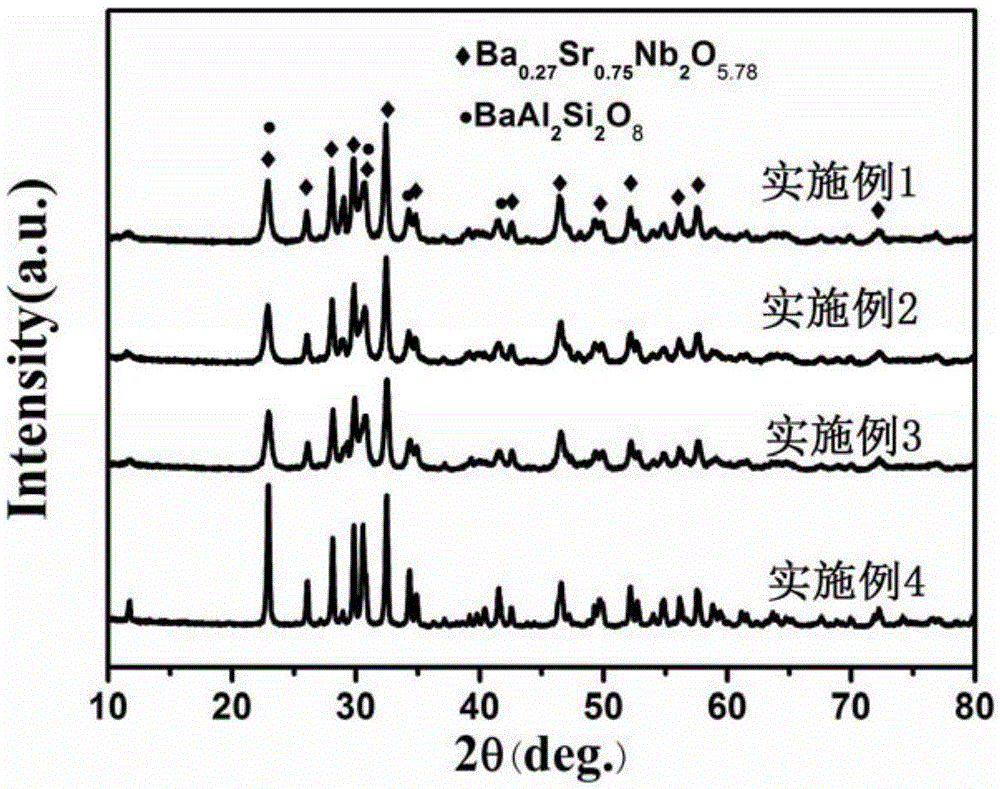
[0042] The DSC of the sample that present embodiment makes is as figure 1 As shown, the DSC curve of this component has two very obvious exothermic peaks; XRD is as follows f...
Embodiment 2
[0044] The preparation method of the strontium barium niobate based glass-ceramic material with high energy storage density adopts the following steps:
[0045] 1) BaCO with a purity greater than 99.0wt% 3 , SrCO 3 , Nb 2 o 5 , SiO 2 、Al 2 o 3 , B 2 o 3 , is raw material batching, and the molar percentage of above-mentioned each component is 20%, 20%, 20%, 33.5%, 5%, 1.5%, after 15 hours of ball mill mixing, drying, melting at 1550 DEG C for 2 hours;
[0046] 2) Pouring the high-temperature melt obtained in step 1) into a copper mold, annealing for stress relief at 650° C. for 5 hours, and then cutting to obtain glass flakes with a thickness of about 1.5 mm;
[0047] 3) The glass flakes prepared in step 2) were kept at 1120° C. for 3 hours for controlled crystallization to obtain glass ceramics.
[0048] The DSC of the sample that present embodiment makes is as figure 1 As shown, the DSC curve of this component has a broad exothermic peak and XRD scanning spectrum co...
Embodiment 3
[0051] The preparation method of the strontium barium niobate based glass-ceramic material with high energy storage density adopts the following steps:
[0052] 1) BaCO with a purity greater than 99.0wt% 3 , SrCO 3 , Nb 2 o 5 , SiO 2 、Al 2 o 3 , B 2 o 3 , is raw material batching, and the molar percentage of above-mentioned each component is 20%, 20%, 20%, 32.5%, 5%, 2.5%, after mixing by ball milling for 15 hours, drying, melting at 1550 ℃ for 2 hours;
[0053] 2) Pouring the high-temperature melt obtained in step 1) into a copper mold, annealing for stress relief at 650° C. for 5 hours, and then cutting to obtain glass flakes with a thickness of about 1.5 mm;
[0054] 3) The glass flakes prepared in step 2) were kept at 1120° C. for 3 hours for controlled crystallization to obtain glass ceramics.
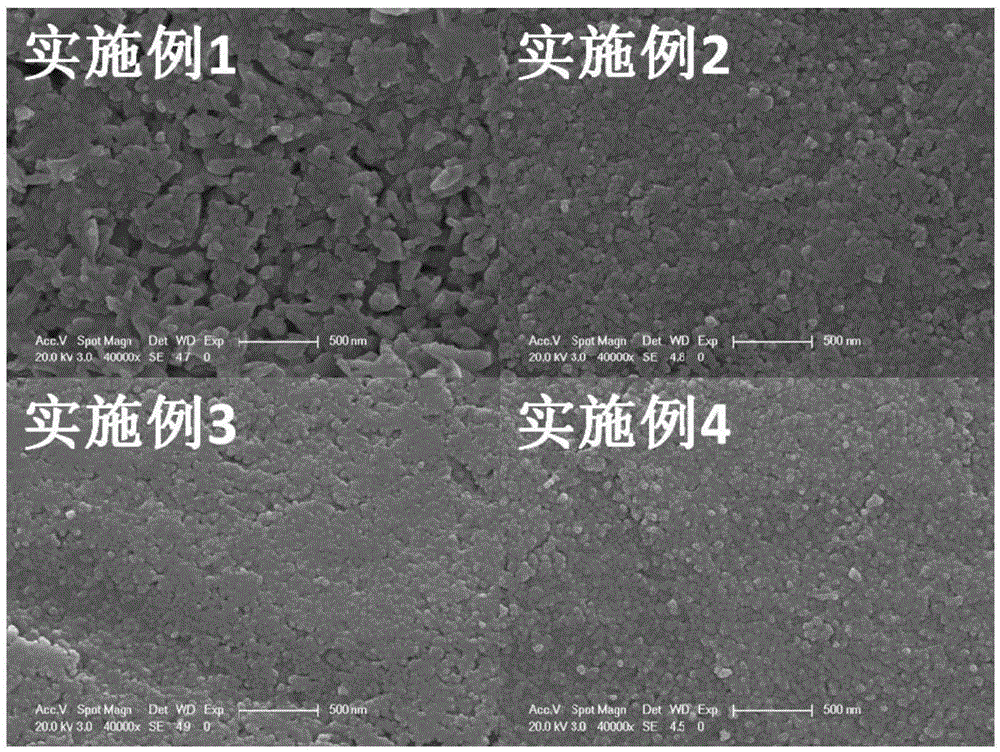
[0055] The DSC of the sample that present embodiment makes is as figure 1 Shown, XRD as figure 2 As shown, SEM as image 3 As shown, the dielectric properties are as ...
the structure of the environmentally friendly knitted fabric provided by the present invention; figure 2 Flow chart of the yarn wrapping machine for environmentally friendly knitted fabrics and storage devices; image 3 Is the parameter map of the yarn covering machine
technical field [0001] The invention belongs to the field of dielectric energy storage materials, in particular to a barium strontium niobate-based glass ceramic energy storage material and a preparation method thereof. Background technique [0002] With the development of pulse technology, dielectric energy storage capacitors have higher and higher requirements in terms of high energy storage density, fast charge and discharge performance, stability, and systemminiaturization and portability. In order to meet these requirements of dielectric energy storage capacitors The main purpose of current research on energy storage dielectrics is to prepare dielectric materials with high dielectric constant and high breakdown field strength. Therefore, material workers from various countries are actively exploring and researching dielectric materials with high dielectric constant, low electrical loss and high compressive strength. At present, glass-ceramic materials are considered t...
Claims
the structure of the environmentally friendly knitted fabric provided by the present invention; figure 2 Flow chart of the yarn wrapping machine for environmentally friendly knitted fabrics and storage devices; image 3 Is the parameter map of the yarn covering machine
Login to View More
Application Information
Patent Timeline
Application Date:The date an application was filed.
Publication Date:The date a patent or application was officially published.
First Publication Date:The earliest publication date of a patent with the same application number.
Issue Date:Publication date of the patent grant document.
PCT Entry Date:The Entry date of PCT National Phase.
Estimated Expiry Date:The statutory expiry date of a patent right according to the Patent Law, and it is the longest term of protection that the patent right can achieve without the termination of the patent right due to other reasons(Term extension factor has been taken into account ).
Invalid Date:Actual expiry date is based on effective date or publication date of legal transaction data of invalid patent.


 Login to View More