
Method for silkening film
A technology of forming filaments and strands, which is applied in the direction of clustering of newly extruded filaments, drawing spinning, filament/thread forming, etc., which can solve the problem of difficult to achieve the shape of the film and the complicated and expensive spinning of the spinneret hole , Nanofibers are difficult to form efficiently linearly, etc., to achieve the effect of improving strength and uniform drafting
- Summary
- Abstract
- Description
- Claims
- Application Information
AI Technical Summary
Problems solved by technology
Method used
Image

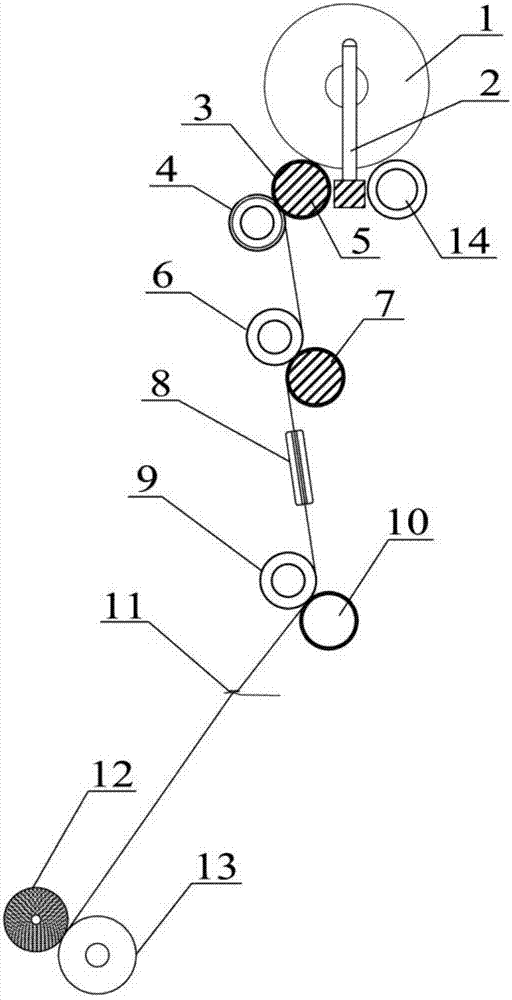
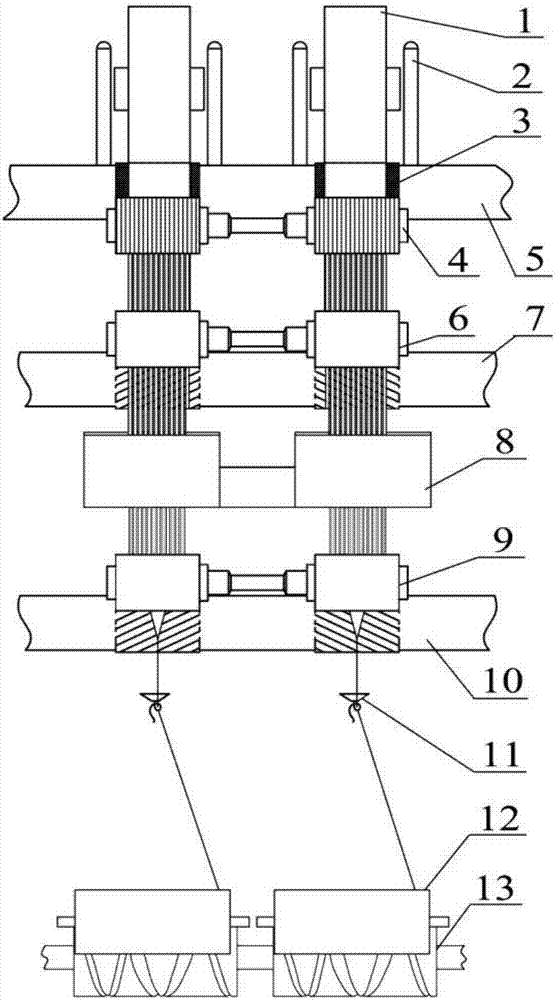
Examples
Embodiment 1
[0020] Polyethylene terephthalate (PET) film material is used for cutting and drawing into filaments.
[0021] The cut-resistant ring 3 is an ultra-high-strength polyethylene material; the distance between the cutting edges of adjacent annular cutters on the circumference of the cutting roller 4 is 0.1 mm; The inner wall surface is heated to 100°C; the molded membrane material is polyethylene terephthalate (PET) membrane material, which belongs to organic polymer membrane material, and the width of the membrane material is 15 mm, and the thickness is 0.05 mm. The PET film roll 1 is placed between the bearing roll 14 and the unwinding roll 5, and the PET film unwound from the PET film roll 1 enters between the cut-resistant ring 3 and the cutting roll 4 through the unwinding roll 5 The formed cutting area is cut to form uniformly spread ribbon-shaped multifilaments. After being output from the cutting area, each PET filament in the ribbon-shaped multifilaments enters the first ...
Embodiment 2
[0023] Polysulfone (PSF) nanofiber membrane material is used for cutting and drawing into filaments.
[0024] The cut-resistant ring 3 is an aramid fiber material; the distance between the edges of adjacent annular cutters on the circumference of the cutting roller 4 is 2 millimeters; the heater 8 is externally connected to a 36-volt safety power supply through a lead wire, and the inner wall of the heating tank of the heater 8 is Heating to 240°C; the type membrane material is polysulfone (PSF) nanofiber membrane, the nanofiber fineness in the type membrane material is 400-600 nanometers, which belongs to thermoplastic nanofiber membrane material, and the width of the membrane material is 20 mm, The thickness is 0.1mm, the PSF nanofiber membrane material package 1 is placed between the bearing roller 14 and the unwinding roller 5, and the PSF nanofiber membrane material unwound from the PSF nanofiber membrane material package 1 is passed through the unwinding roller 5 Enter t...
Embodiment 3
[0026] Graphene paper film material is used for cutting and drawing into filaments.
[0027]The cut-resistant ring 3 is aramid fiber material; the distance between the cutting edges of the adjacent annular cutters on the circumference of the cutting roller 4 is 3 millimeters; the heater 8 is externally connected to a 36-volt safety power supply through a lead wire, and the inner wall of the heating tank of the heater 8 is Heating to 60°C; the molded film material is graphene paper, and graphene paper can be prepared by "Chinese Patent Publication No. CN104961124A, publication date 2015.10.7, invention name is a preparation method of graphene paper", or Directly buy online, the graphene paper film material width that present embodiment selects is 20 millimeters, thickness is 10 nanometers, and the graphene paper film material volume package 1 is placed between the bearing roller 14 and the unwinding roller 5, from The graphene paper film unwound from the graphene paper-type fil...
PUM
| Property | Measurement | Unit |
|---|---|---|
| thickness | aaaaa | aaaaa |
| thickness | aaaaa | aaaaa |
| thickness | aaaaa | aaaaa |
Abstract
Description
Claims
Application Information
 Login to View More