

Resonance scattering spectrometry method for determining Hg<2+> by using ligand for adjusting and controlling activity of silicon dioxide nano-enzyme
A resonance scattering and silicon dioxide technology, applied in the field of analytical chemistry, can solve the problems that the analytical method has not been reported yet, and achieve the effect of simple method, stable system and high sensitivity
- Summary
- Abstract
- Description
- Claims
- Application Information
AI Technical Summary
Problems solved by technology
Method used
Image

Examples
Embodiment
[0022] An aptamer-regulated activity of silica nanozyme-resonance scattering spectrometry for determination of Hg 2+ method, including the following steps:
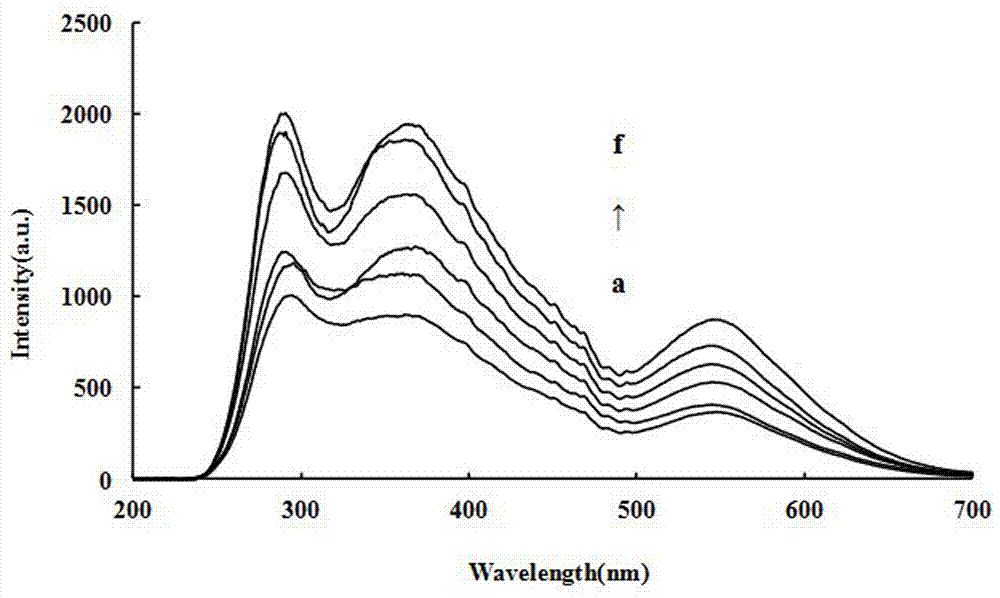
[0023] (1) Prepare a known concentration of Hg 2+ Standard solution system: Add 10μL, 50μL, 100μL, 150μL, 200μL of 100nmol / L Hg into 7 graduated test tubes 2+ Standard solution, then add 100μL 66ng / mL mercury aptamer and 12μL 100μg / mL silicon dioxide to each graduated test tube, mix well, and let stand for 10 minutes; then add 150μL 0.5moL / L glucose, 150μL 0.01mol / L HCl and 100μL 84μmol / L HAuCl 4 , mix well, dilute to 1.5mL with twice distilled water, react in a water bath at 75°C for 20 minutes, take out the test tube, cool with ice water to terminate the reaction, and dilute to 2.0mL with twice distilled water;
[0024] (2) Prepare blank control solution system: do not add Hg with the method of step (1) 2+ Standard solution to prepare blank control solution system;
[0025] (3) Get the Hg prepared by steps (1), (2)...
PUM
 Login to View More
 Abstract
Description
Claims
Application Information
 Login to View More