

Multilayer coaxial fibrous bone repairing membrane material and preparation method thereof
A technology for bone repair and membrane material, which is used in fiber processing, medical science, non-woven fabrics, etc.
- Summary
- Abstract
- Description
- Claims
- Application Information
AI Technical Summary
Problems solved by technology
Method used
Image

Examples
Embodiment 1
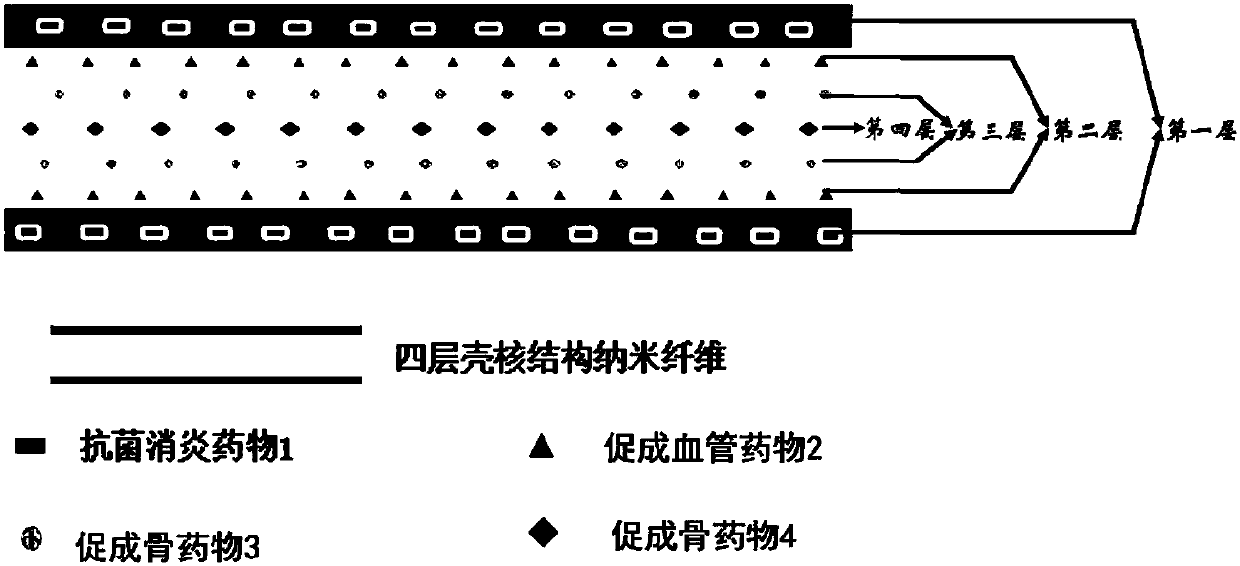
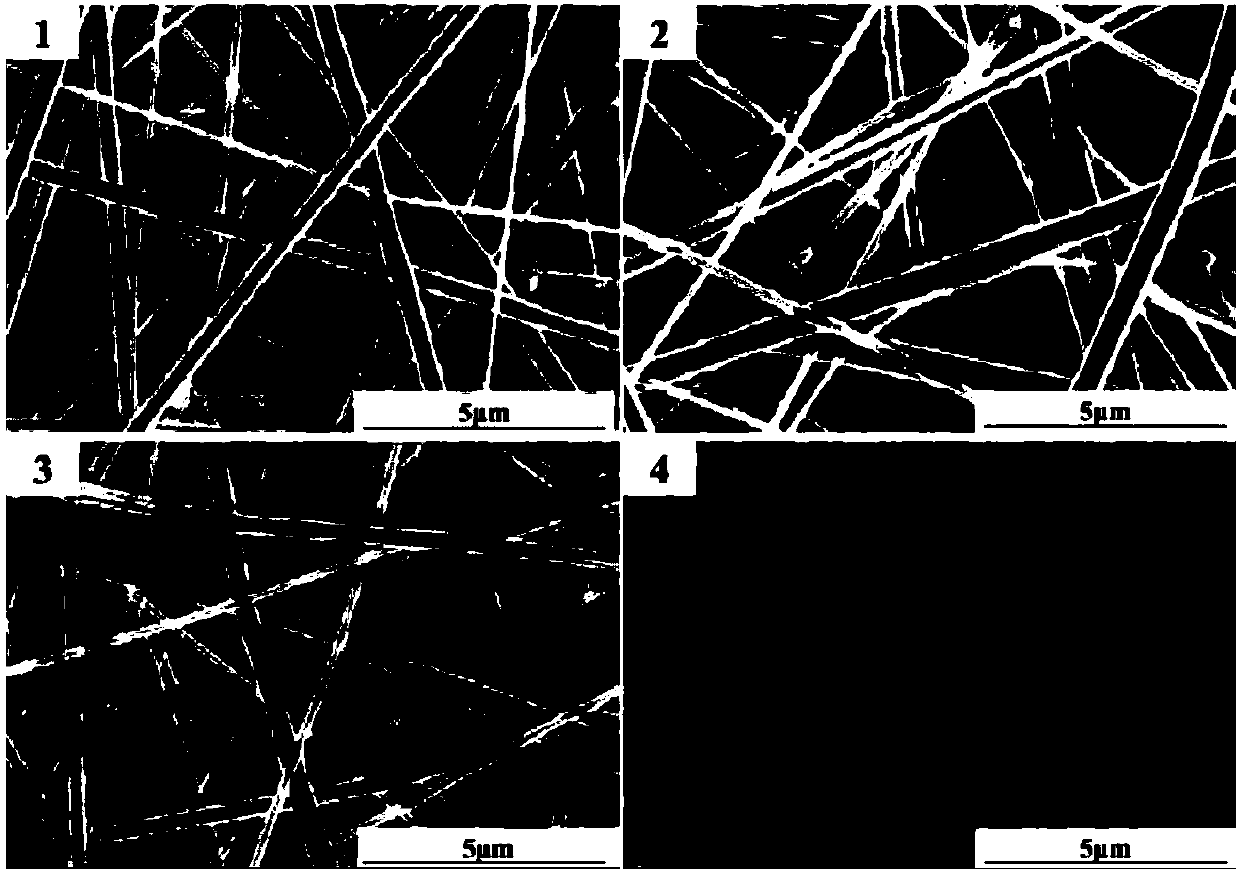
[0052] (1) Take 1 g of gelatin, add it to 10 mL of trifluoroethanol solvent, and stir magnetically at room temperature for 6 hours to obtain a solution A with a gelatin mass concentration of 0.1 g / mL;
[0053] (2) Add 0.01g of ciprofloxacin to solution A, stir magnetically at room temperature for 6h to obtain solution B, the mass ratio of ciprofloxacin to gelatin in solution B is 1 / 100;
[0054] (3) Take 0.2 g of polycaprolactone, add it to 10 mL of trifluoroethanol solvent, and stir magnetically at room temperature for 12 hours to obtain a solution C with a mass concentration of polycaprolactone of 0.02 g / mL;
[0055] (4) Add 0.8 g of gelatin to solution C, and magnetically stir at room temperature for 12 hours to obtain solution D. The mass ratio of polycaprolactone to gelatin in solution D is 20 / 80;
[0056] (5) Add 0.01 g of DFO to solution D, and magnetically stir at room temperature for 6 hours to obtain solution E. The ratio of the mass of DFO in solution E to the total...
Embodiment 2
[0065] (1) Take 0.2 g of polycaprolactone, add it to 10 mL of trifluoroethanol solvent, and stir magnetically at room temperature for 6 hours to obtain a solution A with a mass concentration of polycaprolactone of 0.02 g / mL;
[0066] (2) Add 0.8 g of gelatin to solution A, and magnetically stir at room temperature for 12 hours to obtain solution B. The mass ratio of polycaprolactone to gelatin in solution B is 20 / 80;
[0067] (3) Add 0.3g moxifloxacin to solution B, stir magnetically at room temperature for 6h to obtain solution C, the ratio of the mass of moxifloxacin in solution C to the total mass of polycaprolactone and gelatin is 30 / 100;
[0068] (4) Take 0.5 g of polycaprolactone, add it to 10 mL of trifluoroethanol solvent, and stir magnetically at room temperature for 6 hours to obtain a solution D with a mass concentration of polycaprolactone of 0.05 g / mL;
[0069] (5) Add 0.5 g of gelatin to solution D, and magnetically stir at room temperature for 12 hours to obtain...
Embodiment 3
[0079] (1) Take 0.2 g of polylactic acid, add it to 10 mL of N, N-dimethylformamide solvent, and magnetically stir at room temperature for 9 hours to obtain a solution A with a mass concentration of polylactic acid of 0.02 g / mL;
[0080] (2) Add the chitosan of 0.8g in solution A, magnetically stir 10h at room temperature, obtain solution B, the mass ratio of polylactic acid and chitosan in solution B is 20 / 80;
[0081] (3) Add 0.3g penicillin in solution B, magnetically stir at room temperature for 6h, obtain solution C, the ratio of the quality of penicillin in solution C to the total mass of polylactic acid and chitosan is 30 / 100;
[0082] (4) Take 0.4 g of polylactic acid, add it to 10 mL of N,N-dimethylformamide solvent, and magnetically stir at room temperature for 9 hours to obtain a solution D with a mass concentration of polylactic acid of 0.04 g / mL;
[0083] (5) Add the chitosan of 0.6g in the solution D, magnetically stir 10h at room temperature, obtain solution E, ...
PUM
 Login to View More
 Abstract
Description
Claims
Application Information
 Login to View More