

Method for preparing bismuth nanoparticles on oxide substrate
A bismuth nanometer and oxide technology, which is applied in the field of photocatalytic materials, can solve the problems of low density, uneven particle size and serious agglomeration of Bi nanoparticles, and achieves the effect of simple and easy preparation method, overcoming low density and easy realization.
- Summary
- Abstract
- Description
- Claims
- Application Information
AI Technical Summary
Problems solved by technology
Method used
Image



Examples
Embodiment 1
[0029] a. Weigh 2.0885g of SBN Ps and 0.0946g of NaBH 4 ;
[0030] b. Transfer the substance in step a to an agate mortar, mix well and grind for 30min;
[0031] c. Transfer the mixture in step b to a porcelain boat and place it in a tube furnace for calcination. The calcination conditions are: first use Ar to purge the air in the tube furnace (flow rate is 200mL / min, time is 2h), and then Adjust the flow rate to 120mL / min and start calcination, the calcination temperature is 300℃, and the time is 1h;
[0032] d. Centrifugally wash the sample in step c with ultrapure water for 3-4 times, and then dry it in a vacuum drying oven at 60°C for 6 hours. After drying, the sample can be obtained.
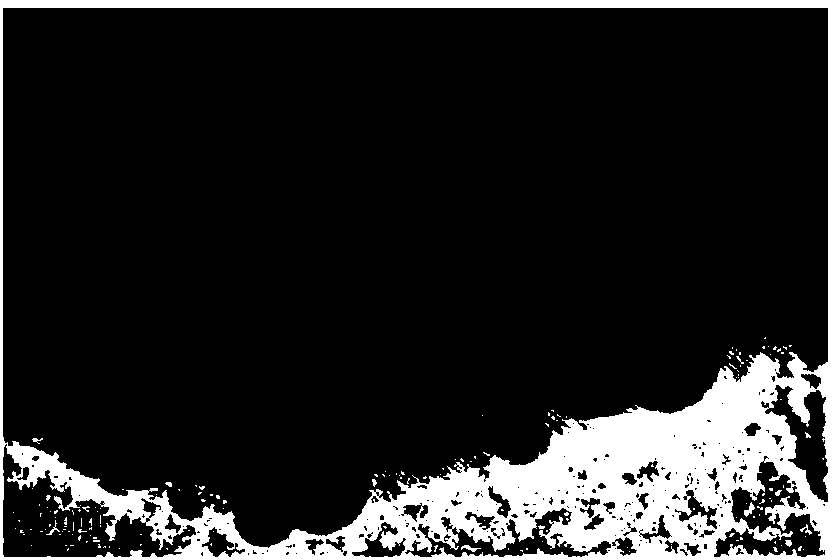
[0033] e. TEM characterization of the prepared target product, the results are as follows figure 2 Shown from figure 2 It can be seen that Bi nanoparticles have grown on SrBi 2 Nb 2 O 9 On the surface of the sheet, the particle size of the generated particles is relatively small, mainly nanoparti...
Embodiment 2
[0035] a. Weigh 2.0885g of SBN Ps and 0.0946g of NaBH 4 ;
[0036] b. Transfer the substance in step a to an agate mortar, mix well and grind for 30min;
[0037] c. Transfer the mixture in step b to a porcelain boat and place it in a tube furnace for calcination. The calcination conditions are: first use Ar to purge the air in the tube furnace (flow rate is 200mL / min, time is 2h), and then Adjust the flow rate to 120mL / min and start calcination, the calcination temperature is 400℃, and the time is 1h;
[0038] d. Centrifugally wash the sample in step c with ultrapure water for 3-4 times, and then dry it in a vacuum drying oven at 60°C for 6 hours. After drying, the sample can be obtained.
[0039] e. TEM characterization of the prepared target product, the results are as follows image 3 Shown from image 3 It can be seen that the smaller particle size of the generated particles is mainly nanoparticles with a diameter of 5 nm to 7 nm.
Embodiment 3
[0041] The preparation process is the same as in Example 2, except that the calcination temperature in step b is 500°C, and the sample is characterized by TEM. The results are as follows Figure 4 Shown from Figure 4 It can be seen that the particle size of the generated particles is relatively small, mainly nanoparticles with a diameter of 5 nm to 7 nm.
PUM
| Property | Measurement | Unit |
|---|---|---|
| particle diameter | aaaaa | aaaaa |
| diameter | aaaaa | aaaaa |
| diameter | aaaaa | aaaaa |
Abstract
Description
Claims
Application Information
 Login to View More