Pea protein-curcumin nano-composite, and preparation method and application thereof
A nano-composite and pea protein technology, which is applied in the direction of non-effective ingredients of polymer compounds, drug combinations, anti-toxic agents, etc., can solve the problems that are difficult to apply to industrial production, the safety of emulsifiers is poor, and the wall materials are prone to flocculation. Achieve the effects of mild reaction conditions, good stability and dispersion, and simple operation
- Summary
- Abstract
- Description
- Claims
- Application Information
AI Technical Summary
Problems solved by technology
Method used
Image

Examples
Embodiment 1
[0058] (1) Purification (removal of impurities) of pea protein:
[0059] Weigh a certain amount of pea protein and disperse it in distilled water (the weight ratio of pea protein to distilled water is 3:100), then homogenize for 15 minutes under stirring conditions, and then use M-100P microfluidization to treat the above-mentioned samples. After processing, the pea protein emulsion was centrifuged at 1,000 rpm, and the suspension was collected and freeze-dried. The particle size of the purified pea protein nanoemulsion is 48.45nm, the Zeta-potential is -35mV, the polydispersity is 0.22, and the surface tension is 65.15mN / m.
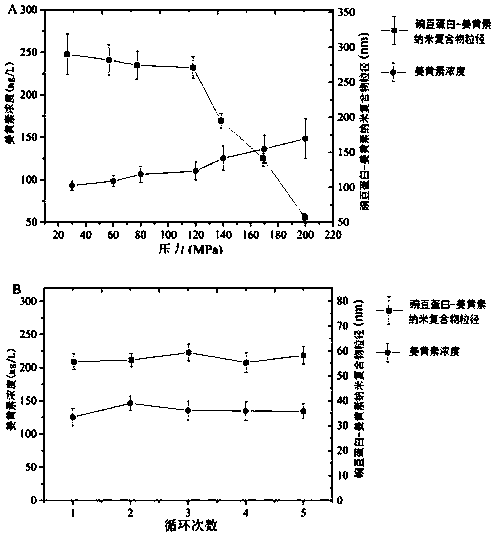
[0060] (2) Optimizing the conditions for microfluidization treatment of pea protein-curcumin nanoemulsion:
[0061] Under the condition that the number of microfluidization cycles is 2 times and the ratio of pea protein (prepared in step (1)) to curcumin is 35:1 (w / w), different pressures (30, 60, 80, 120, 170 and 200MPa) for optimization. Depend on ...
Embodiment 2
[0071] (1) Purification (removal of impurities) of pea protein:
[0072] Weigh a certain amount of pea protein and disperse it in distilled water (the weight ratio of pea protein to distilled water is 4:100), then homogenize for 20 minutes under stirring conditions, and then use M-100P microfluidization to treat the above-mentioned samples. The processed pea protein emulsion was centrifuged at 1,200 rpm, and the suspension was collected and freeze-dried. The particle size of the purified pea protein nanoemulsion is 58.05nm, the Zeta-potential is -34.55mV, the polydispersity is 0.27, and the surface tension is 63.50mN / m.
[0073] (2) prepare the pea protein-curcumin nanocomposite that the ratio of pea protein and curcumin is 35:1:
[0074] Under optimal microfluidization conditions (pressure 200MPa, cycle number 2 times, temperature 4°C and stirring speed 800rpm), take pea protein (prepared in step (1)) and curcumin with a weight ratio of 35:1 The pea protein-curcumin nanocom...
Embodiment 3
[0082] (1) Purification (removal of impurities) of pea protein:
[0083] Weigh a certain amount of pea protein and disperse it in distilled water (the weight ratio of pea protein to distilled water is 5:100), then homogenize for 25 minutes under stirring conditions, and then use M-100P microfluidization to treat the above-mentioned samples. After processing, the pea protein emulsion was centrifuged at 1,000 rpm, and the suspension was collected and freeze-dried. The particle diameter of the purified pea protein nanoemulsion is 52.47nm, the Zeta-potential is -33.45mV, the polydispersity is 0.23, and the surface tension is 63.58mN / m.
[0084] (2) prepare the pea protein-curcumin nanocomposite that the ratio of pea protein and curcumin is 50:1:
[0085] Under optimal microfluidization conditions (pressure 200MPa, cycle number 2 times, temperature 4°C and stirring speed 900rpm), take pea protein (prepared in step (1)) and curcumin with a weight ratio of 50:1 The pea protein-curc...
PUM
| Property | Measurement | Unit |
|---|---|---|
| particle diameter | aaaaa | aaaaa |
| surface tension | aaaaa | aaaaa |
| particle diameter | aaaaa | aaaaa |
Abstract
Description
Claims
Application Information
 Login to View More