Fe-Co-RGO (iron-cobalt-reduced graphene oxide) composite wave absorbing material and preparation method thereof
A composite wave-absorbing material, fe-co technology, applied in chemical instruments and methods, and other chemical processes, can solve the problem of less porous magnetic particle-modified graphene, etc., to improve impedance matching, wave-absorbing performance, and saturation magnetization Improved effect
- Summary
- Abstract
- Description
- Claims
- Application Information
AI Technical Summary
Problems solved by technology
Method used
Image



Examples
preparation example Construction
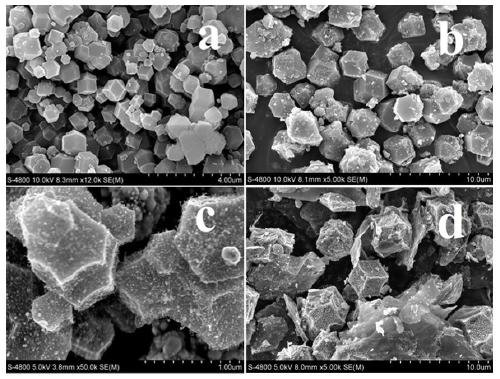
[0040] The invention relates to a Fe-Co-RGO composite wave-absorbing material and a preparation method thereof. Firstly, ultrafine water-soluble Fe is prepared by a hydrothermal method 3 o 4 particles (5-10nm), and then synthesize Fe through one-step in-situ growth method 3 o 4 Mosaic ZIF-67(Fe 3 o 4@ZIF-67), and further obtained Fe-Co alloy embedded nanoporous carbon material (Fe-Co) by carbonization at 700 °C. In the preparation of Fe 3 o 4 Graphene oxide was added to the process of @ZIF-67 and the same steps were repeated to obtain the nanoporous carbon material Fe-Co-RGO.
[0041] The cobalt-based imidazolate framework material (ZIF-67) adopted in the invention has high thermal stability, simple preparation process, is suitable for batch production, has large surface area and high porosity. It has high graphitization properties for carbon materials used as precursors, and has important conditions for the development of light microwave absorbing materials. Due to its...
Embodiment 1
[0071] (a) Water-soluble Fe 3 o 4 preparation of
[0072] (1) Mix 0.81g FeCl under magnetic stirring 3 ·6H 2 O and 0.76 g NaHCO 3 Dissolve in 30ml of distilled water, marked as A solution.
[0073] (2) At the same time, 0.088 g of L-ascorbic acid was dissolved in 10 ml of distilled water under magnetic stirring, and marked as B solution.
[0074] (3) After stirring solution A and solution B for 30 min, solution B was added dropwise to solution A to obtain mixed solution C.
[0075] (4) The mixture C was continuously stirred for 20 minutes, then transferred to a 100ml autoclave, kept at 150°C for 6 hours, and cooled naturally after the reaction was completed.
[0076] (5) For the obtained Fe 3 o 4 Collected by centrifugation, washed several times with deionized water and methanol, and finally dispersed in 10ml methanol solution for subsequent experiments.
[0077] (b) Fe 3 o 4 Preparation of @ZIF-67
[0078] (1) 2.63g 2-methylimidazole and obtained Fe 3 o 4 Dissol...
Embodiment 2
[0091] (a) Water-soluble Fe 3 o 4 preparation of
[0092] (1) Mix 0.81g FeCl under magnetic stirring 3 ·6H 2 O and 0.76 g NaHCO 3 Dissolve in 30ml of distilled water, marked as A solution.
[0093] (2) At the same time, 0.088 g of L-ascorbic acid was dissolved in 10 ml of distilled water under magnetic stirring, and marked as B solution.
[0094] (3) After stirring solution A and solution B for 30 min, solution B was added dropwise to solution A to obtain mixed solution C.
[0095] (4) The mixture C was continuously stirred for 20 minutes, then transferred to a 100ml autoclave, kept at 150°C for 6 hours, and cooled naturally after the reaction was completed.
[0096] (5) For the obtained Fe 3 o 4 Collected by centrifugation, washed several times with deionized water and methanol, and finally dispersed in 10ml methanol solution for subsequent experiments.
[0097] (b) Fe 3 o 4 Preparation of @ZIF-67
[0098] (1) 2.63g 2-methylimidazole and obtained Fe 3 o 4 Dissol...
PUM
 Login to View More
 Abstract
Description
Claims
Application Information
 Login to View More