
Synthetic method of 7-azaindole-5-chloro-6-carboxylic acid
A synthesis method and azaindole technology are applied in the field of azaindole heterocyclic compounds, can solve problems such as no industrialized effective synthesis method, etc., and achieve the effects of simple reaction conditions, cheap reagents and easy purification
Patent Information
- Authority / Receiving Office
- CN · China
- Current Assignee / Owner
- Publication Date
- 2019-01-18
- Estimated Expiration
- Not applicable · inactive patent
Smart Images
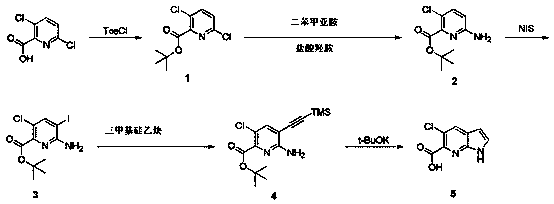
Figure 1
Abstract
Description
technical field
[0001] The present invention relates to azaindole heterocyclic compounds, in particular to a synthesis method of 7-azaindole-5-chloro-6-carboxylic acid (CAS No. 1246088-49-2). Background technique
[0002] Azaindole heterocyclic compounds are a class of important organic compounds widely distributed in nature, with diverse biological activities and high research value in medicinal chemistry. For example, variolin B (Chem. Rev., 2009, 109, 3080–3098) is a compound containing a 7-azaindole ring isolated from Antarctic sponge. cancer agent. There is also diazarebeccamycin (Eur. J. Med. Chem., 2003, 38, 123–140), a synthetic 7-azaindole derivative, which has also been shown to have good anticancer activity.
[0003] 7-azaindole-5-chloro-6-carboxylic acid, as a pharmaceutical intermediate, can be used to synthesize various 7-azaindole derivatives. But so far there is no public report about its industrial synthesis method. Contents of the invention
[0004] T...
Examples
Embodiment 1
[0016] Example 1: Preparation of 7-azaindole-5-chloro-6-carboxylic acid.
[0017] step 1:
[0018] 3,6-Dichloropyridine-2-carboxylic acid (78.3 g, 0.408 mol) was dissolved in tert-butanol (780 mL) and pyridine (215 mL), and cooled to 0°C in an ice-water bath. P-toluenesulfonyl chloride (185 g, 0.97 mol) was added in portions, and after the addition was completed, the mixture was raised to room temperature and stirred overnight. The reaction solution was concentrated to dryness, and the residue was added to 5% aqueous citric acid solution (2 L) and extracted with ethyl acetate (2 L). The organic phase was washed with 5% sodium bicarbonate aqueous solution (500 mL) and saturated brine (500 mL), and the organic phase was dried over anhydrous sodium sulfate, filtered, and concentrated to dryness to obtain compound 1 (100 g, 98% yield). 1 H NMR (400 MHz, CDCl 3 )1.63 (s, 9H), 7.35 (d, J = 8.4 Hz, 1H), 7.71 (d, J = 8.4 Hz, 1H).
[0019] Step 2:
[0020] Compound 1 (50 g, 0...
Embodiment 2
[0027] Example 2, the coupling reaction temperature in step 2 is 85°C, and the reaction time is 2 hours; the reaction temperature in step 3 is 50°C; the reaction temperature in step 4 is 20°C, and the reaction time is 2 hours; the reaction temperature in step 5 is 60°C. All the other are with embodiment 1.
Embodiment 3
[0028] Example 3, the coupling reaction temperature in step 2 is 95°C, and the reaction time is 1 hour; the reaction temperature in step 3 is 60°C; the reaction temperature in step 4 is 35°C, and the reaction time is 0.5 hour; the reaction temperature in step 5 is 70°C. All the other are with embodiment 1.