
Preparation and application of XIST-modified adipose-derived mesenchymal stem cell exosomes
An adipose-derived, quality stem cell technology, applied in the direction of cells modified by introducing foreign genetic material, applications, medical preparations containing active ingredients, etc., can solve the problems of limited preparation technology, difficult to prepare in large quantities, and reduce the effective dose , good effect of macrophage function phenotype regulation, good effect of liver disease treatment
- Summary
- Abstract
- Description
- Claims
- Application Information
AI Technical Summary
Problems solved by technology
Method used
Image

Examples
Embodiment 1
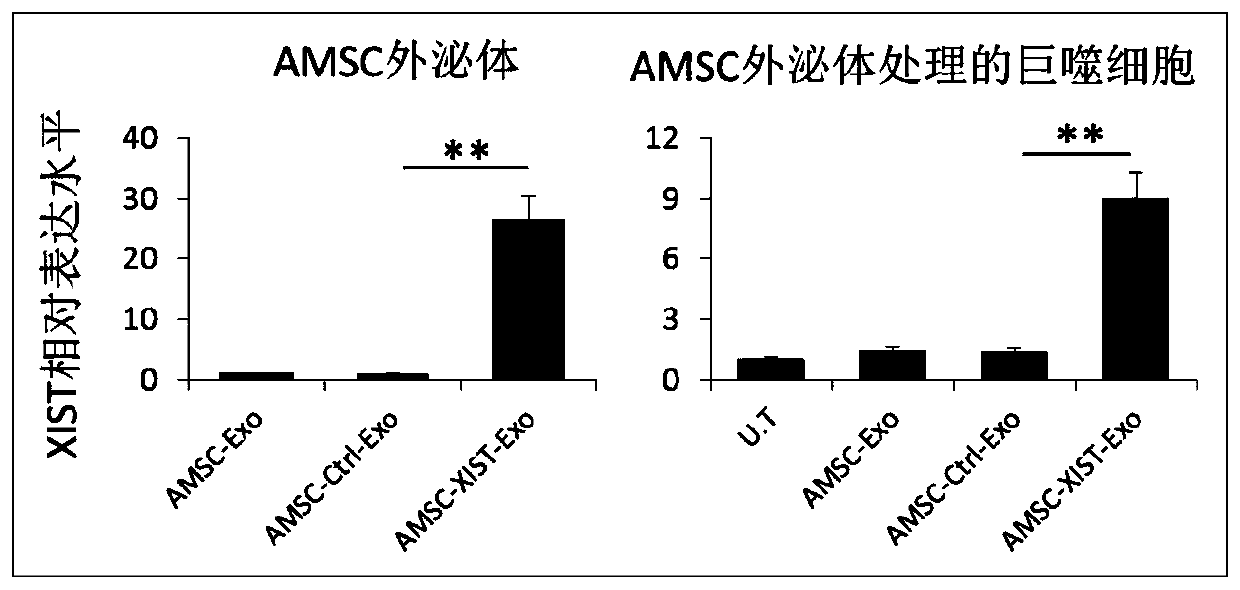
[0036] Example 1 AMSC-XIST-Exo can mediate the delivery of XIST to macrophages
[0037] The RNAs of AMSC-XIST-Exo, AMSC-Ctrl-Exo and native AMSC-Exo were extracted by ncRNA kit, and then reverse transcribed. Reverse transcription system: RNA template - 1 μg; 200 μM random primer - 1 μl; 25 μM Oligo(dT) - 1 μl; 5× reverse transcription buffer - 2 μl; reverse transcriptase mixture - 2 μl; RNase-free water - make up to 10 μl. The reverse transcription reaction program was: 60 min at 42°C, 10 min at 70°C. Then perform fluorescent quantitative PCR detection, the PCR system is: 2×SYBR Green Mix-10 μl; the sequence of the upstream primer of XIST is shown in SEQ:NO. Shown: ggaaagaagaatgcagagccctgtacaaccttccttcctg, 5 μM - 0.8 μl; template - 2ul; dd water - make up to 20 μl. The PCR conditions were: 95°C pre-denaturation for 10 minutes, followed by 40 cycles of 95°C for 5s, 60°C for 30s, and 72°C for 30s. Such as figure 1 As shown, AMSC-XIST-Exo contains a high level of XIST.
[00...
Embodiment 2
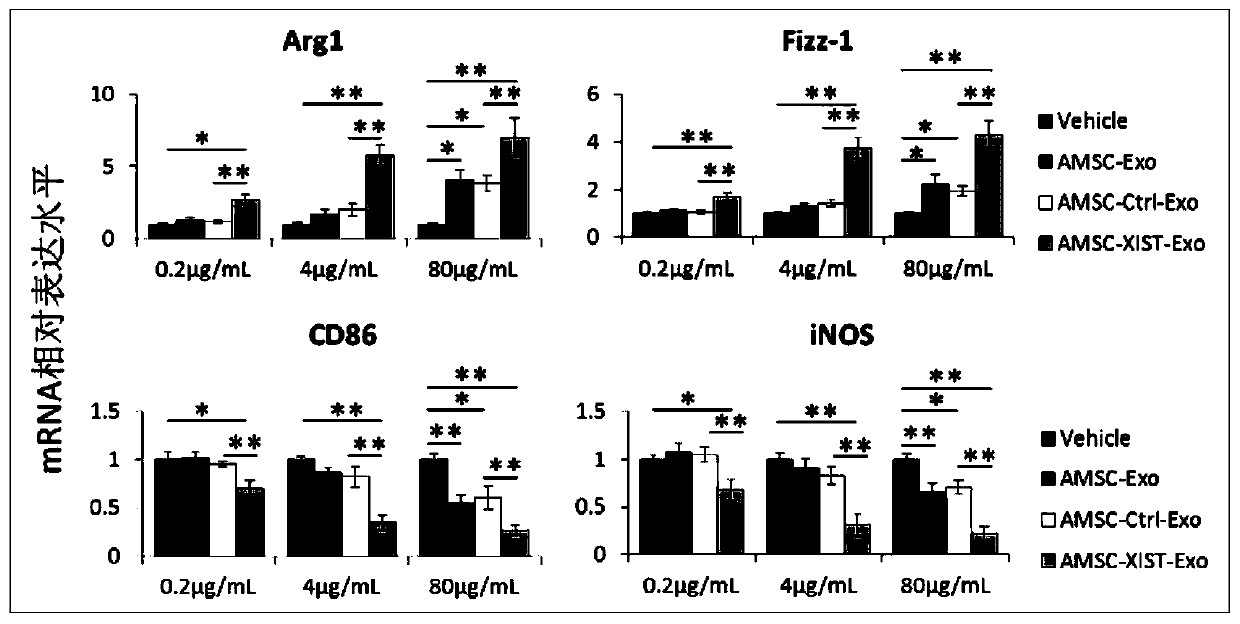
[0040] Example 2 AMSC-XIST-Exo regulates macrophage phenotype
[0041] Add gradient concentrations of AMSC-XIST-Exo, AMSC-Ctrl-Exo and native AMSC-Exo (0.2 μg / mL, 4 μg / mL, 80 μg / mL) to macrophage RAW264.7, and add corresponding volume of PBS as In the control group (Vehicle), the cells were collected after 24 hours for qPCR analysis of macrophage phenotype-related molecules.
[0042] Compared with AMSC-Ctrl-Exo and natural AMSC-Exo, AMSC-XIST-Exo can more significantly up-regulate the expression of molecules related to M2 phenotype of macrophages Arg1 and Fizz-1, while down-regulate the expression of M1 phenotype under the same concentration conditions Expression of related molecules CD86 and iNOS. AMSC-XIST-Exo can significantly affect the expression of M1 / 2 phenotype-related molecules at a concentration of 0.2 μg / mL, while AMSC-Ctrl-Exo and native AMSC-Exo can significantly regulate the M1 / 2 phenotype at a concentration of 80 μg / mL Expression of related molecules ( figur...
Embodiment 3
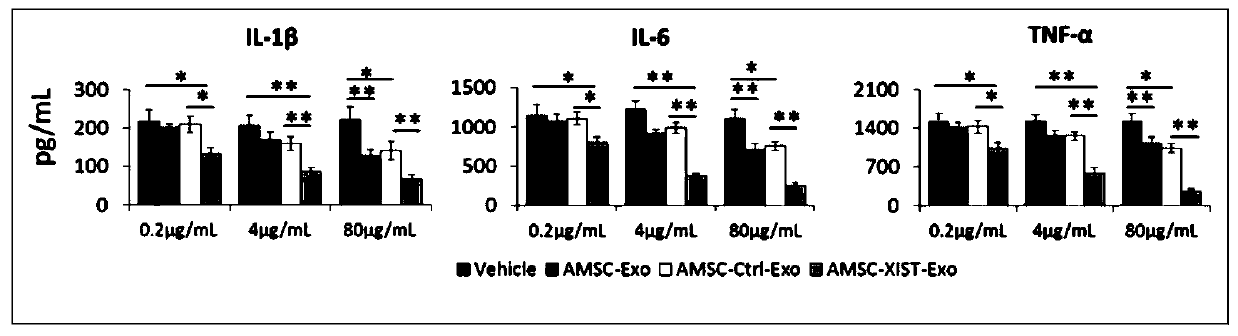
[0043] Example 3 AMSC-XIST-Exo regulates the secretion of macrophage inflammatory factors
[0044] Macrophages RAW264.7 were treated with gradient concentrations of AMSC-XIST-Exo, AMSC-Ctrl-Exo and natural AMSC-Exo (0.2 μg / mL, 4 μg / mL, 80 μg / mL) for 24 hours, and corresponding volumes of PBS was used as the control group (Vehicle); then stimulated with LPS (100ng / mL) for 12h, and then ELISA was used to detect the levels of IL-1β, IL-6 and TNF-α in the cell supernatant.
[0045] Compared with AMSC-Ctrl-Exo and natural AMSC-Exo, AMSC-XIST-Exo can significantly reduce the levels of LPS-induced macrophage inflammatory factors IL-1β, IL-6 and TNF-α under the same concentration conditions. secretion. AMSC-XIST-Exo can significantly inhibit the secretion of macrophage inflammatory factors at a concentration of 0.2 μg / mL, and its inhibitory effect is comparable to that of AMSC-Ctrl-Exo and natural AMSC-Exo at a concentration of 80 μg / mL ( image 3 ).
[0046] Moreover, the AMSC-Exo...
PUM
 Login to View More
 Abstract
Description
Claims
Application Information
 Login to View More