
Method of utilizing dinuclear amine imine magnesium complex to catalyze caprolactone polymerization
A technology of dinuclear amine imine magnesium and complexes, applied in magnesium organic compounds and other directions, can solve problems such as metal residues, and achieve the effects of low cost, excellent catalytic performance and high catalytic activity
- Summary
- Abstract
- Description
- Claims
- Application Information
AI Technical Summary
Problems solved by technology
Method used
Image

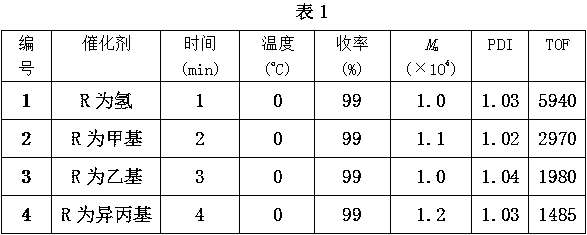
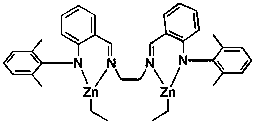
Examples
Embodiment 1
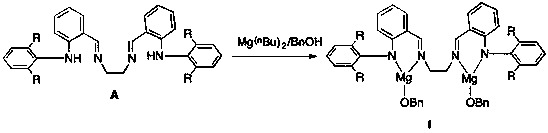
[0035] The structural formula of the ligand used is the above formula (A), where R is hydrogen, and the reaction process is as follows: under a nitrogen atmosphere, slowly add 5 mL of benzyl alcohol tetrahydrofuran solution (2.0 mol / L) to an equimolar amount of Mg( n Bu) 2 Hexane solution (2.0 mol / L, 5 mL) was reacted for 1 hour, 2.09 g of the ligand was dissolved in 20 mL of dry toluene, and added to Mg( n Bu) 2 In the reaction mixture with benzyl alcohol, after adding, the reaction liquid was naturally raised to room temperature, and then heated to 60°C for 3 hours. After the reaction, the solvent was vacuum-dried, and the residue was washed with dry n-hexane, filtered, and then the product was collected and dried. Weighed to obtain 2.75 g of solid, yield 81.2%.
Embodiment 2
[0037] The structural formula of the ligand used is the above formula (A), where R is a methyl group, and the reaction process is as follows: under a nitrogen atmosphere, slowly add 5 mL of benzyl alcohol tetrahydrofuran solution (2.0 mol / L) to an equimolar amount of Mg( n Bu) 2 Hexane solution (2.0 mol / L, 5 mL) was reacted for 1 hour, 2.37 g of the ligand was dissolved in 20 mL of dry toluene, and added to Mg( n Bu)2 and benzyl alcohol reaction mixture, after adding, the reaction liquid was naturally raised to room temperature, and then heated to 40 ° C for 12 hours, after the reaction was completed, the solvent was vacuum-dried, and the residue was washed with dry n-hexane, filtered, and then the product was collected and dried Weighed to obtain 3.27 g of solid, yield 89.1%.
Embodiment 3
[0039] The structural formula of the ligand used is the above formula (A), where R is ethyl, and the reaction process is as follows: under a nitrogen atmosphere, slowly add 5 mL of benzyl alcohol tetrahydrofuran solution (2.0 mol / L) to an equimolar amount of Mg( n Bu) 2 Hexane solution (2.0 mol / L, 5 mL) was reacted for 1 hour, 2.65 g of the ligand was dissolved in 30 mL of dry toluene, and added to Mg( n Bu) 2 In the reaction mixture with benzyl alcohol, after adding, the reaction liquid was naturally raised to room temperature, and then heated to 50 ° C for 4 hours. After the reaction was completed, the solvent was vacuum-dried, and the residue was washed with dry n-hexane, filtered, and then the product was collected and dried. Weighed to obtain 3.17 g of solid, yield 80.3%.
PUM
 Login to View More
 Abstract
Description
Claims
Application Information
 Login to View More