Check patentability & draft patents in minutes with Patsnap Eureka AI!

Method for treating hydrogen sulfide in viscose fiber production waste gas

A viscose fiber and hydrogen sulfide technology, applied in the textile field, can solve the problems of high cost of low-concentration waste gas treatment, unattainable corporate governance, odor, and high operation cost, and achieve sustainable long-term development, high safety, and reduced operation. cost effect

Active Publication Date: 2020-04-17
CHINESE TEXTILE ACAD
View PDF7 Cites 1 Cited by
  • Summary
  • Abstract
  • Description
  • Claims
  • Application Information

AI Technical Summary

Problems solved by technology

At present, the waste gas treatment of viscose fiber production mainly adopts the alkali washing H of German Lurgi company. 2 S plus activated carbon to adsorb CS 2 The method and the post-combustion sulfuric acid (WSA) method of Denmark Topsoe (Topso) company, these two technologies have large investment and high operating costs, especially for low-concentration waste gas treatment costs are higher, and cannot achieve the purpose of corporate stench control. Therefore, the production of the enterprise often causes dissatisfaction among the residents around the factory area, and even many viscose filament enterprises directly discharge the waste gas without any treatment; 2 The by-product sodium hydrosulfide produced by the S method is a hazardous chemical, which brings certain safety hazards

Method used

the structure of the environmentally friendly knitted fabric provided by the present invention; figure 2 Flow chart of the yarn wrapping machine for environmentally friendly knitted fabrics and storage devices; image 3 Is the parameter map of the yarn covering machine
View more

Image

Smart Image Click on the blue labels to locate them in the text.
Viewing Examples
Smart Image
  • Method for treating hydrogen sulfide in viscose fiber production waste gas

Examples

Experimental program
Comparison scheme
Effect test

Embodiment 1

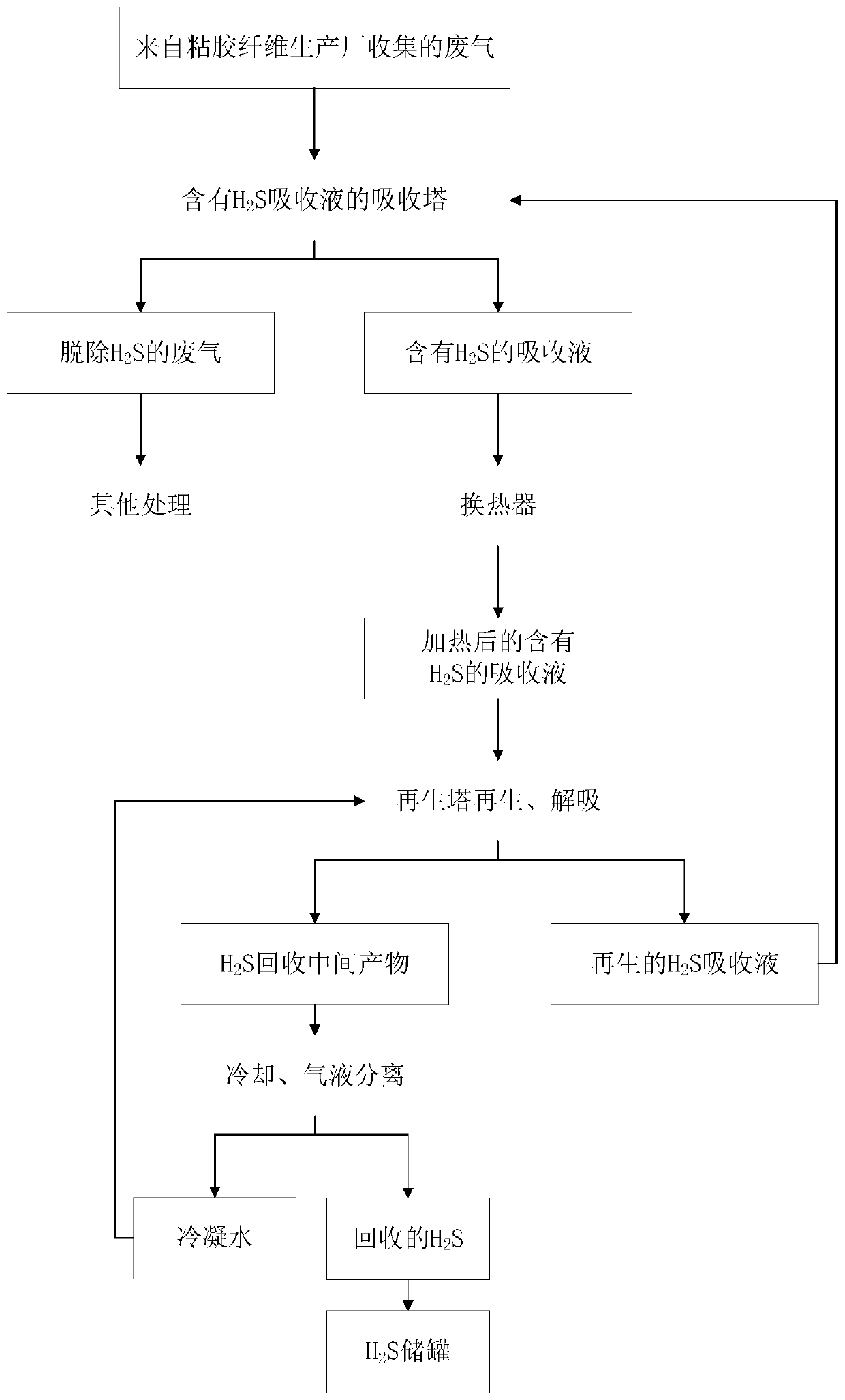
[0042] The temperature is 20°C, H 2 S content is 4675mg / m 3 The raw material gas is continuously sent to the absorption tower, and the H in the raw gas in the absorption tower2 S is sprayed by H from the upper part of the absorption tower 2 S absorption liquid absorption, the absorption liquid contains 1.5mol / L ionic liquid [(CH 3 -)(CH 3 CH 2 CH 2 CH 2 -)N-CH 2 CH 2 CH 2 -NH 2 + -CH 2 CH 3 ]CH 3 COO - , the absorption temperature is 30°C, the removal of H 2 The purified gas after S is sent to the exhaust flue for other treatment; absorb H 2 The absorption liquid (rich liquid) after S enters the lean-rich liquid heat exchanger through the pump from the bottom of the absorption tower, and after absorbing heat, it enters the regeneration tower from the upper part of the regeneration tower for regeneration and desorption of H 2 S, desorption temperature is 85°C, desorption H 2 The absorption liquid (lean liquid) after S flows out from the bottom of the regenerati...

Embodiment 2

[0044] Others are the same as in Example 1, and the difference is that the ionic liquid in the absorption liquid is [(CH 3 -)(CH 3 CH 2 CH 2 CH 2 -)N-CH 2 CH 2 CH 2 -NH 2 + -CH 2 CH 3 ]PF 6 - . H in purified gas 2 S content is 96mg / m 3 , H in raw gas 2 The removal rate of S was 97.9%.

Embodiment 3

[0046] Others are the same as in Example 1, and the difference is that the ionic liquid in the absorption liquid is [(CH 3 -)(CH 3 CH 2 CH 2 CH 2 -)N-CH 2 CH 2 CH 2 -NH 2 + -CH 2 CH 3 ] BF 4 - . H in purified gas 2 S content is 89mg / m 3 , H in raw gas 2 The removal rate of S was 98.1%.

the structure of the environmentally friendly knitted fabric provided by the present invention; figure 2 Flow chart of the yarn wrapping machine for environmentally friendly knitted fabrics and storage devices; image 3 Is the parameter map of the yarn covering machine
Login to View More

PUM

No PUM Login to View More

Abstract

The invention discloses a method for treating hydrogen sulfide in viscose fiber production waste gas and belongs to the technical field of textiles. The method comprises the following steps: obtainingproduction waste gas from a viscose fiber production plant; enabling the waste gas to pass through an absorption tower containing an H2S absorption liquid to obtain an H2S-containing absorption liquid and H2S-removed waste gas; after the H2S-containing absorption liquid absorbs heat through a heat exchanger, obtaining the heated H2S-containing absorption liquid; regenerating and desorbing the heated H2S-containing absorption liquid through a regeneration tower to obtain an H2S recovery intermediate product and a regenerated H2S absorption liquid; cooling the H2S recovery intermediate product,and carrying out gas-liquid separation to obtain recovered H2S and condensed water; sending the recovered H2S to an H2S storage tank; and sending the condensed water to the regeneration tower. The method is low in investment, safe in operation, low in cost and good in H2S treatment effect, the H2S removal rate is larger than or equal to 95%, and the method is suitable for treatment of low-H2S-concentration viscose waste gas.

Description

technical field [0001] The invention relates to the technical field of textiles, in particular to a method for treating hydrogen sulfide in waste gas from viscose fiber production. Background technique [0002] The excellent performance of viscose fiber and the easy availability and renewability of the main raw material cellulose determine that it will have a high demand for a long time, but in the production of viscose fiber, a large amount of hydrogen sulfide (H 2 S) and carbon disulfide (CS 2 ) exhaust gas, causing serious pollution to the environment. Efficient and economical treatment of waste gas has always been a technical problem in the viscose fiber industry. At present, the waste gas treatment of viscose fiber production mainly adopts the alkali washing H of German Lurgi company. 2 S plus activated carbon to adsorb CS 2 The post-combustion sulfuric acid (WSA) method of Danish Topso (Topso) company, these two technologies have large investment and high operating...

Claims

the structure of the environmentally friendly knitted fabric provided by the present invention; figure 2 Flow chart of the yarn wrapping machine for environmentally friendly knitted fabrics and storage devices; image 3 Is the parameter map of the yarn covering machine
Login to View More

Application Information

Patent Timeline
no application Login to View More
Patent Type & Authority Applications(China)
IPC IPC(8): B01D53/14
CPCB01D53/1493B01D53/1468B01D53/1425B01D2257/304
Inventor 朱庆松谢和平孔令熙李晓俊甘丽华
Owner CHINESE TEXTILE ACAD
Features
  • R&D
  • Intellectual Property
  • Life Sciences
  • Materials
  • Tech Scout
Why Patsnap Eureka
  • Unparalleled Data Quality
  • Higher Quality Content
  • 60% Fewer Hallucinations
Social media
Patsnap Eureka Blog
Learn More