Unlock instant, AI-driven research and patent intelligence for your innovation.
Construction and application of heat-resistant yeast engineering bacteria capable of producing glycerine under high temperature aerobiotic condition
What is Al technical title?
Al technical title is built by PatSnap Al team. It summarizes the technical point description of the patent document.
A technology of heat-resistant yeast and engineering bacteria, which is applied in the field of construction of heat-resistant yeast engineering bacteria, and can solve problems such as safety and cost of industrial production with limited application.
Active Publication Date: 2020-05-01
HUAIBEI NORMAL UNIVERSITY
View PDF2 Cites 4 Cited by
Summary
Abstract
Description
Claims
Application Information
AI Technical Summary
This helps you quickly interpret patents by identifying the three key elements:
Problems solved by technology
Method used
Benefits of technology
Problems solved by technology
[0015]
To sum up, glycerin is an important chemical product widely used in medicine, daily chemical industry, food and other industries and scientific research, but its application is limited by the safety and cost of industrial production
Method used
the structure of the environmentally friendly knitted fabric provided by the present invention; figure 2 Flow chart of the yarn wrapping machine for environmentally friendly knitted fabrics and storage devices; image 3 Is the parameter map of the yarn covering machine
View more
Image
Smart Image Click on the blue labels to locate them in the text.
Viewing Examples
Smart Image
Click on the blue label to locate the original text in one second.
Reading with bidirectional positioning of images and text.
[0048] ③ Resuspend the bacteria in 500 μL of distilled water, centrifuge at 12,000 rpm for 5 sec to collect the bacteria, and discard the supernatant.
[0049] ④Take 200 μL of 1x breaking buffer prepared by the laboratory (TritonX-100 (2% (w / v)), SDS (1% (w / v)), NaCl (100mM), Tris-Cl (10mM, pH8.0 ), EDTA (1mM)) to resuspend the bacteria, and transfer the bacteria solution into an EP tube containing 0.3g glass beads (425-600um, sigma, USA).
[0050] ⑤ After adding 200 μL of phenol-chloroform solution, shake at high speed for 3 minutes, add 200 μL of 1x TE (10 mM Tris-HCl, pH 8.0, 1 mM EDTA), and shake slightly.
[0051] ⑥Centrifu...
Embodiment 2
[0165] Embodiment 2: the engineering strain fermentation situation of construction
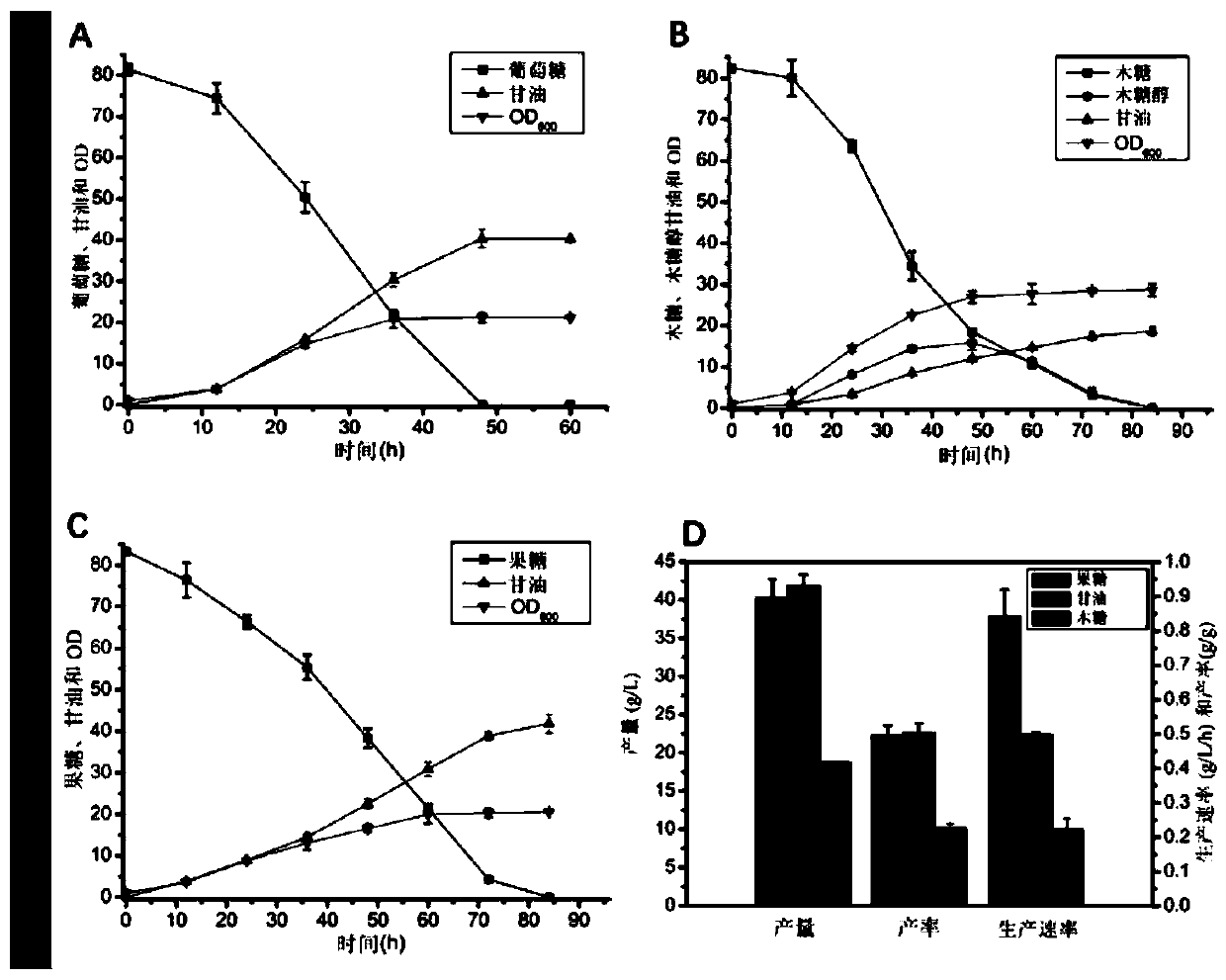
[0166] This example is used to test the effects of engineering strains on producing glycerol by fermentation of glucose, fructose and xylose. The results showed that the engineered strain obtained by transforming heat-resistant yeast could efficiently produce glycerol by aerobic fermentation at high temperature (42°C), and almost no by-products were contained in the fermentation broth after fermentation.
[0167] 1. Resuscitate strain YZB115 on a YPD medium plate and culture at 37°C for 1 day.
[0168] 2. Pick a single clone, inoculate in 5mL liquid YPE medium, 37°C, 250rpm, overnight.
[0169] 3. Seed cultivation. Transfer 5mL of liquid YPE medium to 250mLYPE, culture at 37°C, 250rpm, for 48h.
[0170] 4. Preparation 2.5 LYPD, YPF and YPX are cultured in a 5L fermenter and sterilized for use.
[0171] 5. Put 250mL seed culture medium into 2.5L fermentation medium, ferment at 42°C, rotatio...
the structure of the environmentally friendly knitted fabric provided by the present invention; figure 2 Flow chart of the yarn wrapping machine for environmentally friendly knitted fabrics and storage devices; image 3 Is the parameter map of the yarn covering machine
Login to View More
PUM
Login to View More
Abstract
The invention discloses construction and application of heat-resistant yeastengineeringbacteria capable of producing glycerine under high temperature aerobiotic condition. A heat-resistant kluyveromyces marxianus is used as a platform, methods of genetic engineering, metabolic engineering and the like are utilized, a strain having triose phosphateisomerase (TPI1) deletion is constructed, and the constructed strain has the capacity of efficiently producing the glycerine through efficient utilization of glucose, levulose and xylose under the high temperature aerobiotic condition. The obtainedkluyveromyces marxianus strain YZB115 produces 40.32 g / L glycerine through 80g / L glucose, produces 41.84 g / L glycerine through 80g / L levulose and 18.64g / L glycerine through 80g / L xylose under the aerobiotic condition of 42 DEG C, the production rates are respectively 0.84g / L / h, 0.50g / L / h and 0.22g / L / h, the yields are respectively 0.50g / g, 0.50g / g and 0.23g / g, in the fermentation process of the constructed engineering strain, a by-product namely ethanol is not produced, and xylitol is not accumulated when the operation of producing the glycerine through fermentation of xylose is ended.
Description
technical field [0001] The invention belongs to the field of microbial metabolismengineering and microbial fermentation engineering, and in particular relates to the construction and application of heat-resistant yeast engineering bacteria producing glycerol under high-temperature aerobic conditions. The heat-resistant yeast engineering strain of the invention can produce glycerin by fermenting three kinds of monosaccharides (glucose, fructose and xylose) at relatively high temperature (42 DEG C). Background technique [0002] Glycerin (scientific name glycerol) is an important light chemical raw material with a wide range of uses. Used in the paint industry to produce alkyd resins and phenolic resins; in the pharmaceutical industry as solvents and lubricants; in the food industry as sweeteners, humectants and monoglycerides; in the tobacco industry as solvents and lubricants Moisturizing agent; used as raw material of explosive nitroglycerin in the defense industry, antif...
Claims
the structure of the environmentally friendly knitted fabric provided by the present invention; figure 2 Flow chart of the yarn wrapping machine for environmentally friendly knitted fabrics and storage devices; image 3 Is the parameter map of the yarn covering machine
Login to View More
Application Information
Patent Timeline
Application Date:The date an application was filed.
Publication Date:The date a patent or application was officially published.
First Publication Date:The earliest publication date of a patent with the same application number.
Issue Date:Publication date of the patent grant document.
PCT Entry Date:The Entry date of PCT National Phase.
Estimated Expiry Date:The statutory expiry date of a patent right according to the Patent Law, and it is the longest term of protection that the patent right can achieve without the termination of the patent right due to other reasons(Term extension factor has been taken into account ).
Invalid Date:Actual expiry date is based on effective date or publication date of legal transaction data of invalid patent.



 Login to View More
  Login to View More