AI technical title is built by Patsnap AI team. It summarizes the technical point description of the patent document.
A technology of algae cells and cultures, applied in the field of cultivating algae, which can solve problems such as too much light and unhealthy growth
Pending Publication Date: 2020-09-04
NICHIA CORP
View PDF3 Cites 2 Cited by
Summary
Abstract
Description
Claims
Application Information
AI Technical Summary
This helps you quickly interpret patents by identifying the three key elements:
Problems solved by technology
Method used
Benefits of technology
Problems solved by technology
[0004] Cultivation in an open system is suitable for large-scale production, but if the concentration of the microalgae initially introduced at the beginning of the culture is not high enough, there is a problem that too much light is irradiated per cell, and healthy growth cannot be achieved. Case
Method used
the structure of the environmentally friendly knitted fabric provided by the present invention; figure 2 Flow chart of the yarn wrapping machine for environmentally friendly knitted fabrics and storage devices; image 3 Is the parameter map of the yarn covering machine
View more
Image
Smart Image Click on the blue labels to locate them in the text.
Viewing Examples
Smart Image
Click on the blue label to locate the original text in one second.
Reading with bidirectional positioning of images and text.
Smart Image
Examples
Experimental program
Comparison scheme
Effect test
preparation example Construction
[0157]
[0158] From another point of view, the present invention provides a method for preparing a cell culture of algae selected from the group consisting of green algae, euglena, diatoms, and dinoflagellates.
[0159] The method for producing a culture of algae cells of the present invention (hereinafter also referred to as "the production method of the present invention") is characterized in that the culture selected from green algae , euglena, diatoms, and dinoflagellates algae.
[0160] The algal cells used in the production method of the present invention are cells of algae selected from the group consisting of green algae, euglena, diatoms, and dinoflagellates as described in the above .
[0161] According to the production method of the present invention, it is possible (for example, from the viewpoint of time and / or cost) to produce a culture of algae cells efficiently and / or at a high density (that is, high biomass productivity can be achieved), Further, useful s...
Embodiment
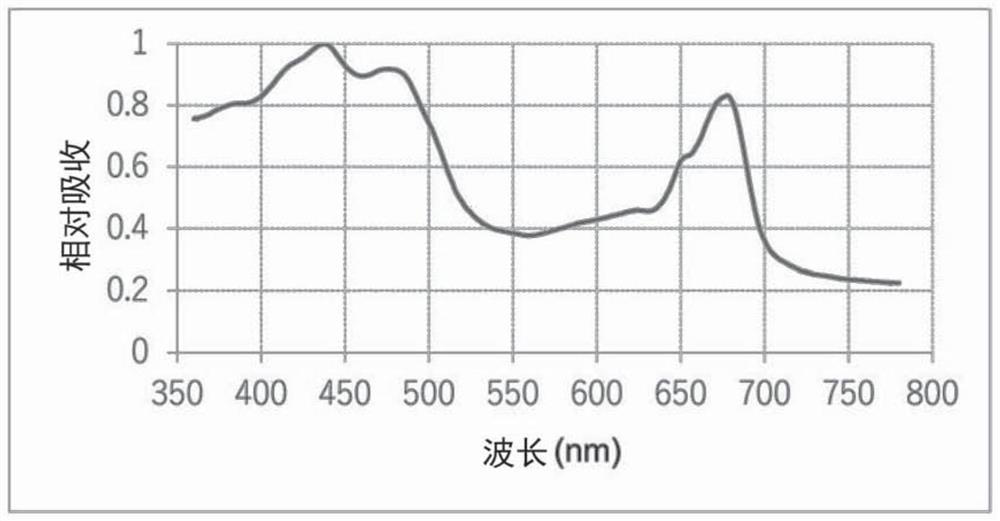
[0385] Experiment 1: Determination of Absorption Spectrum of Chlamydomonas
[0386] method:
[0387] Chlamydomonas reinhardtii CC-125 strain was pre-cultured for 3 days using a bottle-type photobioreactor under the following conditions.
[0390] Medium: Change the amount of nitrogen source to 5 times (add NH 4 Cl to 2.5g / L) HSM medium 500mL
[0391] CO 2 Concentration: supply 2% CO to the medium at 0.1mL / mL medium / min 2 (v / v)
[0392] Temperature: 30°C
[0393] Stirring: 500rpm
[0394] After pre-cultivation, dilute to make the optical density (OD 750 )=0.4 (equivalent to 0.15 g / L in terms of dry weight), the main culture was carried out.
[0395] The main culture was carried out for 2 days under the following conditions.
[0396] Main culture condition (OD at the beginning 750 =0.4)
the structure of the environmentally friendly knitted fabric provided by the present invention; figure 2 Flow chart of the yarn wrapping machine for environmentally friendly knitted fabrics and storage devices; image 3 Is the parameter map of the yarn covering machine
Login to View More
PUM
Property
Measurement
Unit
wavelength
aaaaa
aaaaa
wavelength
aaaaa
aaaaa
wavelength
aaaaa
aaaaa
Login to View More
Abstract
A method of cultivating algal cells of an algae belonging to a class selected from Chlorophyceae, Euglenophyceae, Bacillariophyceae and Haptophyceae includes: irradiating the algal cells with an artificial light having a ratio of (i) photon flux density in a wavelength range of 520-630 nm to (ii) photosynthetic photon flux density, that is 65% or more; and measuring a condition of the algal cellsand / or a condition of an algal cell culture provided by cultivating the algal cells. Irradiation and non-irradiation of the algal cells with the artificial light are switched, or the photon flux density in the wavelength range of 520-630 nm is changed, according to the measured condition of the algal cells and / or the measured condition of the algal cell culture.
Description
technical field [0001] The present invention relates to a method for cultivating algae and a photobioreactor for such culturing. Background technique [0002] Microalgae (eg, Haematococcus pluvialis, Chlorella, and Euglena) are actively cultivated for the production of raw materials for health foods or supplements, or oils suitable for biofuels. [0003] Microalgae are cultured in a closed system using artificial light sources (eg, in a closed type photobioreactor) or in an open system using sunlight (eg, an open type in an open pond). [0004] Cultivation in an open system is suitable for large-scale production, but if the concentration of the microalgae initially introduced at the beginning of the culture is not high enough, there is a problem that too much light is irradiated per cell, and healthy growth cannot be achieved. Case. Therefore, it is necessary to prepare microalgae in a somewhat high concentration in advance, and for this preparation, cultivation in a close...
Claims
the structure of the environmentally friendly knitted fabric provided by the present invention; figure 2 Flow chart of the yarn wrapping machine for environmentally friendly knitted fabrics and storage devices; image 3 Is the parameter map of the yarn covering machine
Login to View More
Application Information
Patent Timeline
Application Date:The date an application was filed.
Publication Date:The date a patent or application was officially published.
First Publication Date:The earliest publication date of a patent with the same application number.
Issue Date:Publication date of the patent grant document.
PCT Entry Date:The Entry date of PCT National Phase.
Estimated Expiry Date:The statutory expiry date of a patent right according to the Patent Law, and it is the longest term of protection that the patent right can achieve without the termination of the patent right due to other reasons(Term extension factor has been taken into account ).
Invalid Date:Actual expiry date is based on effective date or publication date of legal transaction data of invalid patent.



 Login to View More