
A double-stage continuous aging treatment method for aluminum-lithium alloy
An aluminum-lithium alloy and aging treatment technology, which is applied in the field of aluminum alloy processing, can solve the problems of complex precipitation mechanism, long aging time, and reduced atomic diffusion rate, and achieve good yield strength, excellent mechanical properties, and superior room temperature tensile strength. intensity effect
- Summary
- Abstract
- Description
- Claims
- Application Information
AI Technical Summary
Problems solved by technology
Method used
Image

Examples
Embodiment 1
[0051] In this embodiment, an aluminum-lithium alloy plate prepared with the same composition and production process as in Comparative Example 1 is used, and the solution quenching and pre-deformation processes are also the same as those in Comparative Example 1.
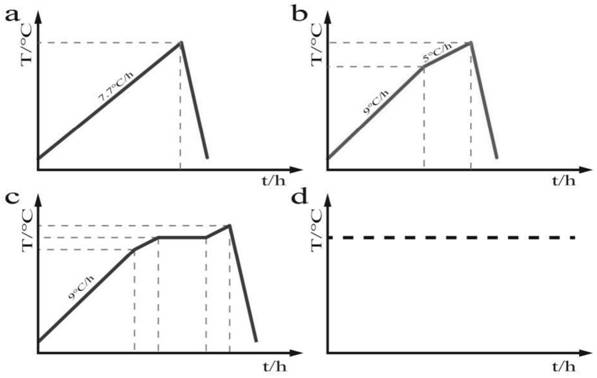
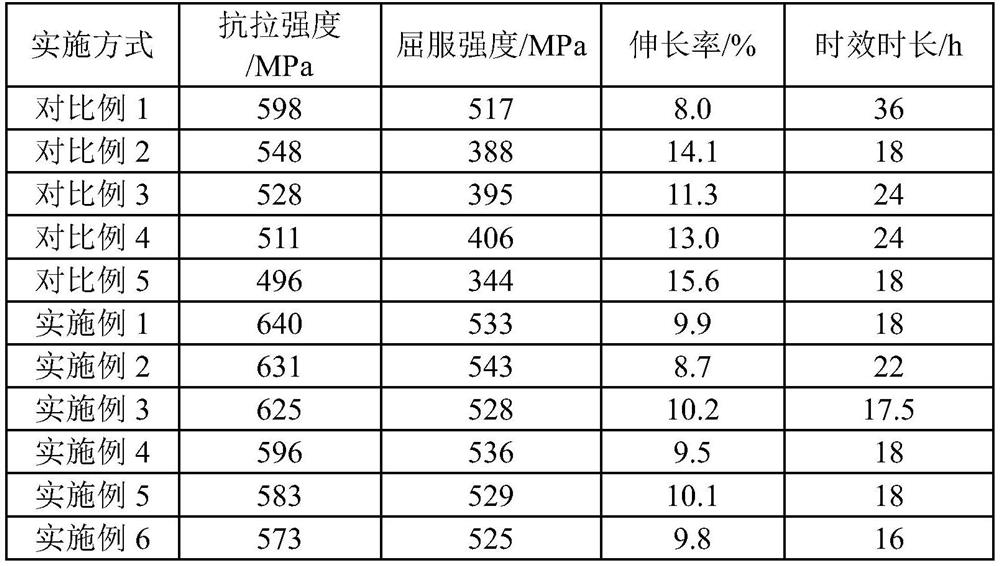
[0052] Aging process: put the sample into a resistance furnace heated to 22°C, and then heat up to 130°C after 12h, with a heating rate of 9°C / h; ℃ / h, the cooling method is furnace cooling, the cooling rate with the furnace is less than 50 ℃ / h, and the final mechanical properties of the obtained materials are shown in Table 1.
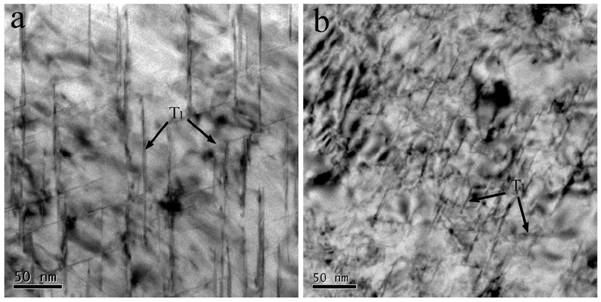
[0053] figure 2 b is the TEM microstructure picture of the comparative example.
Embodiment 2
[0055] In this example, an aluminum-lithium alloy plate prepared with the same composition and production process as in Comparative Example 1 was used, and the sample was subjected to a stepwise temperature rise and solid solution treatment, and the solid solution was carried out in a salt bath. After the solution treatment, the sample was quickly taken out and cooled to room temperature. The quenched samples were pre-deformed by 5% cold rolling.
[0056] Aging process: put the sample into a resistance furnace heated to 21 °C, and then heat up to 140 °C after 17 h, during which the heating rate is 7 °C / h; ℃ / h, the cooling method is furnace cooling, the cooling rate with the furnace is less than 50 ℃ / h, and the final mechanical properties of the obtained materials are shown in Table 1.
Embodiment 3
[0058] In this example, an aluminum-lithium alloy plate prepared with the same composition and production process as in Comparative Example 1 was used, and the sample was subjected to a stepwise temperature rise and solid solution treatment, and the solid solution was carried out in a salt bath. After the solution treatment, the sample was quickly taken out and cooled to room temperature. The quenched samples were pre-deformed by 5% cold rolling.
[0059] Aging process: put the sample into a resistance furnace heated to 0 °C, and then heat up to 120 °C after 10 h, with a heating rate of 12 °C / h; 4 °C / h, the cooling method is furnace cooling, and the cooling rate with the furnace is less than 50 °C / h. The final mechanical properties of the obtained materials are shown in Table 1.
PUM
| Property | Measurement | Unit |
|---|---|---|
| yield strength | aaaaa | aaaaa |
Abstract
Description
Claims
Application Information
 Login to View More