Unlock instant, AI-driven research and patent intelligence for your innovation.

Finite element model modeling method for amplitude modulation decomposition tissue

A technology of amplitude modulation decomposition and model modeling, which is applied in the fields of nanotechnology CAD, special data processing applications, design optimization/simulation, etc. It can solve the problem of increasing model complexity, increasing errors, increasing surface boundary conditions in hole areas, and increasing mesh complexity. and other problems to achieve the effect of reducing complexity and reducing errors

Pending Publication Date: 2020-10-30
XI'AN UNIVERSITY OF ARCHITECTURE AND TECHNOLOGY
View PDF0 Cites 0 Cited by
  • Summary
  • Abstract
  • Description
  • Claims
  • Application Information

AI Technical Summary

Problems solved by technology

[0004] Existing finite element simulations of porous materials mostly only construct one or more spherical or cubic pores in the finite element model, which can only simulate the influence of porosity on the material, which is different from the actual nanoporous observed under the electron microscope. The microstructure of the materials varies widely
There is no way to reflect the effect of real porous structure on nanoporous materials
In order to construct a spherical or cubic hole, the integrity of the model will be destroyed, and the boundary conditions on the surface of the hole area will be increased. The spherical hole will also increase the complexity of the mesh, which increases the complexity of the model and increases the error.

Method used

the structure of the environmentally friendly knitted fabric provided by the present invention; figure 2 Flow chart of the yarn wrapping machine for environmentally friendly knitted fabrics and storage devices; image 3 Is the parameter map of the yarn covering machine
View more

Image

Smart Image Click on the blue labels to locate them in the text.
Viewing Examples
Smart Image
  • Finite element model modeling method for amplitude modulation decomposition tissue
  • Finite element model modeling method for amplitude modulation decomposition tissue
  • Finite element model modeling method for amplitude modulation decomposition tissue

Examples

Experimental program
Comparison scheme
Effect test

Embodiment Construction

[0060] Below in conjunction with specific embodiment and accompanying drawing, the present invention is described in further detail:

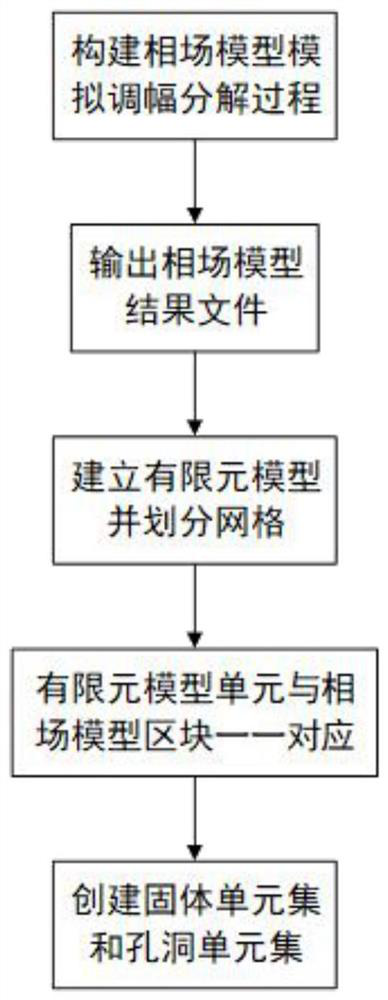
[0061] The finite element model modeling method applicable to the amplitude modulation decomposition structure of nanoporous materials of the present invention, the flow process of this method is as follows figure 1 As shown, the specific implementation steps are as follows:

[0062] 1) According to the diffusion Cahn-Hilliard equation to simulate the diffusion process, the binary alloy amplitude modulation decomposition phase field model is constructed:

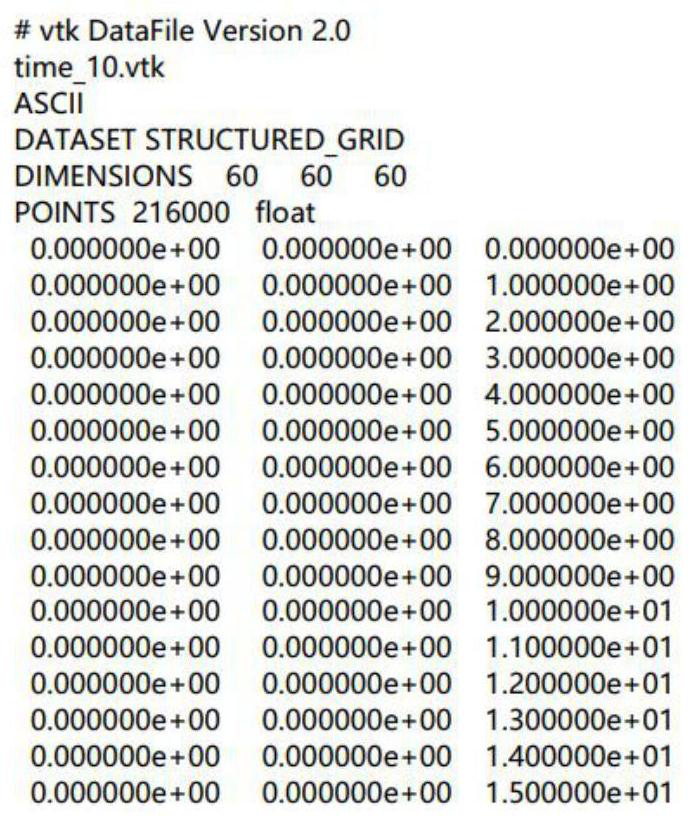
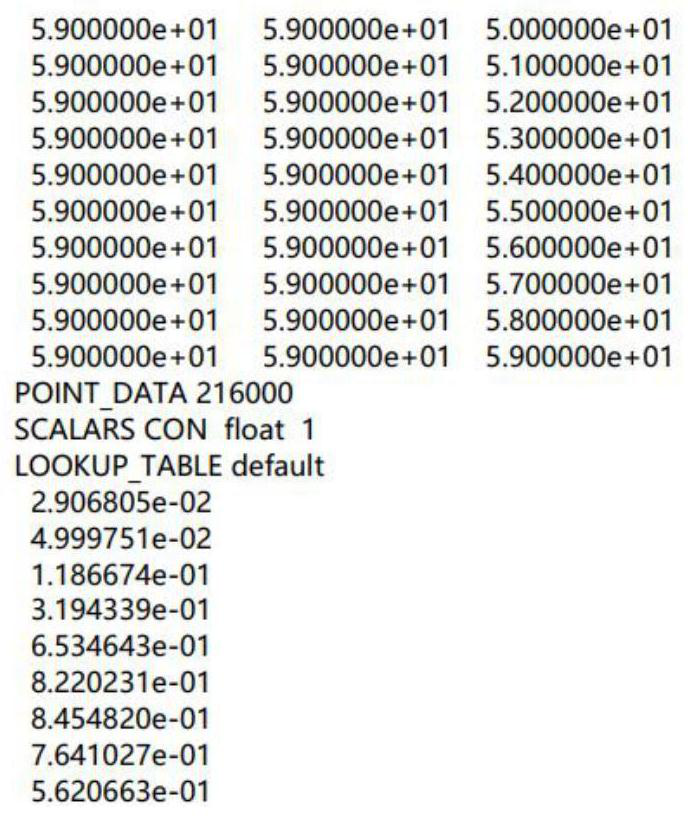
[0063] (1) Assume that a phase field model with a length, width and height of 60 is established. Build a 60x60x60 matrix is the initial concentration field, each element in the matrix is ​​the concentration of the block, the concentration ranges from 0 to 1, c=0 is one phase, c=1 is another phase.

[0064] The concentration of each block in the initialization concentration field is:

[0...

the structure of the environmentally friendly knitted fabric provided by the present invention; figure 2 Flow chart of the yarn wrapping machine for environmentally friendly knitted fabrics and storage devices; image 3 Is the parameter map of the yarn covering machine
Login to View More

PUM

No PUM Login to View More

Abstract

The invention discloses a finite element model modeling method for an amplitude modulation decomposition structure, and belongs to the technical field of material science crystallography, and the method comprises the following steps: 1, simulating a diffusion process according to a diffusion Cashn-Hilliard equation, and constructing a phase field model; 2, reading and arranging data of a phase field model result; 3, creating a hexahedron finite element model and dividing grids; and 4, dividing units of the finite element model into two unit sets, namely a solid unit set and a hole unit set, through a result of the phase field model. According to the method provided by the invention, the finite element model subjected to the binary alloy amplitude modulation decomposition process can be created. The method can be used for researching finite element simulation of nano-porous materials such as nano-silver, nano-gold and nano-copper. And the damage and fracture micromechanisms under various working conditions are explored. Therefore, the nano-porous material can be better used.

Description

technical field [0001] The invention belongs to the field of material science crystallography, and in particular relates to a finite element model modeling method of amplitude modulation decomposition distribution. Background technique [0002] AM decomposition is a type of solid-state phase transition. AM decomposition is a mechanism by which a solid solution breaks down into distinct phases with different compositions and physical properties. It differs from the classical nucleation-driven mechanism, which occurs throughout the material and not just at discrete nucleation sites. Since there are no thermodynamic barriers to the nucleation reaction, the decomposition can only be driven by diffusion processes. Due to this simplicity, besides its broad applications in materials science, the model can be used in other fields such as image inpainting, multiphase fluid flow, phase separation, flow visualization, formation of quantum dots, Taylor flow in microchannels , pores m...

Claims

the structure of the environmentally friendly knitted fabric provided by the present invention; figure 2 Flow chart of the yarn wrapping machine for environmentally friendly knitted fabrics and storage devices; image 3 Is the parameter map of the yarn covering machine
Login to View More

Application Information

Patent Timeline
no application Login to View More
IPC IPC(8): G06F30/23G06F111/14
CPCG06F30/23G06F2111/14
Inventor 姚尧黄琦
Owner XI'AN UNIVERSITY OF ARCHITECTURE AND TECHNOLOGY