

Quantitative characterization method for dispersibility of spherical nano-powder
A nano-powder, dispersive technology, applied in the direction of measuring devices, analyzing materials, and using radiation for material analysis, etc., can solve the problem of quantitative characterization of the degree of agglomeration behavior of materials without spherical nano-powders, and achieve low subjectivity and high speed , a strong representative effect
- Summary
- Abstract
- Description
- Claims
- Application Information
AI Technical Summary
Problems solved by technology
Method used
Image

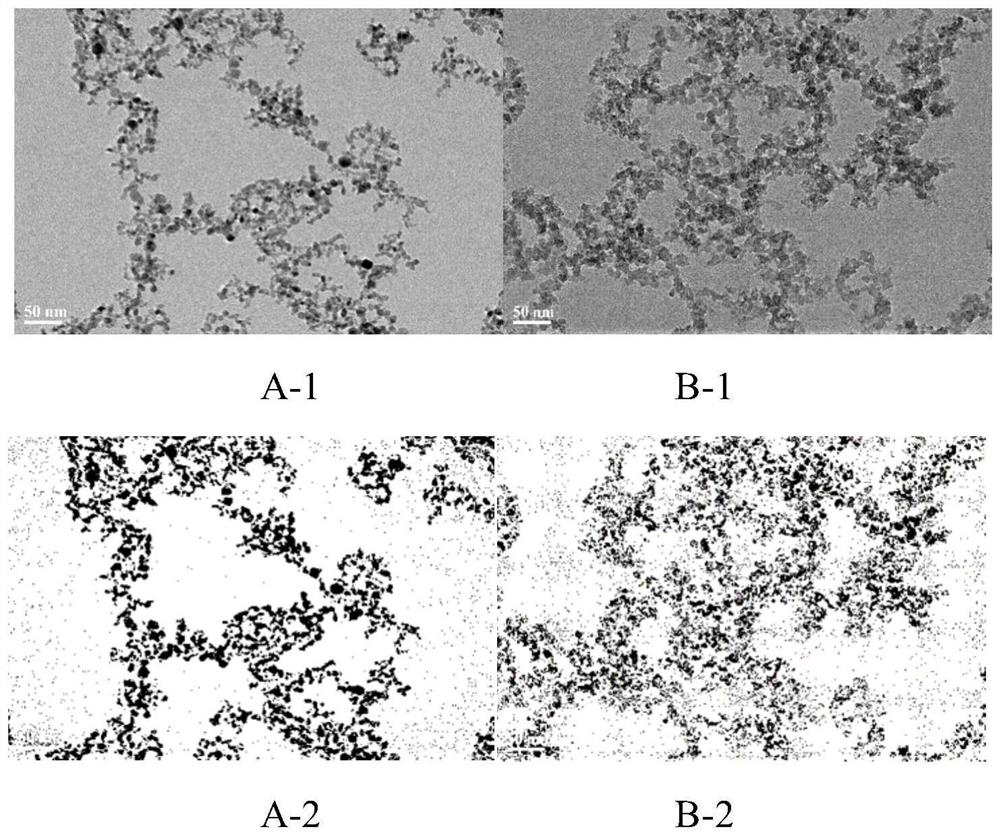


Examples
Embodiment 1
[0041] Quantitative characterization of the dispersion of silica spherical nanopowders:
[0042]S1. Weigh 1 mg of German Evonik brand AEROSIL 380 silica spherical nanopowder (7nm particle size), measure 1 mL of absolute ethanol, put it into a 3 mL centrifuge tube and disperse it by ultrasonic for 10 min, and take a small amount of dispersed powder with a pipette gun. The liquid is added onto the copper grid, 1-2 drops are added dropwise, irradiated and dried by ultraviolet light for 15 minutes, and a silica spherical nano-powder sample is obtained.
[0043] S2. Under the transmission electron microscope, after the overall observation and analysis of the morphology of the entire sample, two regions A and B are selected for shooting to obtain an electron microscope image (such as figure 1 shown), the magnification is 100,000 times, and the scale is 50nm; then the captured image is processed to obtain an electron microscope picture, which meets the following requirements: contras...
Embodiment 2
[0051] Quantitative characterization of the dispersion of titanium dioxide spherical nanopowders:
[0052] S1. Weigh 1mg of titanium dioxide spherical nanopowder (particle size is 25nm), measure 1mL of absolute ethanol, put it into a 3mL centrifuge tube and disperse in ultrasonic for 10min, take a small amount of dispersion liquid with a pipette and drop it on the copper grid, drop Add 1-2 drops, irradiate and dry with ultraviolet light for 15 minutes, and obtain a titanium dioxide spherical nanopowder sample.
[0053] S2. Under the transmission electron microscope, after the overall observation and analysis of the morphology of the entire sample, two regions A and B are selected for shooting to obtain an electron microscope image (such as figure 2 shown), the magnification is 100,000 times, and the scale is 50nm; then the captured image is processed to obtain an electron microscope picture, which meets the following requirements: contrast 100%, brightness-5%, clarity-5%, sat...
Embodiment 3
[0061] Quantitative characterization of the agglomeration of silica spherical nanopowder in silicone rubber:
[0062] S1. Prepare a silicone rubber sample comprising silica spherical nanopowder:
[0063] (1) The silicon dioxide spherical nano-powder in Example 1 is mixed with silicone rubber to prepare a silicone rubber composite material, and the addition amount of the silica spherical nano-powder is respectively 5%, 10%, 15%, and 20%; specifically:
[0064] ① Treat the silica spherical nanopowder and raw rubber at 120°C for 2 hours respectively;
[0065] ② Mix raw rubber (100 parts), hydroxy silicone oil (1.5 parts) and silica spherical nanopowder (30 parts) evenly on a double-roller mill according to different formula ratios. The temperature of the drum should not exceed 50 °C. Several operations such as cutting and triangular bagging should be carried out in the process to speed up the uniform dispersion of the filler in the rubber; each additive needs to be mixed for 2 ...
PUM
| Property | Measurement | Unit |
|---|---|---|
| particle diameter | aaaaa | aaaaa |
Abstract
Description
Claims
Application Information
 Login to View More