
Preparation method of photocatulyzed active bromine adulerated titanium dioxide nano-material
A photocatalytic activity, titanium dioxide technology, applied in the direction of titanium dioxide, chemical instruments and methods, titanium oxide/hydroxide, etc., can solve the problems of non-correlated bromine-doped titanium dioxide nanomaterials, etc., achieve high light quantum efficiency, simple preparation method, The effect of low production costs
- Summary
- Abstract
- Description
- Claims
- Application Information
AI Technical Summary
Problems solved by technology
Method used
Image

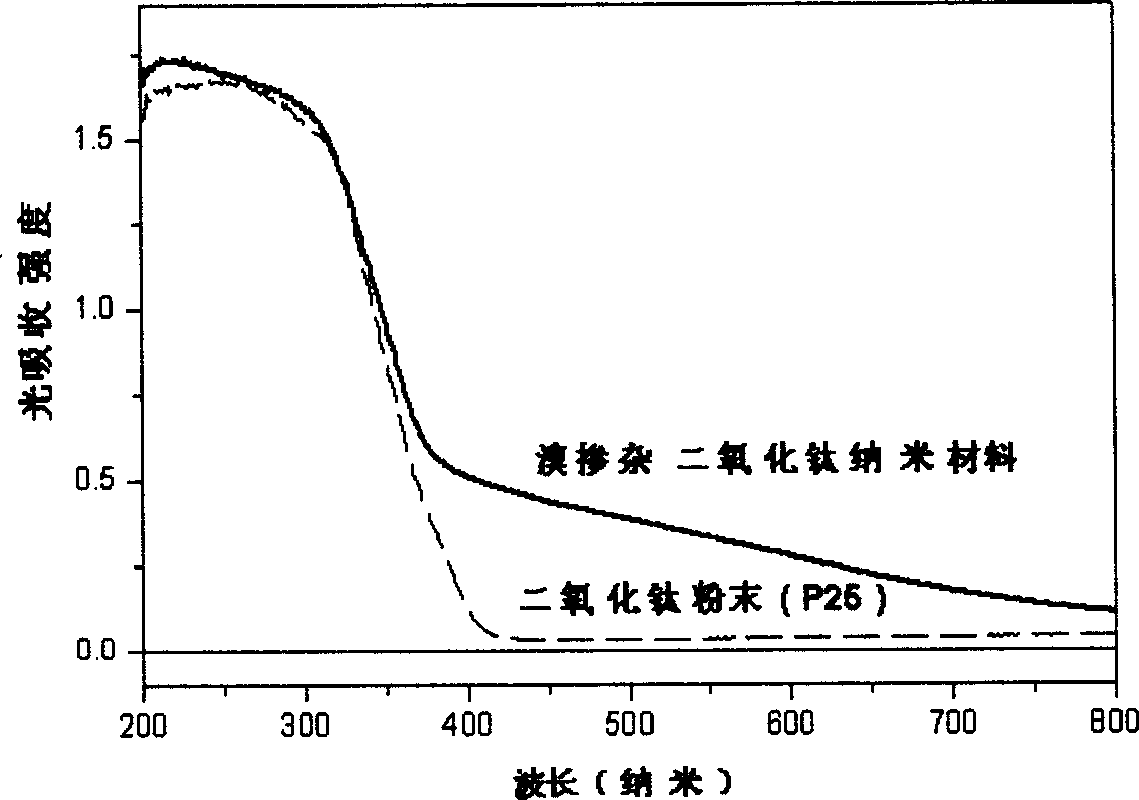
Examples
Embodiment 1
[0027]15ml of bromine aqueous solution (with a mass percentage of 3%) and 10ml of tetrabutyl titanate (with a mass percentage of >98.0%) were reacted until a white precipitate was completely formed. The white precipitate is directly heated in an oven, treated at 120°C for 8 hours, and evaporated to remove water and alcohols produced during the reaction to obtain a solid dry product. Grind the obtained solid dry matter to make the particles uniform and reduce soft agglomeration. After grinding, it is placed in a muffle furnace and calcined at 320°C for 2 hours to obtain a bromine-doped titanium dioxide nano catalyst material with high catalytic activity under visible light. In the catalytic activity test, the apparent rate constant of the first-order reaction kinetics of the catalytic degradation of phenol by the catalyst material is k=6.86×10 -3 min -1 , Is the apparent rate constant of first order reaction kinetics of titanium dioxide powder (P25, Degussa) k = 1.04×10 -3 min -1 I...
Embodiment 2
[0030] 15ml of bromine aqueous solution (3% by mass) was reacted with 10ml of titanium sulfate (>40.0% by mass) until a white precipitate was completely formed. After washing the generated white precipitate with deionized water, until the anion (sulfate ion) concentration is less than 0.5 mg / L. Then it is filtered to collect the precipitated material washed with deionized water. The white precipitate is directly heated in an oven, treated at 120°C for 8 hours, and evaporated to remove water and alcohols produced during the reaction to obtain a solid dry product. Grind the dry solids to make the particles uniform and reduce soft agglomeration. Then it is placed in a muffle furnace and calcined at 350°C for 2 hours to obtain a bromine-doped titanium dioxide nanomaterial with high catalytic activity under visible light. In the catalytic activity test, the first-order reaction kinetics apparent rate constant of the catalytic degradation of phenol by the catalyst material is k=5.41×10 ...
Embodiment 3
[0032] 10ml of hydrogen bromide solution (2mol / L) and 10ml of tetrabutyl titanate (mass percentage> 98.0%) are reacted until a white precipitate is completely formed. The white precipitate is directly heated in an oven, treated at 120°C for 8 hours, and evaporated to remove water and alcohols produced during the reaction to obtain a solid dry product. Grind the obtained solid dry matter to make the particles uniform and reduce soft agglomeration. After grinding, it is placed in a muffle furnace and calcined at 350° C. for 2 hours to obtain a bromine-doped titanium dioxide nanomaterial with high catalytic activity under visible light. In the catalytic activity test, the apparent rate constant of the first-order reaction kinetics of the catalytic degradation of phenol is k=5.72×10 -3 min -1 , Is the apparent rate constant of first order reaction kinetics of titanium dioxide powder (P25, Degussa) k = 1.04×10 -3 min -1 5.5 times. It can be seen that after 2 hours of heat treatment, a ...
PUM
 Login to View More
 Abstract
Description
Claims
Application Information
 Login to View More