
Method for modifying lithium ion battery cathode
A lithium-ion battery and cathode technology, applied in electrode manufacturing, secondary batteries, circuits, etc., can solve problems such as negative discharge characteristics of the cathode, and achieve the effects of improving cycle performance, increasing discharge current, and shortening the cycle
- Summary
- Abstract
- Description
- Claims
- Application Information
AI Technical Summary
Problems solved by technology
Method used
Image

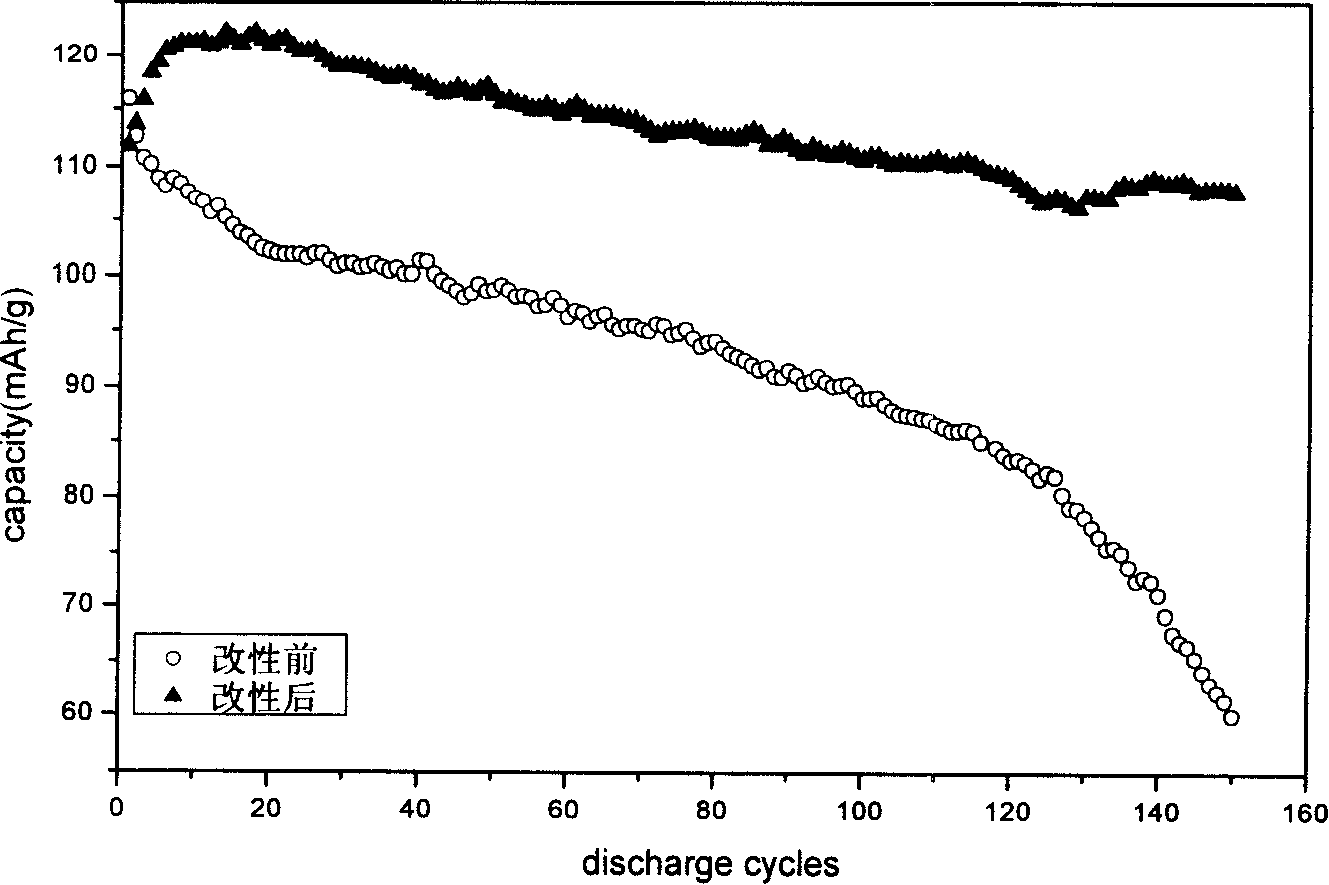
Examples
Embodiment 1
[0015] Embodiment 1: at first sodium p-toluenesulfonate, p-toluenesulfonic acid and pyrrole are dissolved in water by making the p-methylbenzenesulfonate containing 0.5mol / L, 0.01mol / L p-methyl The mixed solution of benzenesulfonic acid and 0.05mol / L pyrrole; Then LiMn 2 o 4 , conductive carbon black and polyvinylidene fluoride are mixed in the mass ratio of 65:20:15 to make a mixture, and the mass concentration of the mixture obtained by adding 1-methyl 2-pyrrolidone solvent into the mixture is 50% slurry; Coat the slurry with a thickness of 100 μm on the aluminum foil and dry it to prepare the lithium-ion battery cathode. 2 Polymerization at low temperature for 60 seconds, cleaning the surface of the electrode with deionized water, and heat treatment at 60°C for 48 hours.
Embodiment 2
[0016] Embodiment 2: first sodium p-toluenesulfonate, p-toluenesulfonic acid and pyrrole are dissolved in water to make the p-toluenesulfonate containing 0.01mol / L, 0.3mol / L p-toluene Sulfonic acid and 0.4mol / L pyrrole mixture; then LiCoO 2 , conductive carbon black and polytetrafluoroethylene are mixed in the mass ratio of 90:5:5 to form a mixture, and the mass concentration of the mixture obtained by adding 1-methyl 2-pyrrolidone solvent into the mixture is 80% slurry; Coat the slurry with a thickness of 1000 μm on the aluminum foil and dry to prepare the lithium-ion battery cathode. 2 Polymerization at low temperature for 300 seconds, cleaning the surface of the electrode with deionized water, and heat treatment at 150°C for 18 hours.
Embodiment 3
[0017] Embodiment 3: at first sodium p-toluenesulfonate, p-toluenesulfonic acid and pyrrole are dissolved in water to make the p-toluenesulfonate containing 0.3mol / L, 0.5mol / L p-toluene Sulfonic acid and 0.1mol / L pyrrole mixture; then LiNiO 2 , conductive carbon black and polyvinylidene fluoride are mixed in the mass ratio of 80:7:13 to form a mixture, and the mass concentration of the mixture obtained by adding 1-methyl 2-pyrrolidone solvent to the mixture is 60% slurry; Coat the slurry with a thickness of 400 μm on the aluminum foil and dry to prepare the lithium-ion battery cathode. 2 Polymerization at low temperature for 150 seconds, cleaning the surface of the electrode with deionized water, and heat treatment at 300°C for 1 hour.
PUM
 Login to View More
 Abstract
Description
Claims
Application Information
 Login to View More