Check patentability & draft patents in minutes with Patsnap Eureka AI!

Removal of aromatic hydrocarbons from lean acid gas feed for sulfur recovery

a technology of aromatic hydrocarbons and sulfur, which is applied in the direction of gas treatment, gaseous fuels, inorganic chemistry, etc., can solve the problems of affecting the structure of plants, requiring constant maintenance, and significant environmental problems, and achieve the effect of efficient removal of aromatic hydrocarbons

Active Publication Date: 2020-01-28
AXENS SA
View PDF10 Cites 0 Cited by
  • Summary
  • Abstract
  • Description
  • Claims
  • Application Information

AI Technical Summary

Benefits of technology

This process effectively reduces the content of aromatic hydrocarbons and C4+ aliphatic hydrocarbons, enabling suitable sulfur recovery even with low H2S concentrations, preventing catalyst deactivation and improving overall sulfur recovery efficiency.

Problems solved by technology

The presence of hydrogen sulfide in industrial gases causes significant environmental problems and is detrimental to the plant structure, requiring constant maintenance.
The presence of H2S in the acid gas obtained after purification of natural gas remains problematic and sulfur recovery units (SRU) are thus installed to convert poisonous sulfur compounds, as H2S, into harmless elemental sulfur.
% of H2S applying the Claus process happens to be more complicated: the first combustion step cannot be conducted at sufficiently elevated temperatures or cannot be conducted at all due to the presence of significant amounts of CO2 in the feed that cools down the combustion reaction below 1100° C. or even inhibits the combustion reaction when the content of CO2 exceeds 85%.
These aromatic hydrocarbons and C4+ aliphatic hydrocarbons are however harmful to the installed unit because they deactivate the catalysts operated in the catalytic step of the Claus process.
This results in poor sulfur recovery and frequent catalyst replacement.
AGE however can be found unsatisfactory when the initial concentration of H2S in the acid gas is too low (usually less than 20 mol.
The fuel gas, however, is used in the unit as a feed for an incinerator and / or utility boilers and, its flowrate thus remains limited by the demand of the incinerator or utility boilers.
This would thus result in high waste of fuel gas, particularly when the content of aromatics and aliphatic hydrocarbons is high in rich amine solvent obtained from “high pressure” sour natural gas absorber.
In this context, the fuel gas stripping would not provide a satisfactory solution to the problem of aromatic and C4+ aliphatic hydrocarbons removal from lean acid gas prior to sulfur recovery.
Although technically feasible, these processes however remain costly due to the necessary regeneration cycles of the carbon beds and the difficulties to valorize the products issued from these regenerations due to the presence of pollutants such as H2S.

Method used

the structure of the environmentally friendly knitted fabric provided by the present invention; figure 2 Flow chart of the yarn wrapping machine for environmentally friendly knitted fabrics and storage devices; image 3 Is the parameter map of the yarn covering machine
View more

Image

Smart Image Click on the blue labels to locate them in the text.
Viewing Examples
Smart Image
  • Removal of aromatic hydrocarbons from lean acid gas feed for sulfur recovery
  • Removal of aromatic hydrocarbons from lean acid gas feed for sulfur recovery

Examples

Experimental program
Comparison scheme
Effect test

example 2

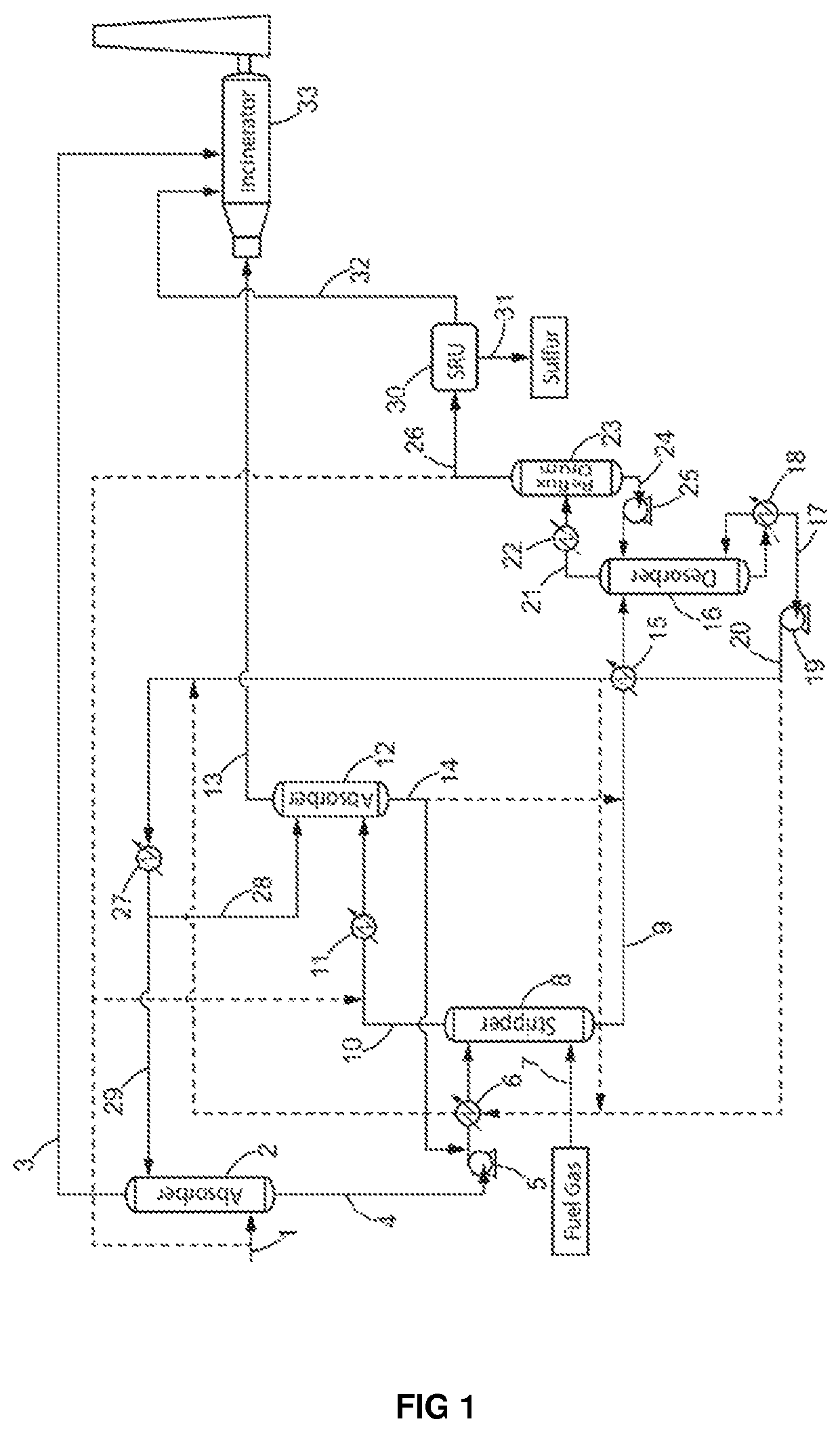
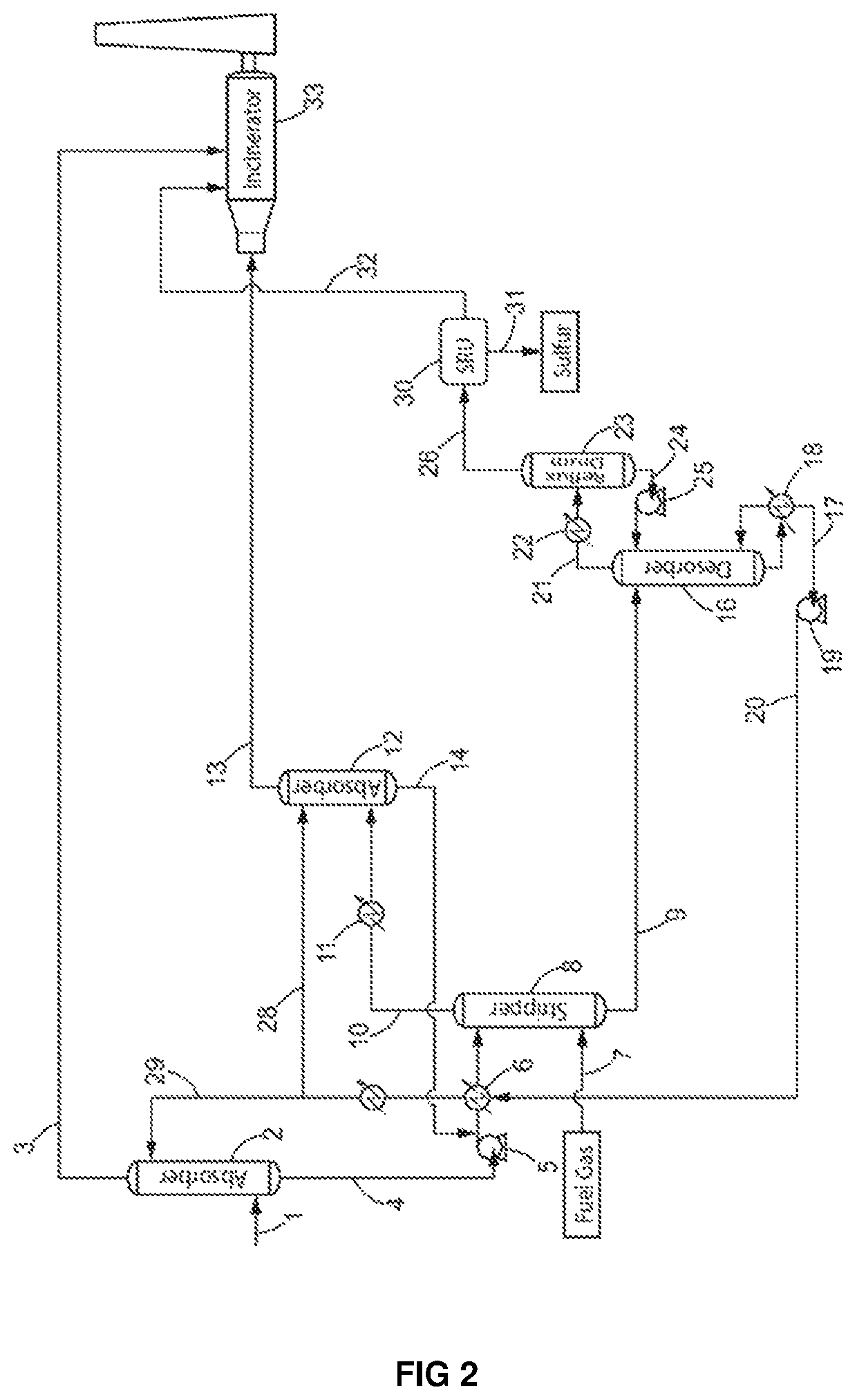
[0201]A process for sulfur recovery from a lean acid gas as illustrated in FIG. 2 was operated using an acid gas containing:[0202]0.2 mol. % of H2S,[0203]92.0 mol. % of CO2, and[0204]1500 mol. ppm of BTX.[0205]180 mol. ppm C4+[0206]7.3 mol % of water, the rest being other hydrocarbons such as methane, ethane and propane as well as sulfur species such as mercaptans

[0207]This lean acid gas was sent to a first absorption zone (2) at a flow rate of 2 800 kmol / h. In this a first absorption zone (2), the lean acid gas contacted a 45 wt % (11 mol. %) methyldiethanolamine (MDEA) aqueous solution (29) introduced at a flow rate of 335 m3 / h, at a temperature of 45° C. and at a pressure ranging of 1.55 barA.

[0208]The gas stream (3) exiting the first absorption zone (2) at a flow rated of 2580 kmol / h contained:[0209]92.8 mol. % of CO2 [0210]2S, and[0211]1510 mol. ppm of BTX (92%).[0212]195 mol. ppm of C4+ (representing the entire initial amount of C4+ in the lean acid gas).[0213]6.6 mol. % of wa...

the structure of the environmentally friendly knitted fabric provided by the present invention; figure 2 Flow chart of the yarn wrapping machine for environmentally friendly knitted fabrics and storage devices; image 3 Is the parameter map of the yarn covering machine
Login to View More

PUM

PropertyMeasurementUnit
pressureaaaaaaaaaa
temperatureaaaaaaaaaa
temperaturesaaaaaaaaaa
Login to View More

Abstract

The present invention is directed to a process for the removal of aromatic hydrocarbons from a lean acid gas containing less than 20 mol. % of H2S, comprising:a) contacting the lean acid gas stream (1) with a H2S-selective liquid absorbent solution (29) in a first absorption zone (2) to produce a gas stream depleted in H2S (3) and an absorbent solution enriched in H2S (4),b) introducing the absorbent solution (4) into a non-thermic stripping zone (8) where it is contacted with a stripping gas stream (7) to obtain an absorbent solution depleted in C4+ aliphatic and aromatic hydrocarbons (9) and a stripping gas stream enriched in aromatic and C4+ aliphatic hydrocarbons (10),c) contacting the stripping gas stream (10) obtained in step b) with a H2S-selective liquid absorbent solution (28) in a second absorption zone (12) to obtain a stripping gas stream depleted in H2S (13), and an absorbent solution enriched in H2S (14)d) introducing the absorbent solution (9) obtained in step b) into a desorption zone (16) wherein the H2S-selective liquid absorbent solution (17) is recovered and a lean acid gas is produced.

Description

[0001]The present invention relates to a process for the removal of aromatic hydrocarbons, such as benzene, toluene, ethyl benzene and xylene (BTX) and aliphatic hydrocarbons having 4 carbon atoms or more (C4+) from a lean acid gas containing CO2 and less than 20 mol. % of H2S prior to sulfur recovery.BACKGROUND OF THE INVENTION[0002]Natural gas, as it is captured from naturally occurring deposits, is composed primarily of light aliphatic hydrocarbons such as methane, propane, butane, pentane, and their isomers. Certain contaminants are naturally present in the gas, and must be removed prior to delivery of the purified gas for private use or commercial conditioning. These contaminants include aliphatic hydrocarbons having 4 carbon atoms or more (C4+) and aromatic hydrocarbons such as benzene, toluene, ethyl benzene and xylenes collectively referred to as “BTX”, but more importantly acid components such as hydrogen sulfide (H2S) and carbon dioxide (CO2).[0003]The presence of hydrogen...

Claims

the structure of the environmentally friendly knitted fabric provided by the present invention; figure 2 Flow chart of the yarn wrapping machine for environmentally friendly knitted fabrics and storage devices; image 3 Is the parameter map of the yarn covering machine
Login to View More

Application Information

Patent Timeline
no application Login to View More
Patent Type & Authority Patents(United States)
IPC IPC(8): B01D53/14C01B17/04C10L3/10
CPCC10L3/103B01D53/1468C10L3/104B01D53/1487B01D53/1418C01B17/0408B01D53/1406C01B17/043C01B17/0417B01D2252/602C10L2290/12B01D2252/20489C10L2290/541B01D2252/20431B01D53/1425B01D2251/30B01D2251/606B01D2251/61B01D2252/2056B01D2256/22B01D2256/245B01D2257/7022B01D2257/7027C10L3/101
Inventor FILLATRE, EMILEPERDU, GAUTHIERMARES, BENOIT
Owner AXENS SA
Features
  • R&D
  • Intellectual Property
  • Life Sciences
  • Materials
  • Tech Scout
Why Patsnap Eureka
  • Unparalleled Data Quality
  • Higher Quality Content
  • 60% Fewer Hallucinations
Social media
Patsnap Eureka Blog
Learn More