

Non-volatile memory and method with bit line compensation dependent on neighboring operating modes
a non-volatile, operating mode technology, applied in static storage, digital storage, instruments, etc., can solve the problems of unsuitable mobile and handheld environment, bulky disk drives, and easy mechanical failure, and achieve high capacity, non-volatile memory devices. high performance
- Summary
- Abstract
- Description
- Claims
- Application Information
AI Technical Summary
Benefits of technology
Problems solved by technology
Method used
Image

Examples
Embodiment Construction
All Bit Line Programming
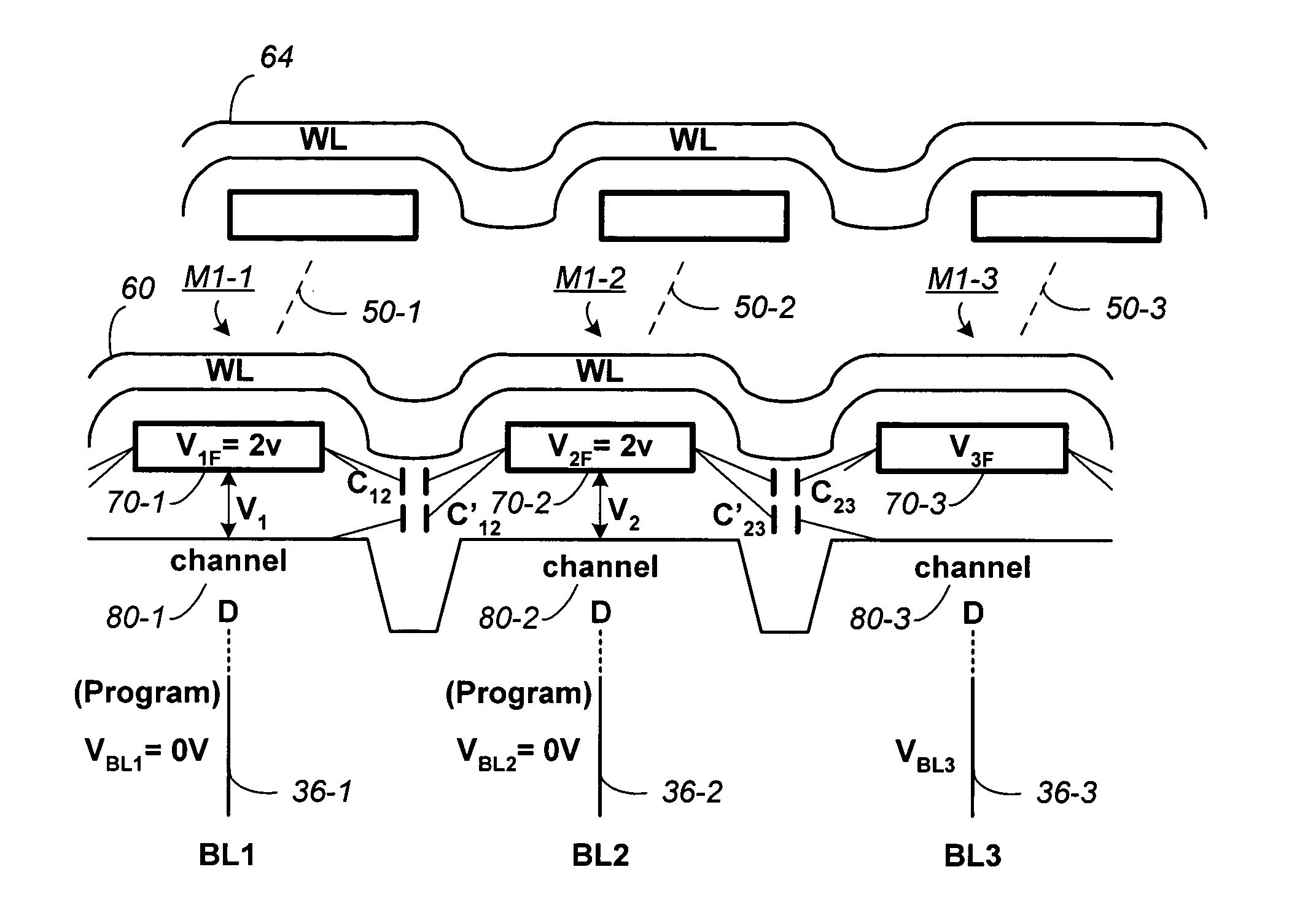
[0051] The sense module 380 shown in FIG. 4A and FIG. 8 is preferably implemented in a memory architecture configured to perform all-bit-line sensing. In other words, contiguous memory cells in a row are each connectable to a sense module to perform sensing in parallel. Such a memory architecture is also disclosed in co-pending and commonly assigned U.S. patent application Ser. No. 10 / 254,483 filed by Cernea et al., on Sep. 24, 2002 entitled, “Highly Compact Non-Volatile Memory And Method Thereof.” The entire disclosure of said patent application is hereby incorporated herein by reference.
[0052] As described earlier, the number of memory cells in a “page” that are programmed or read simultaneously may vary according to the size of data sent or requested by a host system. Thus, there are several ways to program the memory cells coupled to a single word line, such as (1) programming even bit lines and odd bit lines separately, which may comprise upper page pr...
PUM
 Login to View More
 Abstract
Description
Claims
Application Information
 Login to View More