Although
etching processes are precisely prepared and controlled, some defects may appear on a PCB.
Defects such as opens or shorts may immediately lead to rejection of the PCB, while micro-semi-cracks or filamentary shorts, poor cleanliness, or geometrical changes in the conducting paths may create hidden faults, which may deteriorate the functionality of the assembled PCB to the point of rendering it useless.
A manual visual method is limited in performance, labor-intensive and prone to
human fatigue.
Both visual and
laser methods have high
optical resolution, but are limited in their ability to reveal narrow cracks or filament-type shorts and other invisible flaws, such as salt, residues left over from the
etching process, or under-etching characterized by a series of random
copper dots and partially conducting surfaces.
As mentioned by Finarov in U.S. Pat. No. 5,333,052, an optical inspection
system becomes ineffective, generating many false alarms when the conductive surfaces suffer from colorization due to
metal oxidation (which changes color and
reflectivity).
However,
laser-based optical inspection cannot be used to distinguish between two non-fluorescing materials, such as two
metal layers, or to image a thin insulating film on a
metal layer that does not fluoresce because of its composition or thinness.
A “flying probes” technique is very slow and of low effectiveness.
Along with the recent developments in high-density PCBs with extremely fine parts and wiring patterns, it has become difficult to correctly position test probes onto the areas to be inspected in the case of inspections using an in-circuit tester.
Moreover, when test probes are positioned on a
high density PCB, the circuit board might be damaged due to disconnections induced in the wiring pattern, as mentioned by Kawaike et al in U.S.
patent application Ser. No. 10 / 198,739.
Additional disadvantages of ECT include its incapability to localize the position of a defect, and its low ability to observe conducting path geometry violations.
These technologies require very expensive and complex equipment, also involving safety issues.
The main limitation of this system is its
low resolution and the impossibility to reveal defects in the Z (depth) direction.
In other words, Soiferman's method cannot provide a
high resolution 3-dimensional PCB pattern image.
The main limitation of Daalmans' method and system is the low inductivity of the coils, which requires the use of an
excitation signal from a
transmitter coil at very high frequencies.
This means that the EC
penetration depth is very small, and that it is impossible to detect any defects inside the subsurface region.
This feature makes the method non-universal and labour-intensive.
Any defect in the conducting surface will disrupt the flow of induced current.
Kawaike's detection method has
low resolution for distinguishing between faulty and good patterns, and cannot determine the type of defect and its lateral localization in the PCB.
Their technique is limited by the very small
signal generated by the tangential component, which is very difficult to preserve in practice when high scanning velocities are used.
Another limitation of the tangential component measurement is the substantial difficulty in inspecting a multilayer PCB.
Therefore, the resolution of the testing sensor becomes very critical.



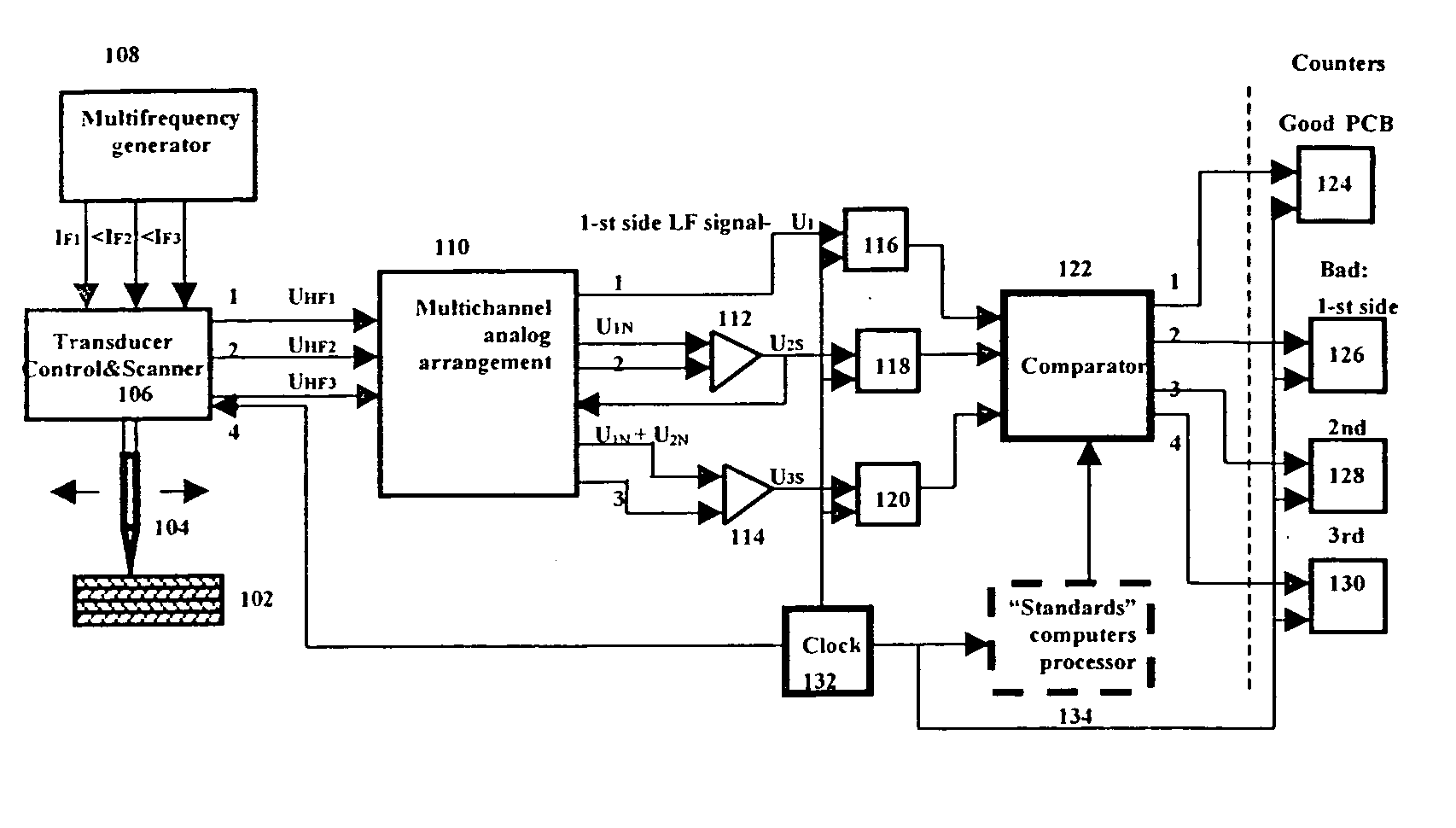
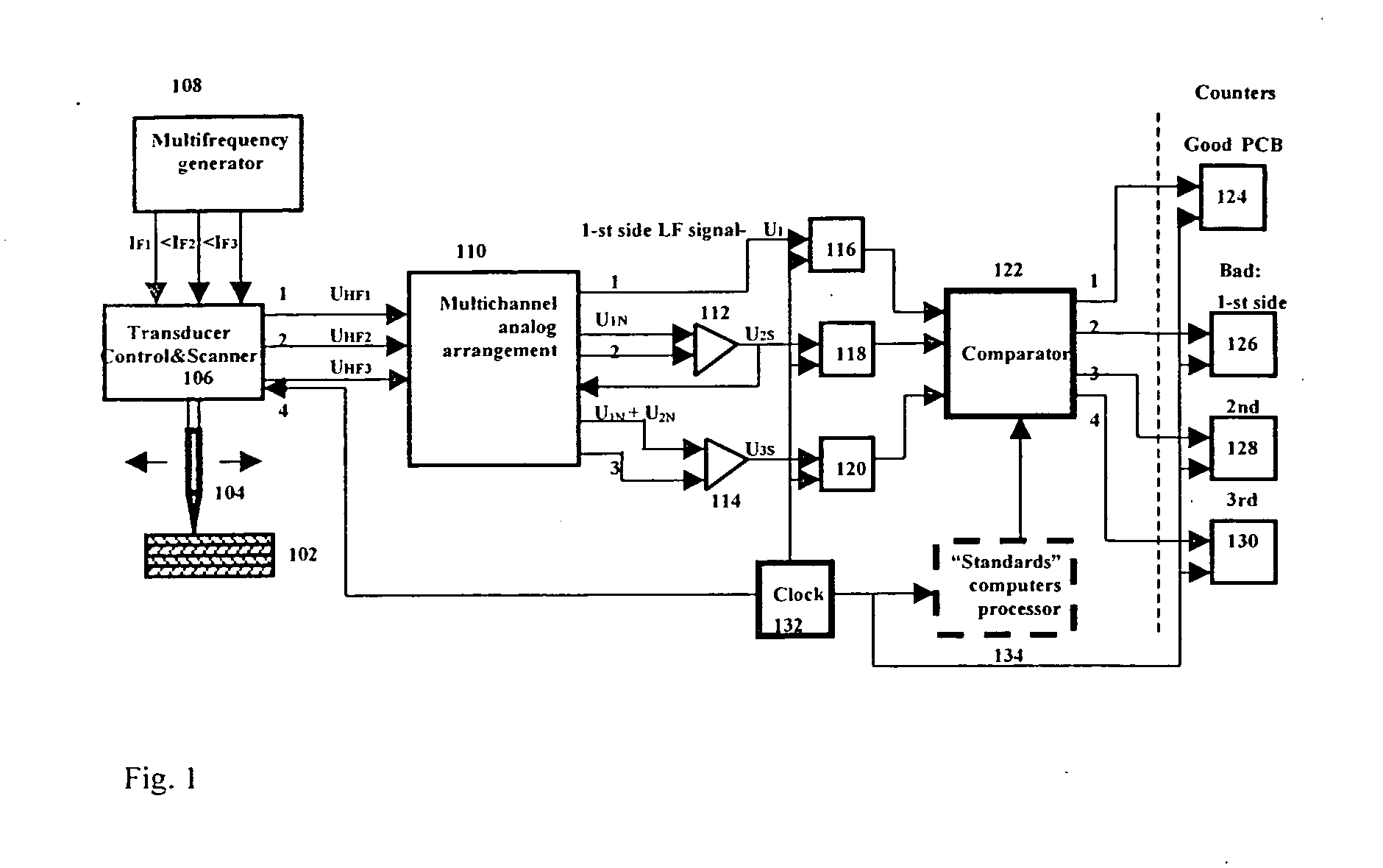
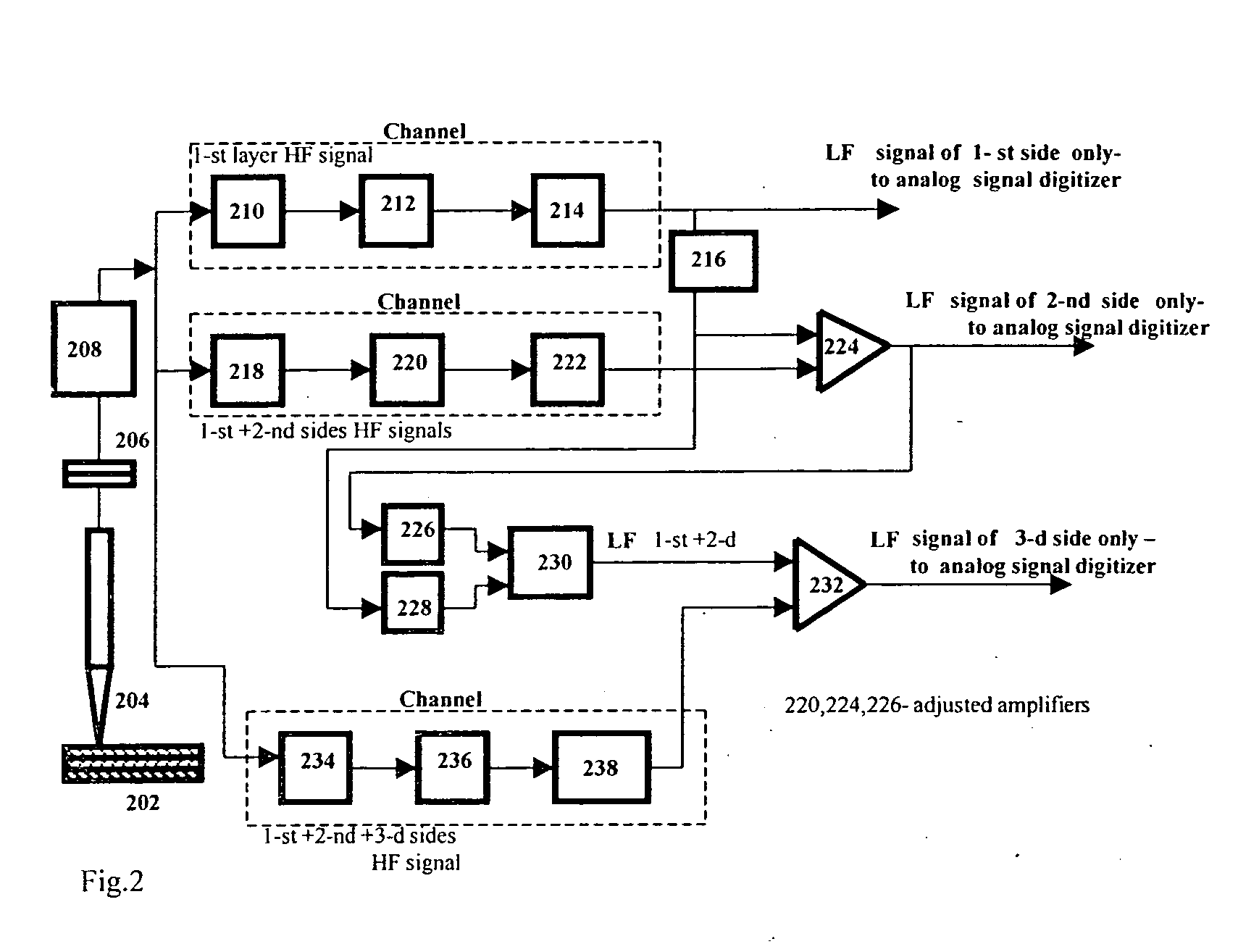
 Login to View More
  Login to View More