

Processing rubber to metal adhesive
a technology of metal adhesive and processing method, which is applied in the direction of adhesive process with surface pretreatment, non-macromolecular adhesive additives, layered products, etc., can solve the problems of poor spraying performance of dispersions, poor wet film coverage over the intended bonding area, and poor spraying characteristics. , to achieve the effect of controlling and uniformizing the thickness of dry film
- Summary
- Abstract
- Description
- Claims
- Application Information
AI Technical Summary
Benefits of technology
Problems solved by technology
Method used
Image

Examples
example 1
Adhesive Example 1
See Example 70-R, Series 70 Below
[0069]
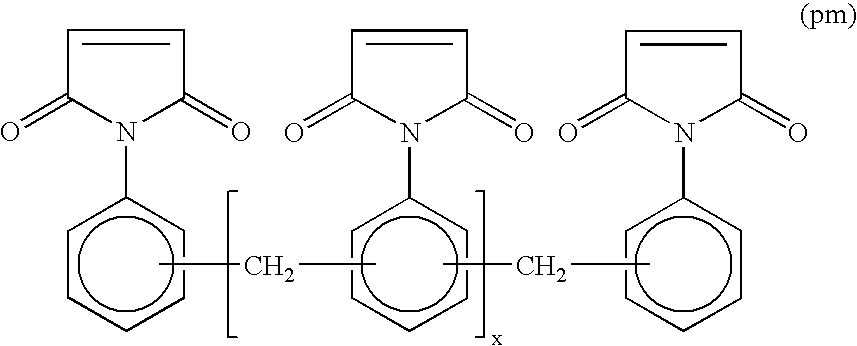
Component DescriptionWt. %Dry WeightWet WeightDinitrosobenzene (DNB)20.65.3715.34Zinc oxide1.032.682.68m-phen bismaleimide1.032.682.68C NR15.54.044.04Carbon Black10.260.26CSM16.44.274.27Ceramic spheres25.76.706.70Xylene0.0064.0326.00100.0
example 2
Adhesive Example 2
See Example 70-Q in Series 70 Below
[0070]
Component DescriptionWt. %Dry WeightWet WeightDinitrosobenzene20.05.2014.86Zinc oxide10.02.602.60Bismaleimide**10.02.602.60Chlorinated natural rubber15.13.923.92Carbon Black**4.01.041.04Chlorosulfonated PE (CSM)15.94.144.14Ceramic spheres**256.506.50Xylene0.0064.3426.0100.0
[0071] Preparation Procedure: [0072] (1) ** these solids were pre-dried in an oven at 170° F. (76° C.) for 48 hrs. [0073] (2) Xylene was charged to a tank equipped with a Hockmeyer® mixer. [0074] (3) CNR rubber, carbon black, maleimide, zinc oxide and ceramic spheres were added and mixed for 30 minutes. Speed was adjusted upwards if needed. [0075] (4) a pre-agitated 35% solution of DNB in xylene was added with mixing for 15 minutes. [0076] (5) Ingredients were pumped to a sandmill and recirculated back to the tank until a o to 2.0 mil grind is obtained using a Hegman® grind guage available from Precision Guage & Tool Co. Dayton, Ohio. Carbon black and CNR...
PUM
| Property | Measurement | Unit |
|---|---|---|
| particle diameter | aaaaa | aaaaa |
| particle diameter | aaaaa | aaaaa |
| thickness | aaaaa | aaaaa |
Abstract
Description
Claims
Application Information
 Login to View More