[0008] Preferably, the datastore may comprise a
relational database, object
database, a flat file, an
ASCII list, registry entries, an
XML file, or any other type of commonly known data listing. However, in the case where storage space is limited for the
verification system, a flat file structure for the
database may be more desirable, and require less
software instructions to read and retrieve information therefrom. The datastore may also comprise an independent
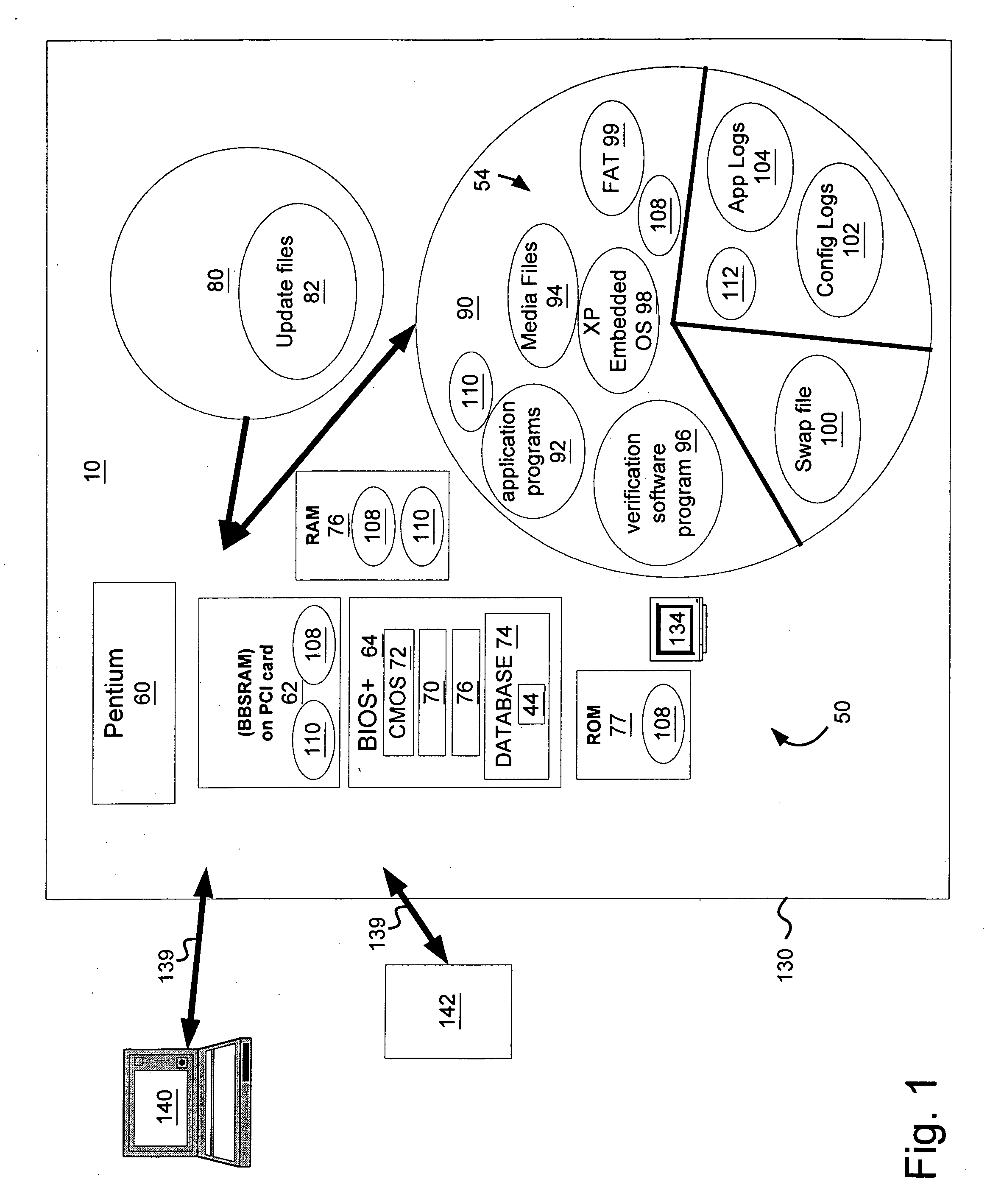
system stack of bindings, which comprise numbers, identification strings or signatures in the datastore for algorithmically verifying or authenticating the components, or from manufacturers of the components, each identification number being verified using the binding from the manufacturer of the respective component to verify the component. Especially in the context of smaller devices such as personal digital assistants (PDAs), such a system stack may comprise a subset of one or more global component datastores containing bindings from manufacturers of the components, each binding of the subset being associated with at least one of the identification numbers of one of the components in the device. Providing such a limited subset helps control the size of the
verification system by controlling the size of the datastore. Another example of a
verification system in which it may be desirable to limit the size of the datastore is one in which the datastore is stored in a
personal computer's (PC's) complementary
metal oxide semiconductor memory (
CMOS), along with other configuration settings for the PC. Storing the datastore in the
CMOS may improve security wherein the PC may be configured such that only users with administrative passwords may change the content of the portion of the
CMOS containing the datastore.
[0012] Either contained in the device, or attachable to the device, is a processor and a memory containing
executable instructions or a
software program file for verification of the components (verification software), which may itself be one of the components to verify. The verification software may be stored on a persistent storage media, such as a hard disk device,
read only memory (ROM), electrically erasable programmable read-only memory (
EEPROM), in the aforementioned CMOS memory, battery-backed
random access memory,
flash memory or other type of persistent memory. Additionally, the verification software may also be stored on volatile storage media, such as
random access memory (RAM). Preferably, the verification software is stored in a basic input / output system (
BIOS) on a
solid-state persistent memory device or
chip.
BIOS chips have been used for storing verification software, such as the
BIOS+
chip used by Bally Gaming, Inc. of Las Vegas, Nev. in their EVO™ gaming system. Placing the verification software in the BIOS is advantageous because the code in the BIOS is usually the first code executed upon boot or start-up of the device, making it hard to bypass the verification process.
[0014] The persistent storage media may be a removable storage unit such as a CD-ROM reader, a WORM device, a CD-RW device, a
floppy disk device, a removable hard disk device, a ZIP disk device, a JAZZ disk device, a DVD device, a removable
flash memory device, or a hard card device. However, the datastore is preferably stored in a non-removable, secure device either within the device being verified, or remotely on a
server, in order to enhance security.
[0027] In this regard, the system of the claimed invention has a
file allocation reader stored in the basic input / output system (BIOS) or
firmware hub (FWH). This makes accessing files stored in the persistent storage media (or volatile storage media) or device possible in the absence of a running and
operating system. The processor may access the
file allocation reader in the BIOS to open the
file allocation structure on the persistent storage media and read it. For faster access, the processor may move the contents of the file allocation structure into a RAM. The processor may then process the file allocation structure to provide access to files stored on the persistent storage device.



 Login to View More
  Login to View More