[0019] The present invention addresses the foregoing need through provision of microcrystal sample mounts in which a thin
plastic film is employed to support a crystal to be analyzed. The film has a thickness of 50 μm or less and is preferably made from polyimide. A key feature of the invention is that a curvature is imparted to the film to increase its
structural rigidity substantially. The increase in rigidity enables the use of thinner films with thicknesses on the order of 3-15 μm (or even thinner, provided other
mount dimensions are correspondingly reduced), which reduces background scattering of the X-rays.
[0020] To provide the requisite curvature, a number of techniques can be employed, depending upon the type of
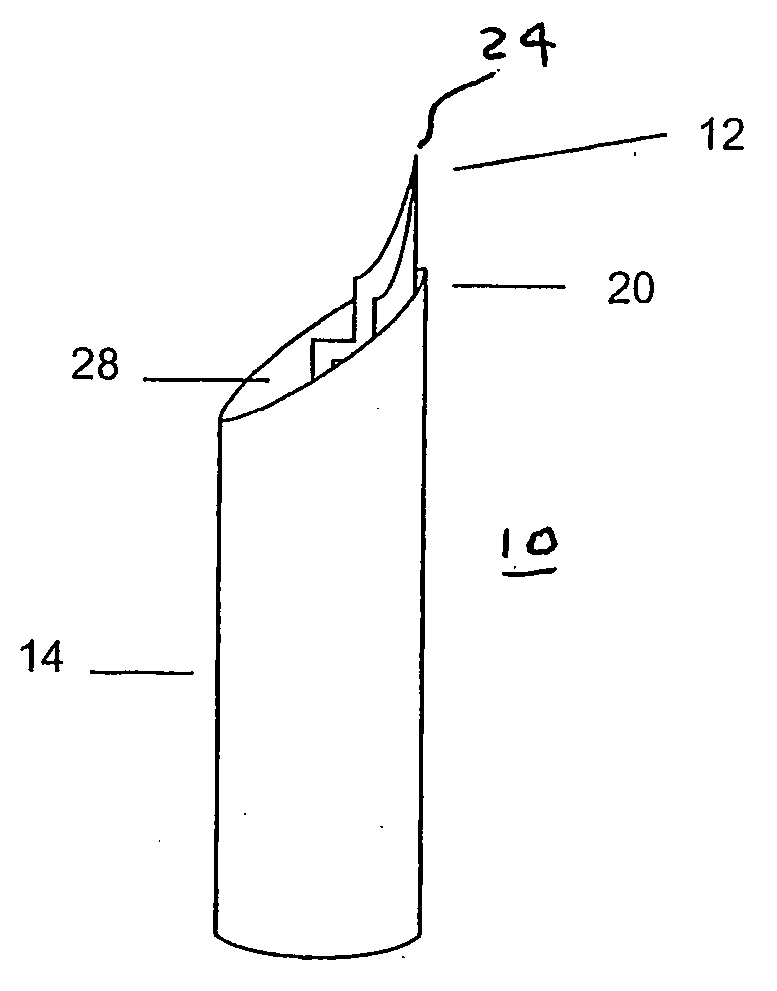
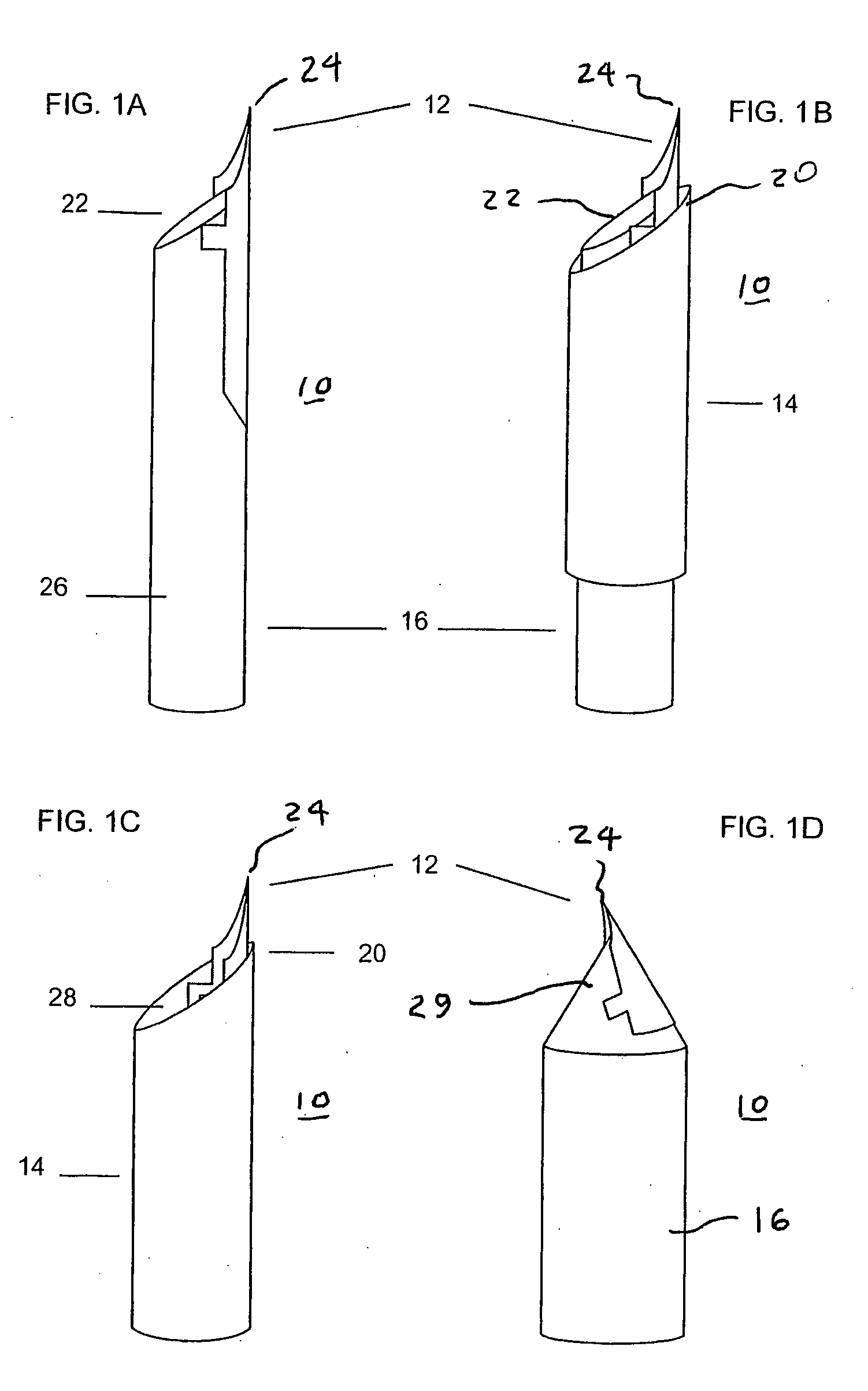
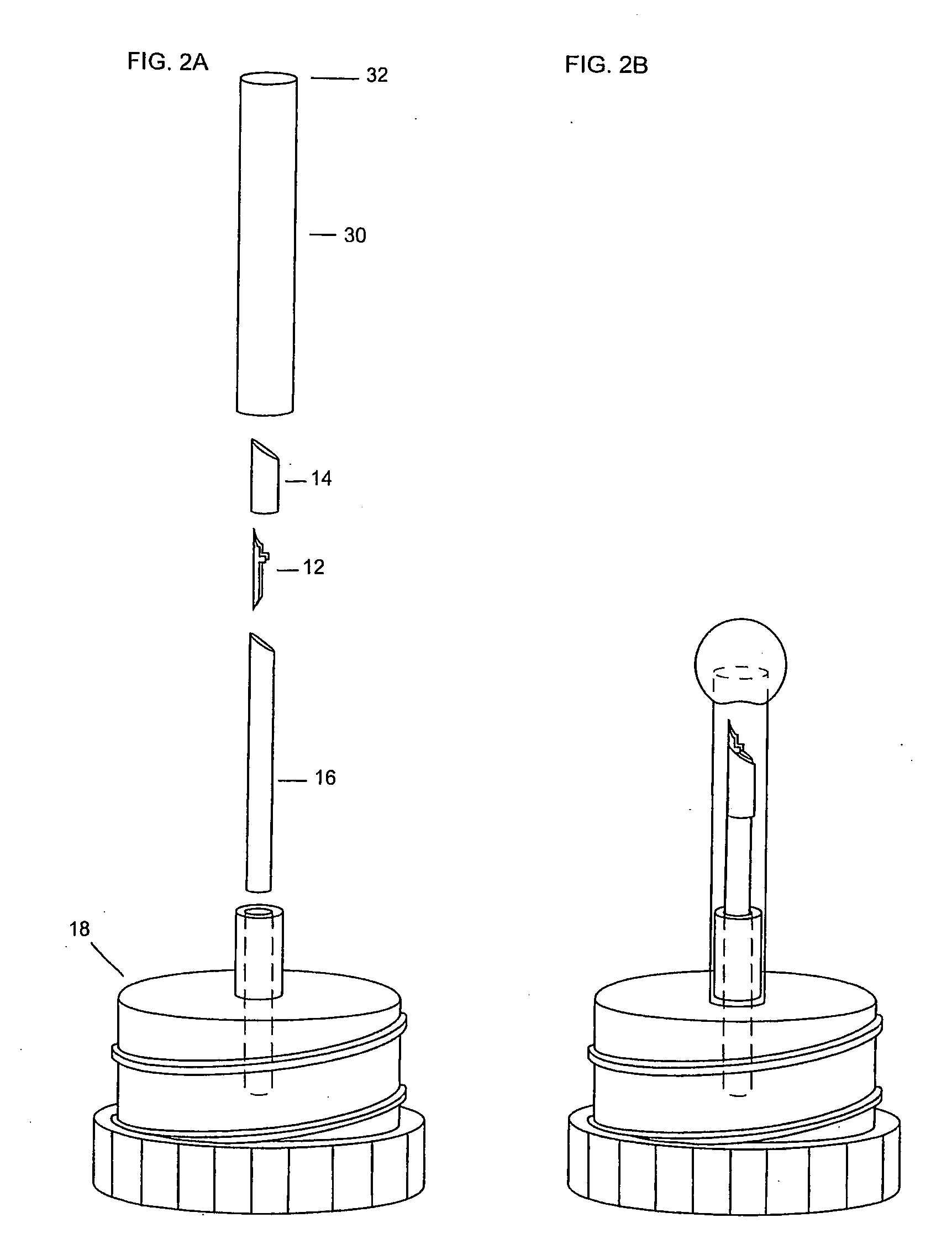
crystallography application. In cryocrystallography applications, where capillary tubes are not employed, the polyimide film is preferably mounted either to an external curved surface of a rod or pin, the internal curved surface of a hollow rod or sleeve, or between both a sleeve and a rod. In these embodiments, the rod and / or hollow sleeve preferably have beveled top ends to maximize the viewing angle of the sample position so that one can see crystals and any crystal aperture when the rod, sleeve and
mount are angled relative to the horizontal. Alternatively, the film can be attached to a rod having a conical end such that the plastic mount is tilted relative to the rod, so that it is easier to scrape a crystal off a flat surface and the crystal is located on axis, which makes alignment even easier.
[0022]
Polyimide is a good choice for the
film material because of its excellent mechanical properties; because it has a
low density and is composed of low
atomic number elements so that it scatters X-rays very weakly; and because its gold
hue provides good
optical contrast with macromolecular crystals. The polyimide films are microfabricated to have a tapered tip end for holding a crystal to be examined. This tapering minimizes the volume of the film in the X-ray beam (whose size is usually matched to or smaller than the crystal size) when the plane of the film is oriented parallel to the beam. Preferably, a first sample aperture is disposed at the tip end for reception of the crystal, though the aperture is not essential. This aperture allows the crystal to be precisely located, and further minimizes the volume of the film in the X-ray beam and thus the background scatter from the film. For mounts intended for cryocrystallography of macromolecular or
virus crystals grown in solution, a small channel is preferably disposed in the film that connects the sample aperture to a larger aperture which facilitates wicking of any excess fluid from the sample aperture with little risk of touching the crystal. The
large aperture also reduces the total area of polyimide and thus reduces the fluid resistance and flow disturbances caused as the mount is moved through a crystal-containing drop. The channel and
large aperture are not necessary for “dry” crystals of inorganic or small-molecule organic materials where excess fluid is not an issue.
[0023] The film preferably has a small
fixed width (5-100 μm, depending on the size of the crystals to be examined) surrounding the sample aperture that reduces scattering from the polyimide film (and any adsorbed fluid) when the plane of the film is oriented parallel to the X-ray beam. An overall triangular shape of a top portion of the film that is intended to extend beyond the rod or sleeve to which it is attached, together with a tapered or beveled shape of the rod or sleeve, provides a good aerodynamic profile that minimizes sample “
flutter” in a
gas cooling stream (relevant for lowest mosaicity crystals).
[0024] The present invention thus provides an alternative to conventional loops that retains all of their advantages (including complete compatibility with existing and developing technologies for high-
throughput crystallography), but that resolves most if not all of the problems in mounting smaller crystals. Their potential advantages include completely reproducible sample “loop” sizes down to 3 micrometers or even smaller if thinner, shorter films with larger curvature are used, accurate and reproducible sample positioning, good sample-mount contrast, easier removal of excess liquid, minimal
thermal mass and more rapid flash cooling; reduced background scattering, and easy design customization and
mass production. In addition, the color, rigidity and reproducibility of the mounts should make it feasible to retrieve crystals using robots, with large savings in labor. In contrast, the use of loop type mounts requires that all crystals be retrieved by hand from
crystallization drops, because loops are floppy and have little contrast with drop solutions.


 Login to View More