Unlock instant, AI-driven research and patent intelligence for your innovation.

Illumination system for a microlithographic projection exposure apparatus

a technology of exposure apparatus and illumination system, which is applied in the direction of microlithography exposure apparatus, printers, instruments, etc., can solve the problem that the geometrical optical flux cannot be changed by conventional refractive optical elements such as lenses, and achieve the effect of increasing flexibility

Inactive Publication Date: 2007-02-01
CARL ZEISS SMT GMBH
View PDF12 Cites 27 Cited by
  • Summary
  • Abstract
  • Description
  • Claims
  • Application Information

AI Technical Summary

Benefits of technology

[0012] It is an object of the present invention to provide an illumination system having increased flexibility with respect to the setting of various illumination parameters and particularly of the angular distribution of the projection light bundle.
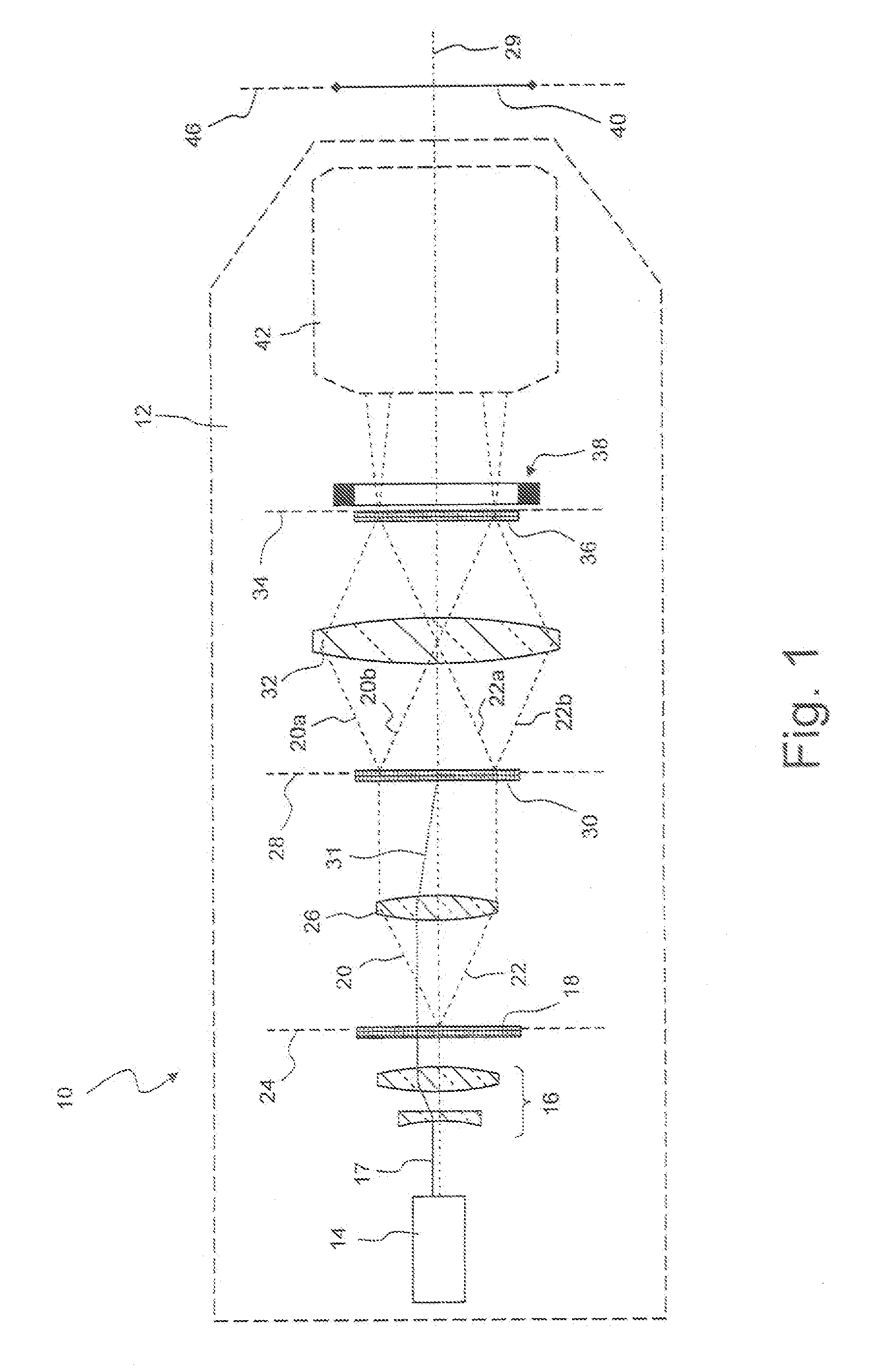
[0014] The third optical raster element is thus positioned in a field plane of the illumination system and introduces a new degree of design freedom for the modification of the angular distribution of the projection light bundle. Further, since there are three optical raster elements, the geometrical optical flux is increased in three steps instead of only two steps. This considerably simplifies the design of all optical elements that are located, if viewed along the optical axis, in front of the third optical raster element.
[0016] Since the resulting angular distribution of the light bundle that impinges on the reticle may be described as a convolution of the intensity distributions generated by the first and the third optical raster elements in pupil planes, the angular distribution may be improved in many respects. For example, since most optical raster elements illuminate, due to their raster structure, the pupil plane not uniformly but only in the form of separated segments, a third optical raster element in the form of a frosted glass plate or a similar scattering plate can smooth the transitions between contiguous illuminated segments in the pupil plane.
[0020] In a preferred embodiment a holder is provided for interchangeably holding the first and / or the third optical raster element. This allows to easily interchange raster elements and therefore to modify the angular distribution of the projection light bundle.
[0026] In a preferred embodiment the polarization manipulator is positioned immediately in front of the third optical raster element. This has the advantage that the projection light has the desired polarization state before it enters the third optical raster element. Thus it is possible to adapt the polarization state generated by the polarization manipulator to the specific properties of the optical raster element. For example, if the third optical raster element is a linear diffraction grating, the polarization state can be manipulated such that the projection light passing through the polarization manipulator is linearly polarized along the longitudinal direction of the grooves. This, in turn, results in a tangential polarization of the projection light bundle. Tangential polarization has been found to be particularly advantageous because it results in improved contrast on the photoresist.
[0027] If the polarization state of the projection light impinging on the polarization manipulator is linear, the polarization manipulator may be realized as a polarization rotation device such as a waveplate that rotates the direction of polarization as desired. This has the advantage that no light is lost in the polarization manipulator. If the projection light is fully or partially unpolarized, the polarization manipulator may be realized as a linear polarizer.

Problems solved by technology

Since the geometrical optical flux is not altered when a light bundle traverses an interface between media having different refractive indices, the geometrical optical flux cannot be changed by conventional refractive optical elements such as lenses.

Method used

the structure of the environmentally friendly knitted fabric provided by the present invention; figure 2 Flow chart of the yarn wrapping machine for environmentally friendly knitted fabrics and storage devices; image 3 Is the parameter map of the yarn covering machine
View more

Image

Smart Image Click on the blue labels to locate them in the text.
Viewing Examples
Smart Image
  • Illumination system for a microlithographic projection exposure apparatus
  • Illumination system for a microlithographic projection exposure apparatus
  • Illumination system for a microlithographic projection exposure apparatus

Examples

Experimental program
Comparison scheme
Effect test

Embodiment Construction

[0040]FIG. 1 shows a meridional section of an illumination system according to the present invention that is to be used in a projection exposure apparatus. For the sake of clarity, the illustration shown in FIG. 1 is considerably simplified and not to scale. The illumination system, which is denoted in its entirety by 10, comprises a light source that is, in the embodiment shown, realized as an excimer laser 14. The excimer laser 14 emits projection light that has a wavelength in the deep ultraviolet (DUV) spectral range. The projection light emerging from the exit facet of the laser 14 forms a coherent light bundle having a small cross section and a low divergence. Thus the geometrical optical flux of the light bundle as emitted by the laser 14 is small.

[0041] The light bundle then enters a beam expansion unit 16 in which the light bundle is expanded. In FIG. 1 this expansion is represented by a ray 17 of the light bundle. Since the ray 18 is diverted at refractive interfaces, the...

the structure of the environmentally friendly knitted fabric provided by the present invention; figure 2 Flow chart of the yarn wrapping machine for environmentally friendly knitted fabrics and storage devices; image 3 Is the parameter map of the yarn covering machine
Login to View More

PUM

No PUM Login to View More

Abstract

An Illumination system for a microlithographic projection exposure apparatus has a light source and a first optical raster element that is positioned in or in close proximity to a first plane. The first plane is conjugated to a pupil plane of the illumination system by Fourier transformation. A second optical raster element is positioned in or in close proximity to the pupil plane. A third optical raster element is positioned in or in close proximity to a second plane that is also conjugated to the pupil plane by Fourier transformation. The third optical raster element, which can be a diffractive optical element, introduces an additional degree of design freedom for the modification of the angular distribution of the projection light bundle.

Description

CROSS-REFERENCE TO RELATED APPLICATIONS [0001] This is a continuation of International Patent Application PCT / EP2004 / 001129, which was filed on Feb. 7, 2004. The full disclosure of this earlier application is incorporated herein by reference.BACKGROUND OF THE INVENTION [0002] 1. Field of the Invention [0003] The invention relates generally to illumination systems for microlithographic projection exposure apparatus. More particularly, the invention relates to illumination systems comprising diffractive or other raster optical elements for manipulating the angular distribution of projection light produced by the illumination system. [0004] 2. Description of Related Art [0005] Microlithography (also called photolithography) is a technology for the fabrication of integrated circuits, liquid crystal displays and other microstructured devices. More particularly, the process of microlithography, in conjunction with the process of etching, is used to pattern features in thin film stacks tha...

Claims

the structure of the environmentally friendly knitted fabric provided by the present invention; figure 2 Flow chart of the yarn wrapping machine for environmentally friendly knitted fabrics and storage devices; image 3 Is the parameter map of the yarn covering machine
Login to View More

Application Information

Patent Timeline
no application Login to View More
IPC IPC(8): G03B27/54G03F7/20
CPCG03F7/70158G03F7/70108
Inventor SINGER, WOLFGANGWANGLER, JOHANNES
Owner CARL ZEISS SMT GMBH