

Process for producing indolopyrrolocarbazole derivative
a technology of indolopyrrolacarbazole and derivative, which is applied in the field of pharmaceuticals, can solve the problems of high cost of waste treatment, unfavorable influence of compound and compound, and high construction fees and running costs of the room, so as to improve the yield and purity of compound (iv) or a salt thereof, and improve the efficiency of industrial production.
- Summary
- Abstract
- Description
- Claims
- Application Information
AI Technical Summary
Benefits of technology
Problems solved by technology
Method used
Image

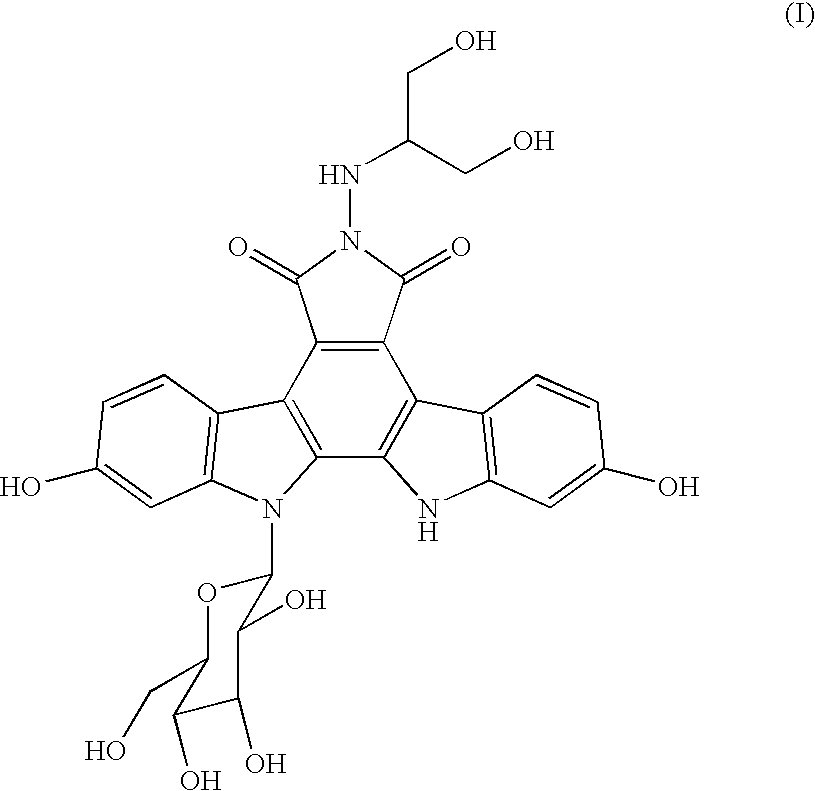
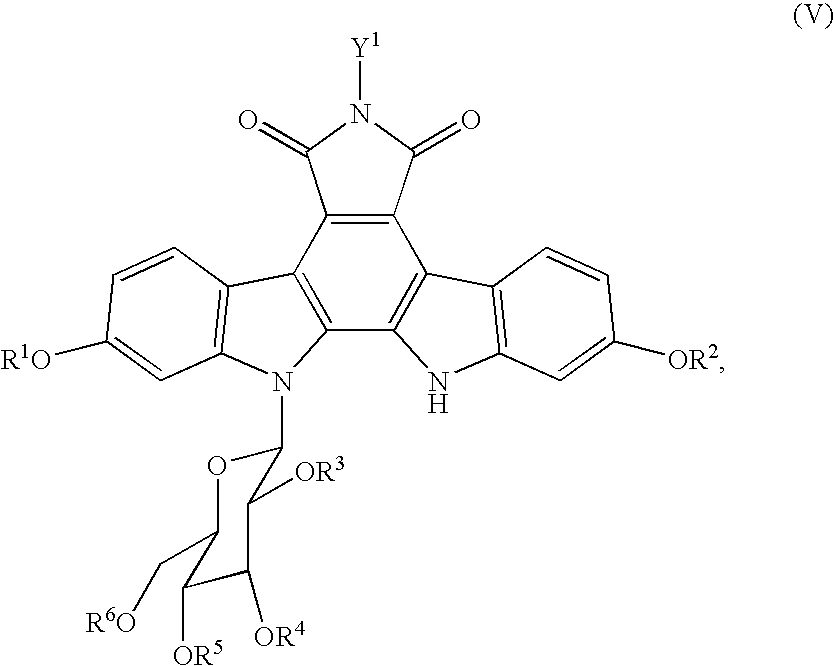
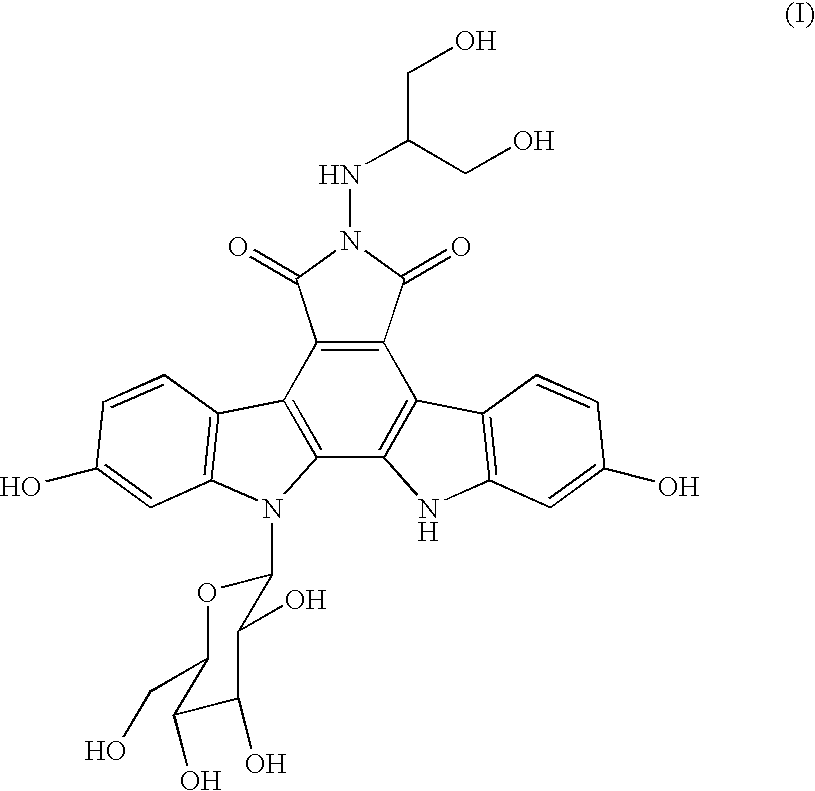
Examples
example 1
[0087] Production of 12,13-dihydro-2,10-dibenzyloxy-13-(β-D-2,3,4,6-tetra-O-benzylglucopyranosyl)-5H-indolo[2,3-a]pyrrolo[3,4-c]carbazole-6-methyl-5,7(6H)-dione 0.4 t-butyl methyl etherate
[0088] In the above reaction equation, Bn is a benzyl group.
[0089] t-butyl methyl ether (61 mL) and the compound (1) (10.2 g, 18.5 mmol, 1 equivalent) were placed in a 1L three-neck flask equipped with a mechanical stirrer, a thermometer and a N2 introducing tube. The inner wall of the flask was washed using t-butyl methyl ether (31 mL). This suspension was stirred at 20 to 25° C for 10 minutes, and a solution of 1-chloro-2,3,4,6-O-tetrabenzyl-D-glucopyranose in t-butyl methyl ether (prepared according to the disclosure of WO 02 / 36601)(70 mL) was added. T-butyl methyl ether (14 mL) was used to wash the flask for transferring the solution. This mixture (yellow suspension) was stirred at room temperature for 30 minutes, and a 48% by weight aqueous KOH solution (75 g (containing 36 g as potassium h...
example 2
Preparation of 12,13-dihydro-2,10-dibenzyloxy-13-(β-D-2,3,4,6-tetra-O-benzylglucopyranosyl)-5H-indolo[2,3-a]carbazole-5,6-dicarboxylic acid anhydride
[0100]
[0101] A stirrer and a thermometer were set on a 50 L-flask, and a 48% by weight aqueous potassium hydroxide solution (2.7 L) was placed therein. 12,13-dihydro-2,10-dibenzyloxy-13-(β-D-2,3,4,6-tetra-O-benzylglucopyranosyl)-5H-indolo[2,3-a]pyrrolo[3,4-c]carbazole-6-methyl-5,7(6H) -dione-0.4t-butyl methyl etherate (1.5 kg, 1.35 mol) obtained in Example 1 was placed therein while stirring, and subsequently toluene (5.4 L) was placed therein, and the mixture was stirred at room temperature for 30 minutes. Ethanol (13.5 L) was added dropwise to the mixture at the same temperature over 30 minutes, and the solution was stirred at room temperature overnight. The resulting red brown solution was cooled to −5° C. or lower, a 10% by weight aqueous citric acid solution (29 L) was added dropwise over 30 minutes to pH 6.3, and the mixture was ...
example 3
Preparation of 12,13-dihydro-2,10-dibenzyloxy-6-N-(1 - benzyloxymethyl-2-benzyloxyethylamino)- 13-(β-D-2,3,4,6-tetra-O-benzylglucopyranosyl)-5H-indolo[2,3-a]pyrrolo[3,4-c]carbazole-5,7(6H)-dione
[0119]
[0120] A mixture of 12,13-dihydro-2,10-dibenzyloxy-13-(β-D-2,3,4,6-tetra-O-benzylglucopyranosyl)-5H-indolo[2,3-a]carbazole-5,6-dicarboxylic acid anhydride (1.00 g, 0.94 mmol) obtained in Example 2, N-(1-benzyloxymethyl-2-benzyloxyethyl)hydrazine 1 / 2 oxalate (398 mg, 1.20 mmol) and N,N-dimethylacetamide (9.2 mL) was degassed, and heated to 62° C. after replacement with nitrogen. To this solution was added dropwise triethylamine (0.17 mL, 1.20 mmol), and the solution was stirred at this temperature for 3 hours. The reaction solution was cooled to room temperature, and t-butyl methyl ether (20 mL) and water (4.7 mL) were added thereto. Using IN hydrochloric acid, the pH of the aqueous layer was adjusted to 4, and the solution was stirred for 20 minutes. The organic layer was separated, wa...
PUM
| Property | Measurement | Unit |
|---|---|---|
| temperature | aaaaa | aaaaa |
| temperature | aaaaa | aaaaa |
| pH | aaaaa | aaaaa |
Abstract
Description
Claims
Application Information
 Login to View More