Sensor, sensing apparatus and sensing method

a sensing apparatus and sensor technology, applied in the field of sensors, can solve the problems of reducing the accuracy of initial detection of fluorescence, affecting the detection accuracy of fluorescence, and affecting the detection accuracy of original detection of fluorescence, so as to increase the power of measurement light, increase the probability of transition, and enhance the effect of localized plasmon enhancemen

US20080137063A1Inactive Publication Date: 2008-06-12FUJIFILM CORP
3 Cites 6 Cited by

Patent Information

Authority / Receiving Office
US · United States
Current Assignee / Owner
Publication Date
2008-06-12
Estimated Expiration
Not applicable · inactive patent

Smart Images

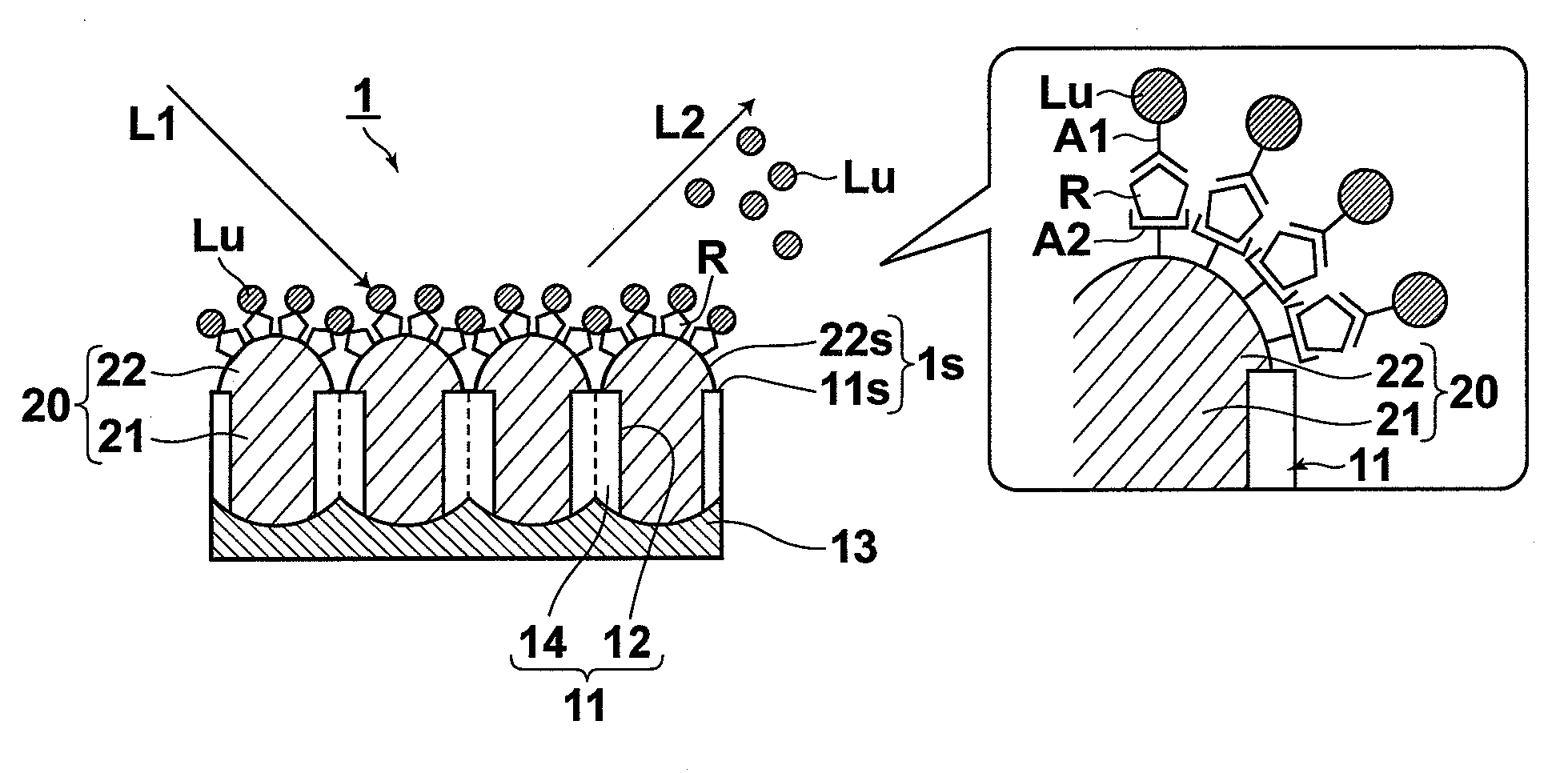
  • Figure 1
    Figure 1
  • Figure 2
    Figure 2
  • Figure 3
    Figure 3
Patent Text Reader

Abstract

A sensor has a sensing surface, to which a specific substance R to be detected can bind. Further, the sensor has a metal portion, at least a portion of which is exposed at the sensing surface, and in which localized plasmons can be excited. The sensor is used in sensing, in which the substance R to be detected is marked with a fluorescent marker Lu that selectively binds to the substance R to be detected and one of two-photon excitation fluorescence and multi-photon excitation fluorescence of the fluorescent marker Lu is detected. Further, the sensing surface is illuminated with measurement light L1 having a wavelength that can excite localized plasmons in the metal portion and that is an absorption wavelength of the fluorescent marker Lu, at which the fluorescent marker Lu emits one of the two-photon excitation fluorescence and the multi-photon excitation fluorescence.
Need to check novelty before this filing date? Find Prior Art

Description

BACKGROUND OF THE INVENTION

[0001] 1. Field of the Invention

[0002] The present invention relates to a sensor that is used in sensing, in which a substance to be detected is marked with a fluorescent marker that selectively binds to the substance to be detected and one of two-photon excitation fluorescence and multi-photon excitation fluorescence of the fluorescent marker is detected. The present invention also relates to a sensing apparatus and a sensing method using the sensor.

[0003] 2. Description of the Related Art

[0004] In recent years, fluorescence measurement methods have been proposed in fluorescent analysis that is performed in immunity measurement and the like in the field of biochemistry. In the fluorescence measurement methods, a sensor having a sensing surface, to which a specific substance to be detected can bind, is used. In the methods, a fluorescent marker that has bound to the substance to be detected is excited by evanescent waves or surface plasmons and the substance t...

Examples

Embodiment Construction

“Sensor”

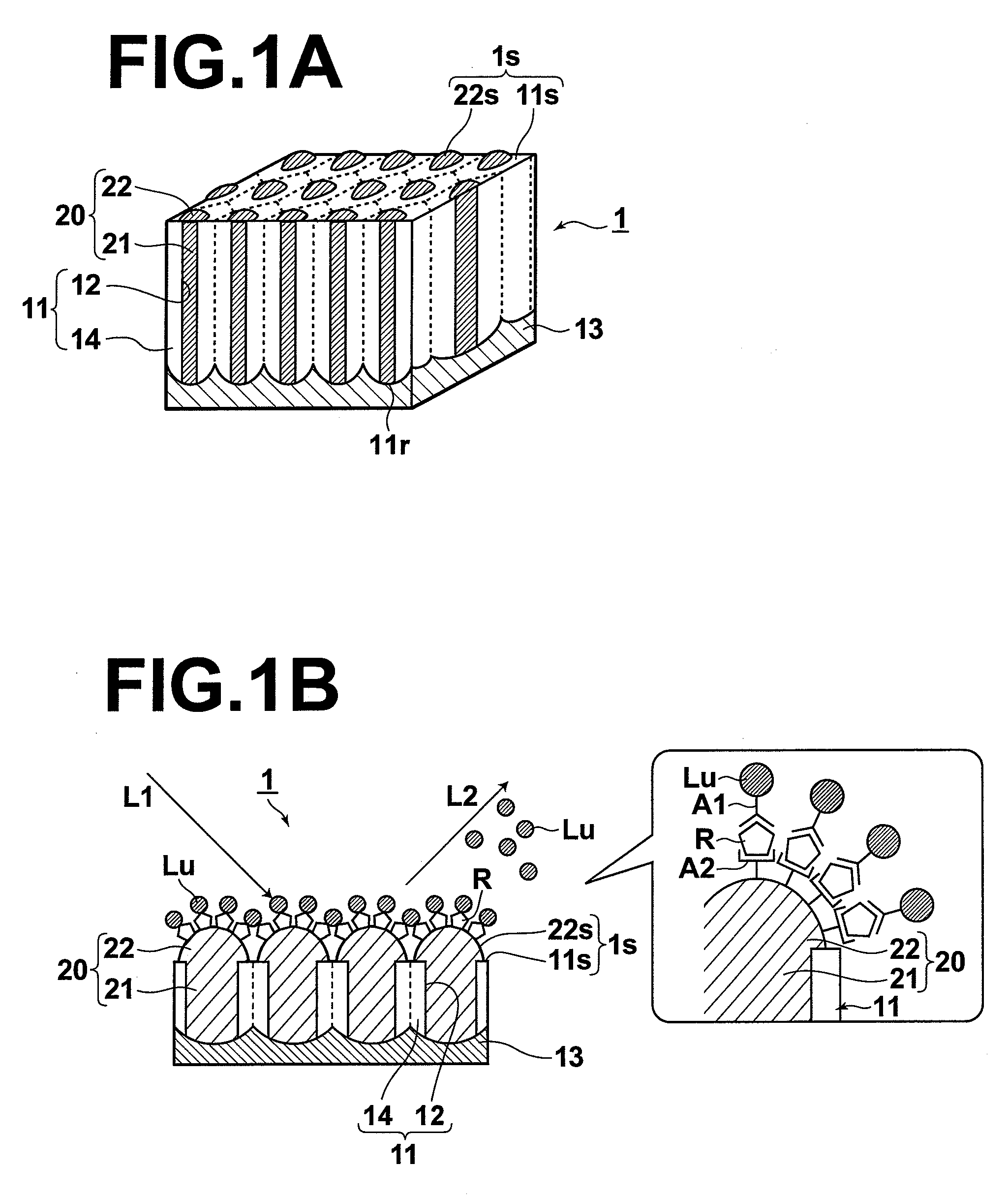
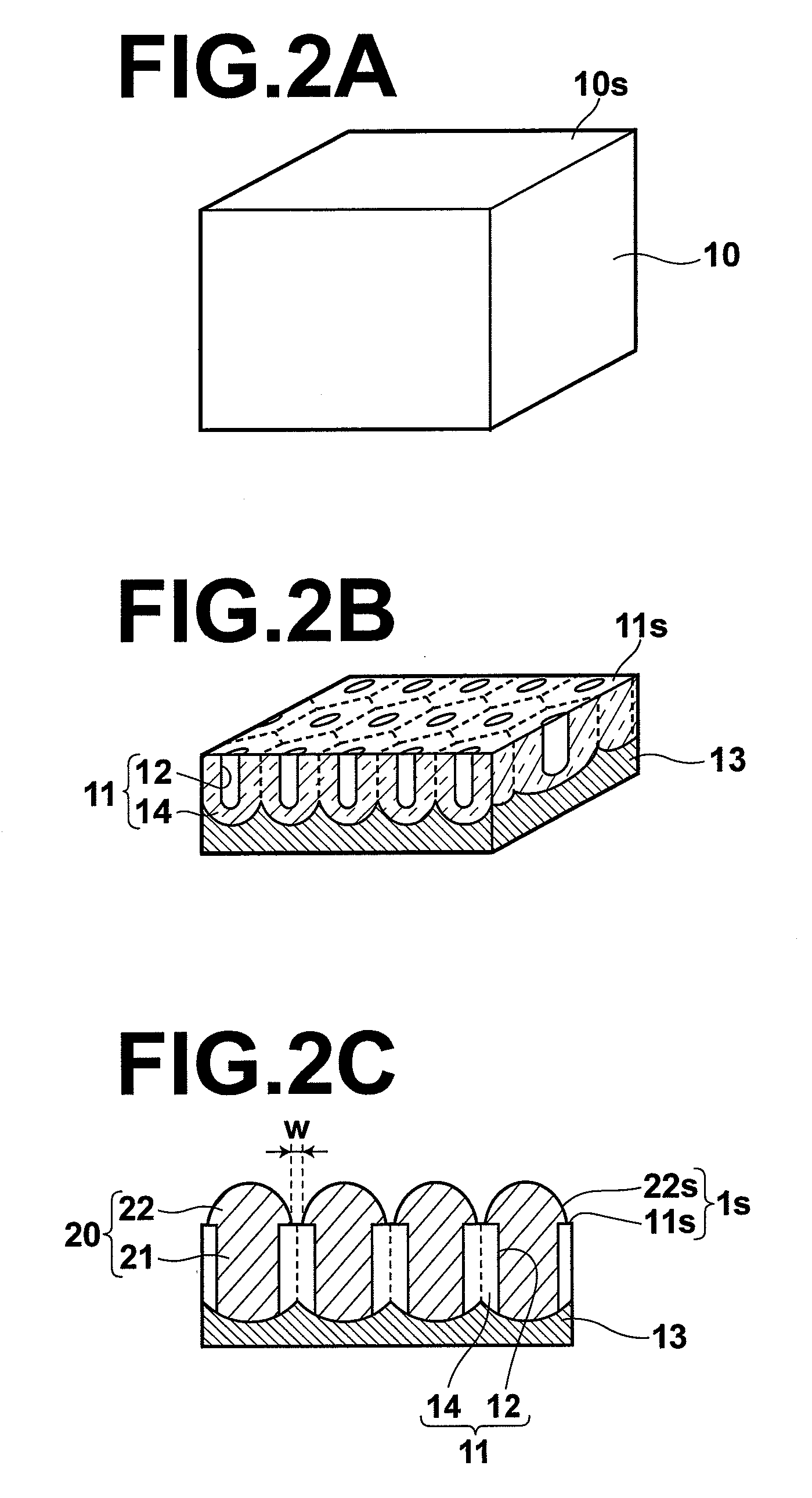
[0053]The structure of a sensor according to an embodiment of the present invention will be described with reference to the attached drawings. FIG. 1A is a perspective view showing the whole structure of the sensor. FIG. 1B is a cross-sectional view of the sensor in the thickness direction of the sensor during sensing. Further, FIG. 1B includes a schematic diagram illustrating a binding state at a sensing surface during sensing. FIGS. 2A through 2C are diagrams illustrating the process of producing the sensor according to the present embodiment.

[0054]A sensor 1 according to the present embodiment is used in sensing, in which a substance R to be detected is marked with a fluorescent marker Lu that selectively binds to the substance R to be detected and one of two-photon excitation fluorescence and multi-photon excitation fluorescence of the fluorescent marker Lu is detected. The sensor 1 includes a sensing surface 1s, to which only the substance R to be detected can bind.

[005...