
Compounds Having Activity in Correcting Mutant-Cftr Processing and Uses Thereof
a technology of compound and mutant, applied in the field of compound having activity in correcting mutantcftr processing, can solve the problems of not offering clinically useful therapies, and progressive deterioration of lung function
- Summary
- Abstract
- Description
- Claims
- Application Information
AI Technical Summary
Benefits of technology
Problems solved by technology
Method used
Image

Examples
example 1
Discovery and Characterization of ΔF508-CFTR Correctors
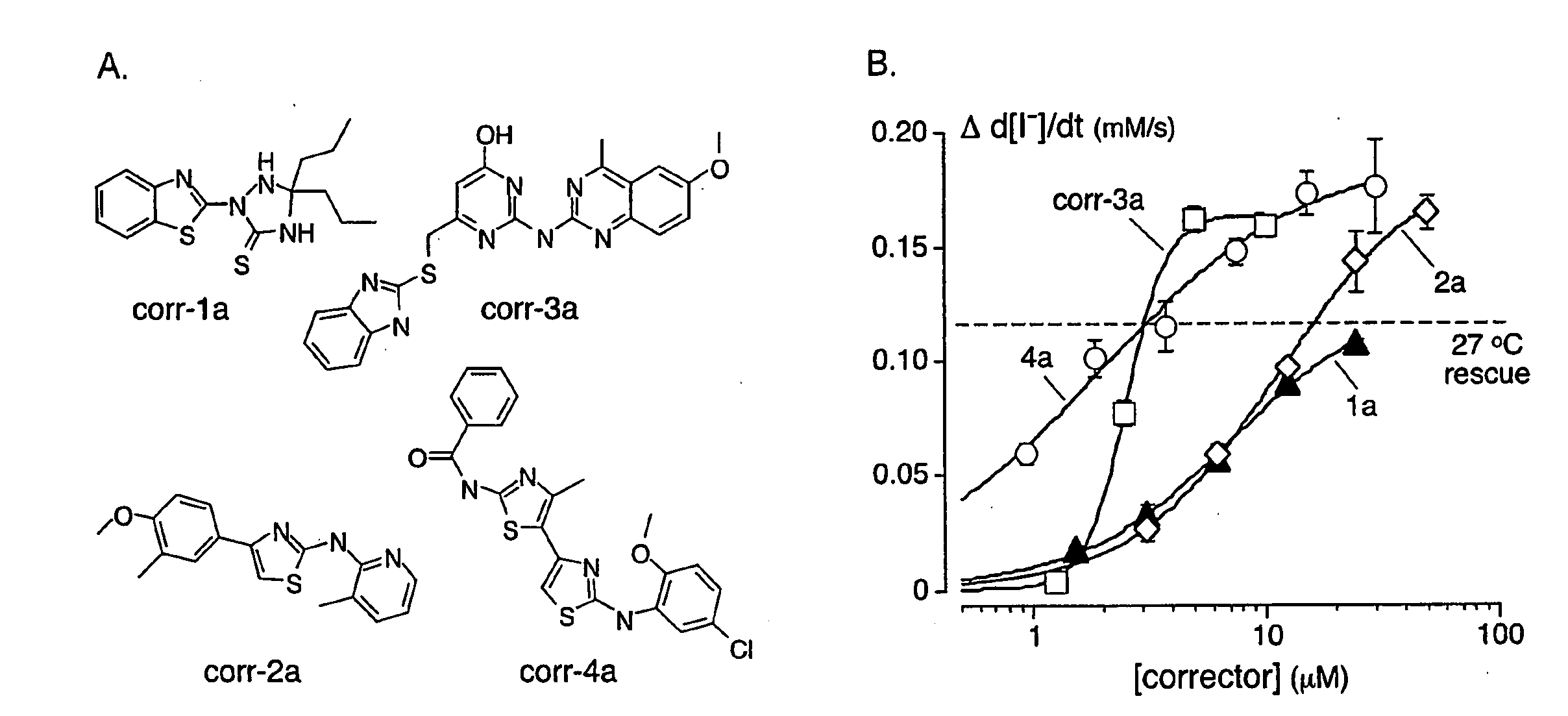
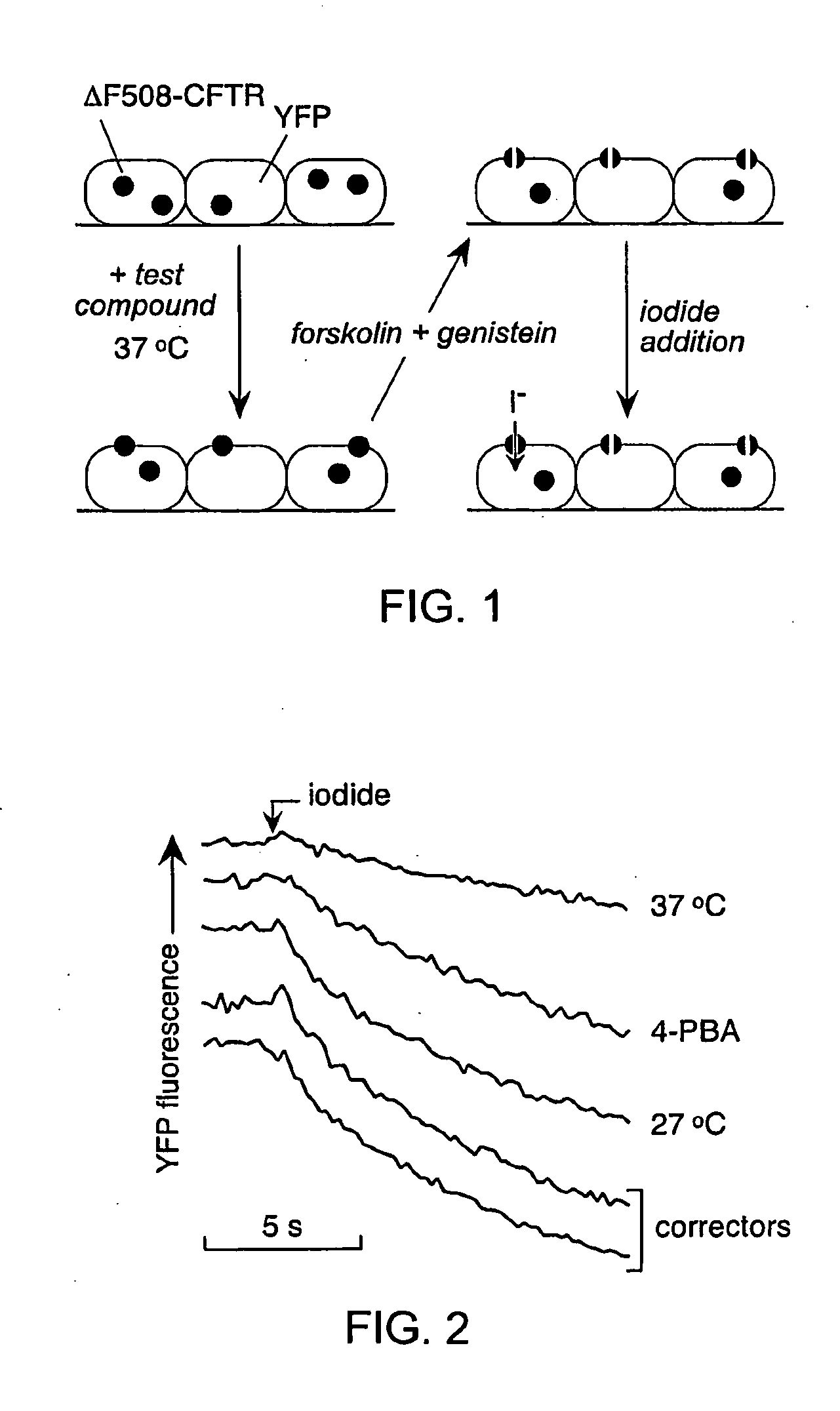
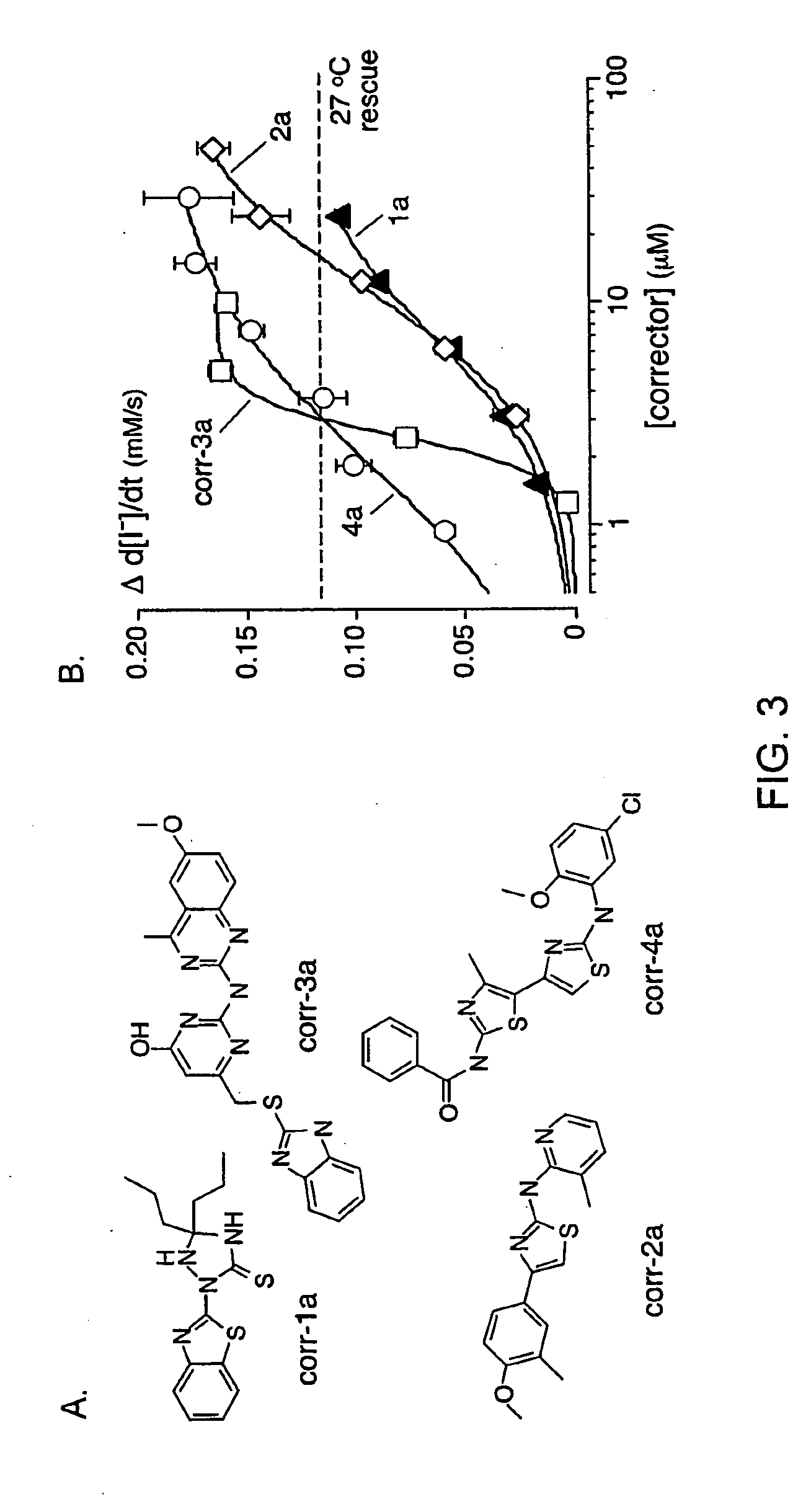
[0183]As depicted in FIG. 1, FRT cells coexpressing ΔF508-CFTR and a fluorescent YFP halide sensor were incubated with test compounds (10 μM) for 18-24 hours at 37° C. in a 96-well format. ΔF508-CFTR mediated iodide influx was then assayed after compound washout and addition of the potentiators forskolin and genistein. Primary screening of 150,000 compounds produced 45 compounds that increased iodide influx (Δd[T] / dt) by >0.10 μmM / s, and 15 compounds increasing iodide influx by >0.20 mM / s. Examples of original data from individual wells are shown in FIG. 2. The negative control was vehicle (DMSO) alone (labelled ‘37° C.’), and the positive controls were 4-phenylbutyrate (4-PBA) and reduced temperature (27° C.) incubation rescue. Examples of two active compounds are shown.
[0184]Active compounds were retested, and ΔF508-CFTR specificity was verified by inhibition of the increased iodide influx by CFTRinh-172, and lack of corrector...
example 2
Mechanistic Analysis of ΔF508-CFTR Correctors
[0190]To provide biochemical evidence for the biosynthetic processing of ΔF508-CFTR in the presence of correctors, the accumulation of mature, complex-glycosylated ΔF508-CFTR-CtHA was monitored by immunoblot analysis in baby hamster kidney (BHK) cells. Incubation of cells with correctors for 16-24 hours at 37° C. resulted in the accumulation of complex-glycosylated ΔF508-CFTR (FIG. 10, panel A). This was evidenced by the slower electrophoretic mobility (apparent M.W. ˜170 kDa) of the complex-glycosylated ΔF508-CFTR immunoreactive band, compared to its core-glycosylated counterpart (apparent M.W. ˜150 kDa), the predominant form in non-treated cells. Similar results were obtained in ΔF508-CFTR expressing FRT cells. The accumulation of the complex-glycosylated ΔF508-CFTR in corrector-treated cells was comparable to that produced by low temperature incubation without correctors (FIG. 10, panel B). The corrector compounds did not produce an ER...
example 3
ΔF508-Correction in Human Airway Epithelium
[0194]The corrector compounds were also tested on differentiated primary cultures of human airway epithelial cells from ΔF508-CFTR homozygous subjects. Cells polarized on permeable supports were mounted in Ussing chambers for measurement of chloride secretion by short-circuit current analysis. After blocking Na+ current with amiloride, cells treated with DMSO vehicle alone showed little response to forskolin, genistein, or CFTRinh-172 (FIG. 13). Incubation at 27° C. for 24 hours resulted in the appearance of significant chloride current as seen by the increased current after forskolin and genistein, and the inhibition by CFTRinh-172. The results show that incubation with the compound corr-4a at 37° C. for 24 hours increased chloride current comparably. For comparison, data for non-CF bronchial epithelial cells are shown (FIG. 13, bottom panel). FIG. 14, panel A, summarizes the changes in short-circuit current produced by CFTRinh-172 inhibit...
PUM
| Property | Measurement | Unit |
|---|---|---|
| temperature | aaaaa | aaaaa |
| w/w | aaaaa | aaaaa |
| median diameter | aaaaa | aaaaa |
Abstract
Description
Claims
Application Information
 Login to View More