Check patentability & draft patents in minutes with Patsnap Eureka AI!

Porous monodispersed particles and method for production thereof, and use thereof

Inactive Publication Date: 2009-02-05
SOKEN CHEM & ENG CO LTD
View PDF3 Cites 10 Cited by
  • Summary
  • Abstract
  • Description
  • Claims
  • Application Information

AI Technical Summary

Benefits of technology

[0021]The porous monodispersed particles according to the invention are not only spherical and porous, but also have a narrow particle-size distribution and are monodispersed.
[0022]Therefore, the porous monodispersed particles are usable as a carrier that can incorporate a variety of pigments, pharmaceutical agents, and the like, and are also suitable for use as various types of adsorbents, columns, and the like, because of their porosity.
[0023]Moreover, the colored monodispersed particles according to the invention are monodispersed and spherical, while containing a large amount of pigment.
[0024]The colored monodispersed particles are thus usable as a display element of electronic paper, a spacer for liquid crystal display panels, a toner for printers, a cosmetic product, and the like.

Problems solved by technology

Known porous particles with a particle diameter in the order of micrometers, however, have low porosity and a wide particle-size distribution and are not monodispersed, and therefore have not been practical.
Moreover, colored resin particles produced by staining resin particles with a dye have problems of poor color developing stability and the like.
The colored resin particles obtained by these methods, however, had a wide particle-size distribution, and were not monodispersed.
The pigment, however, was not easily agglomerated in the porous particles obtained by this method, and the amount of pigment contained therein was small.

Method used

the structure of the environmentally friendly knitted fabric provided by the present invention; figure 2 Flow chart of the yarn wrapping machine for environmentally friendly knitted fabrics and storage devices; image 3 Is the parameter map of the yarn covering machine
View more

Image

Smart Image Click on the blue labels to locate them in the text.
Viewing Examples
Smart Image
  • Porous monodispersed particles and method for production thereof, and use thereof
  • Porous monodispersed particles and method for production thereof, and use thereof
  • Porous monodispersed particles and method for production thereof, and use thereof

Examples

Experimental program
Comparison scheme
Effect test

preparation example 1

Preparation of Seed Particles A

First Step

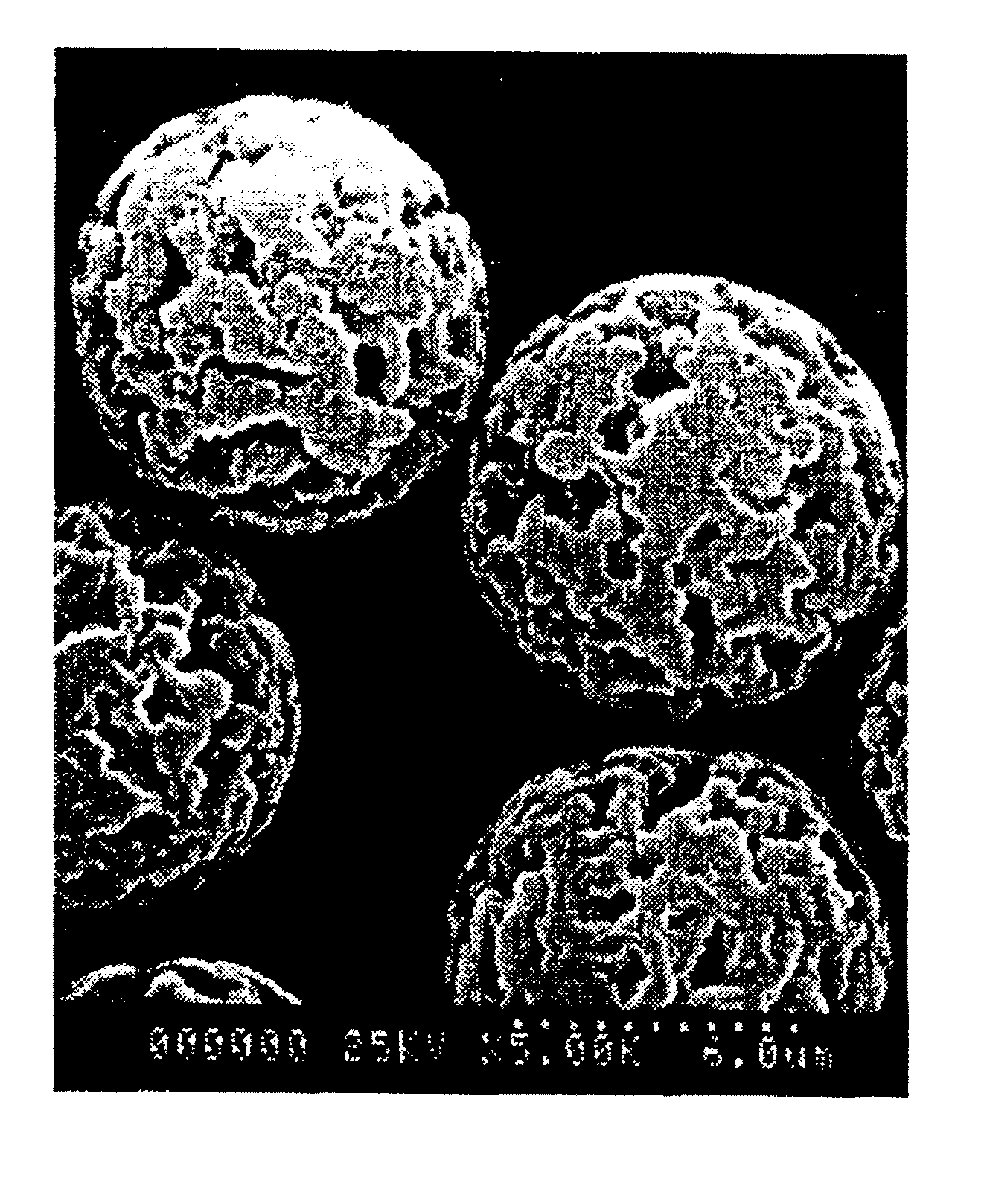
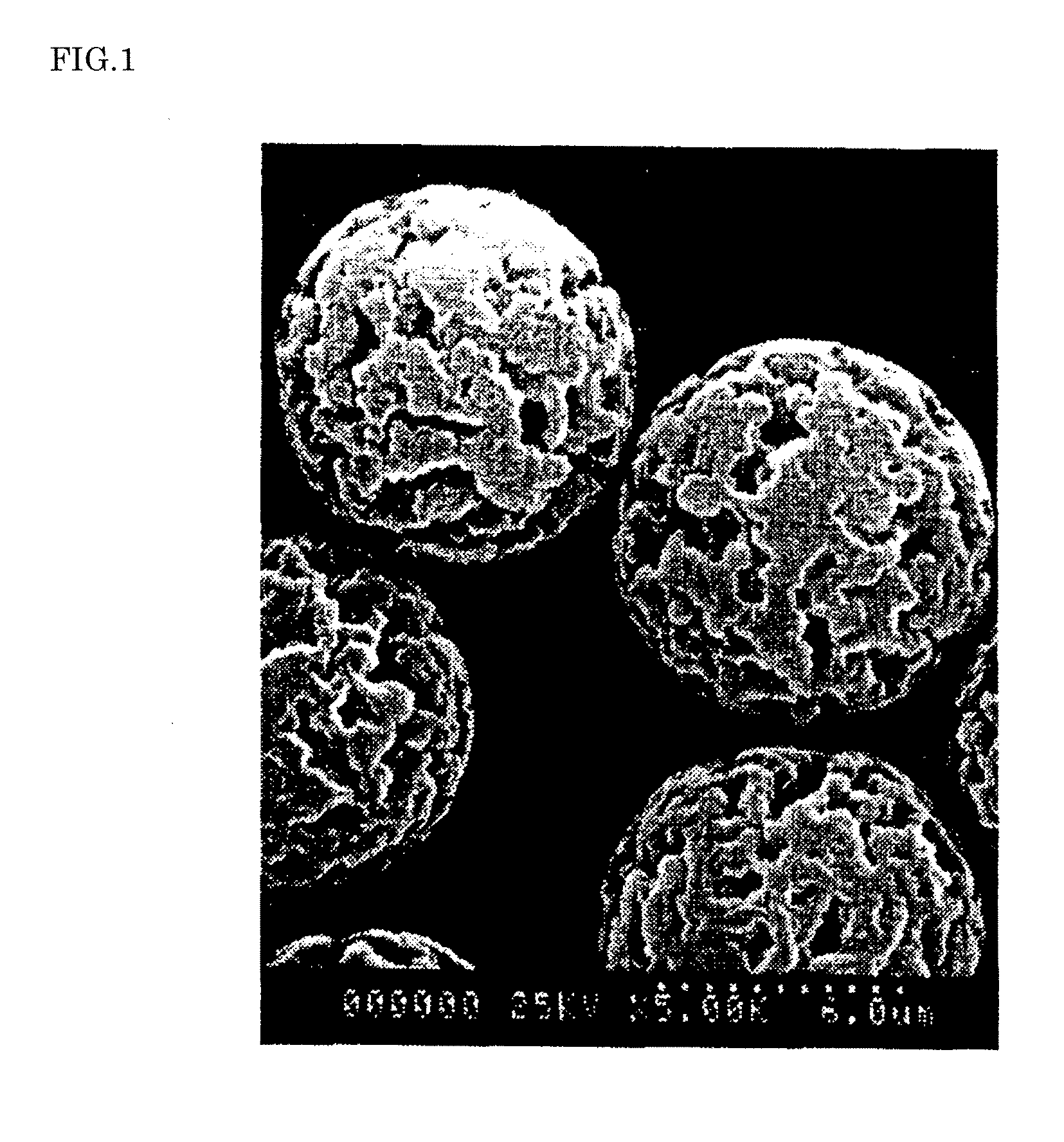
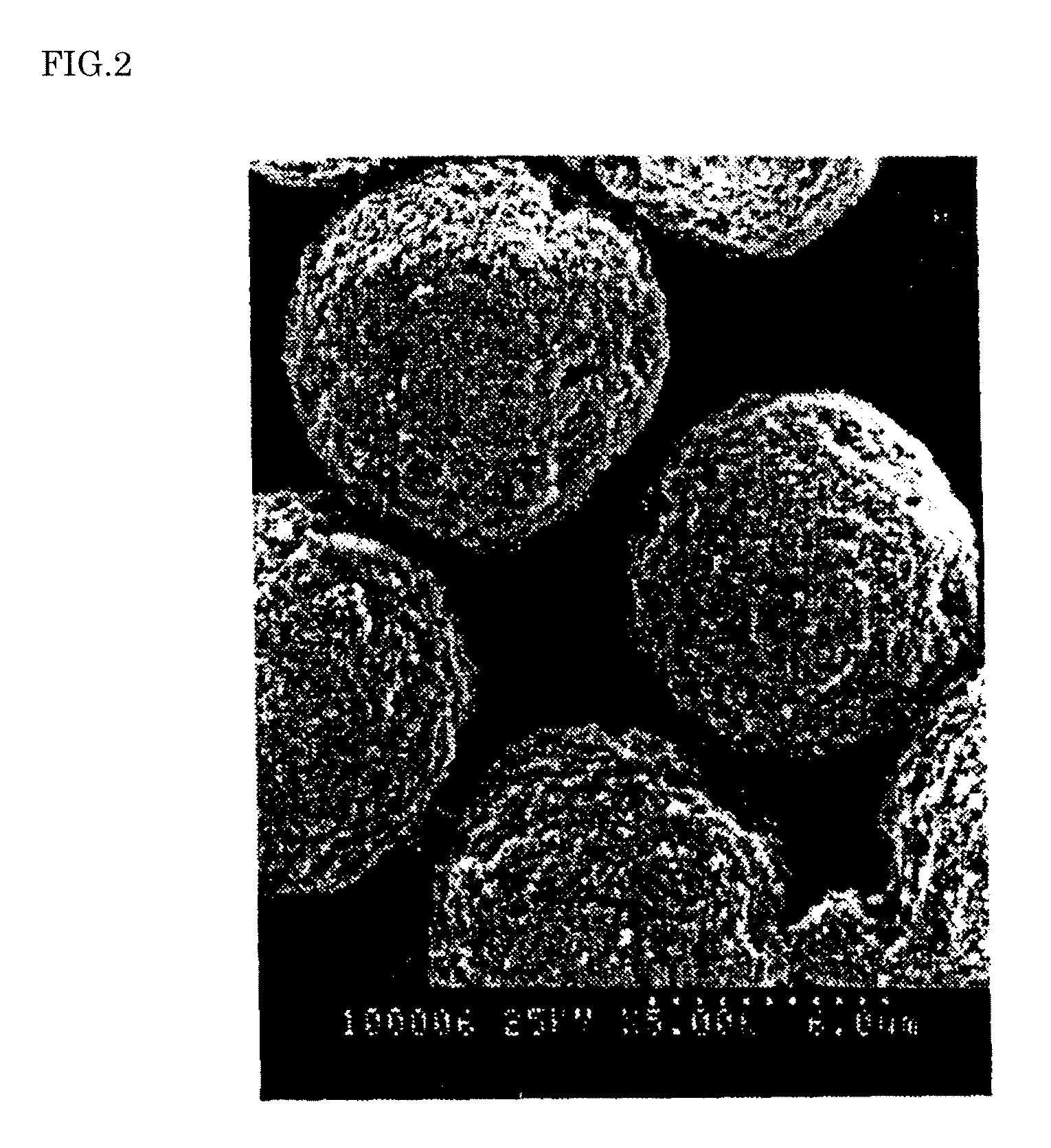
[0048]A 1 L separable flask was charged with 84 parts by weight of methyl methacrylate as a swelling monomer, 1.3 parts by weight of benzoylperoxide, 0.7 parts by weight of sodium dodecylbenzenesulfonate, and 200 mL of water, and the mixture was emulsified using a homogenizer. After the addition of 15.4 parts by weight of PMMA seed particles with a particle diameter of 0.4 μm (MP-1100 manufactured by Soken Chemical & Engineering Co., Ltd.), the emulsion was stirred at 80 rpm at 50° C. for 40 minutes to become swollen and polymerized while further stirring at 75° C. for 1.5 hours to produce seed particles A. The resulting seed particles were observed by SEM to confirm that the average particle diameter was 0.75 μm and the particles were monodispersed (CV value: 2.1%).

preparation example 2

Preparation of Seed Particles B

Second Step

[0049]Seed particles B were produced in the same manner as in Preparation Example 1, except for using 82.1 parts by weight of methyl methacrylate as a swelling monomer and 17.9 parts by weight of the seed particles A obtained in the Preparation Example 1 as seed particles. The resulting seed particles were observed by SEM to confirm that the average particle diameter was 1.3 μm and the particles were monodispersed (CV value: 2.0%). The weight average molecular weight (Mw) measured by gel permeation chromatography (GPC, column: HXL-H, G7000HXL, GMHXL-L, and G2500HXL (manufactured by Tosoh Corp.), detector: a refractive index detector) was 220,000.

preparation example 3

Preparation of Seed Particles C

Second Step

[0050]Seed particles C were produced in the same manner as in Preparation Example 1, except for using 88.1 parts by weight of methyl methacrylate as a swelling monomer and 11.9 parts by weight of the seed particles A obtained in the Preparation Example 1 as seed particles. The resulting seed particles were observed by SEM to confirm that the average particle diameter was 1.5 μm and the particles were monodispersed (CV value: 2.1%). The weight average molecular weight was 232,000.

the structure of the environmentally friendly knitted fabric provided by the present invention; figure 2 Flow chart of the yarn wrapping machine for environmentally friendly knitted fabrics and storage devices; image 3 Is the parameter map of the yarn covering machine
Login to View More

PUM

PropertyMeasurementUnit
Percent by massaaaaaaaaaa
Login to View More

Abstract

To provide porous monodispersed particles obtained by preparing, as seed particles, poly(methyl methacrylate) particles or acrylic resin particles comprising 70% by mass or more of methyl methacrylate as a copolymerization component, swelling the seed particles 20 to 80 times the size of the original seed particles by mass using a swelling solution comprising an oil-soluble polymerization initiator and a monomer mixture containing 70% by mass or more of methyl methacrylate and 3 to 8% by mass of divinylbenzene, and polymerizing the monomers. The particles are porous particles with a diameter of the order of micrometers and a narrow particle-size distribution and are monodispersed. Colored monodispersed particles obtained by agglomerating a pigment in the porous monodispersed particles are monodispersed and spherical, and contain a large amount of pigment therein.

Description

TECHNICAL FIELD[0001]The present invention relates to porous monodispersed particles, a method for producing the same, and uses of the same. More particularly, the invention relates to porous monodispersed particles which are virtually spherical, have a large surface area, and have a uniform particle diameter, to a method for producing the same, and to colored monodispersed particles obtained by agglomerating a pigment in the porous monodispersed particles and a method for producing the same.BACKGROUND ART[0002]Methods which utilize phase separation by emulsion polymerization have heretofore been known to produce particles in the order of submicrometers having various shapes such as DARUMA-shaped (potbellied particles), IIDAKO-shaped (octopus ocellatus-shaped particles), KONPEITO-shaped (a Japanese confectionery with wart-like protrusions over the surface-shaped particles), hollow particles, and other irregularly shaped particles (see Non-Patent Document 1).[0003]On the other hand, ...

Claims

the structure of the environmentally friendly knitted fabric provided by the present invention; figure 2 Flow chart of the yarn wrapping machine for environmentally friendly knitted fabrics and storage devices; image 3 Is the parameter map of the yarn covering machine
Login to View More

Application Information

Patent Timeline
no application Login to View More
IPC IPC(8): C08J9/18
CPCC08F265/04C08F265/06C08L51/003C08L2666/02C08J3/12C08J9/16
Inventor CUI, YING
Owner SOKEN CHEM & ENG CO LTD
Features
  • R&D
  • Intellectual Property
  • Life Sciences
  • Materials
  • Tech Scout
Why Patsnap Eureka
  • Unparalleled Data Quality
  • Higher Quality Content
  • 60% Fewer Hallucinations
Social media
Patsnap Eureka Blog
Learn More