
Polarization conversion device, polarized illumination optical device, and liquid crystal projector
a technology of polarization conversion and optical device, which is applied in the direction of instruments, polarising elements, projectors, etc., can solve the problems of high manufacturing cost, deterioration of polarization conversion efficiency, and high cost of crystal itself, and achieves efficient conversion, excellent thermal resistance, and low cost.
- Summary
- Abstract
- Description
- Claims
- Application Information
AI Technical Summary
Benefits of technology
Problems solved by technology
Method used
Image

Examples
Embodiment Construction
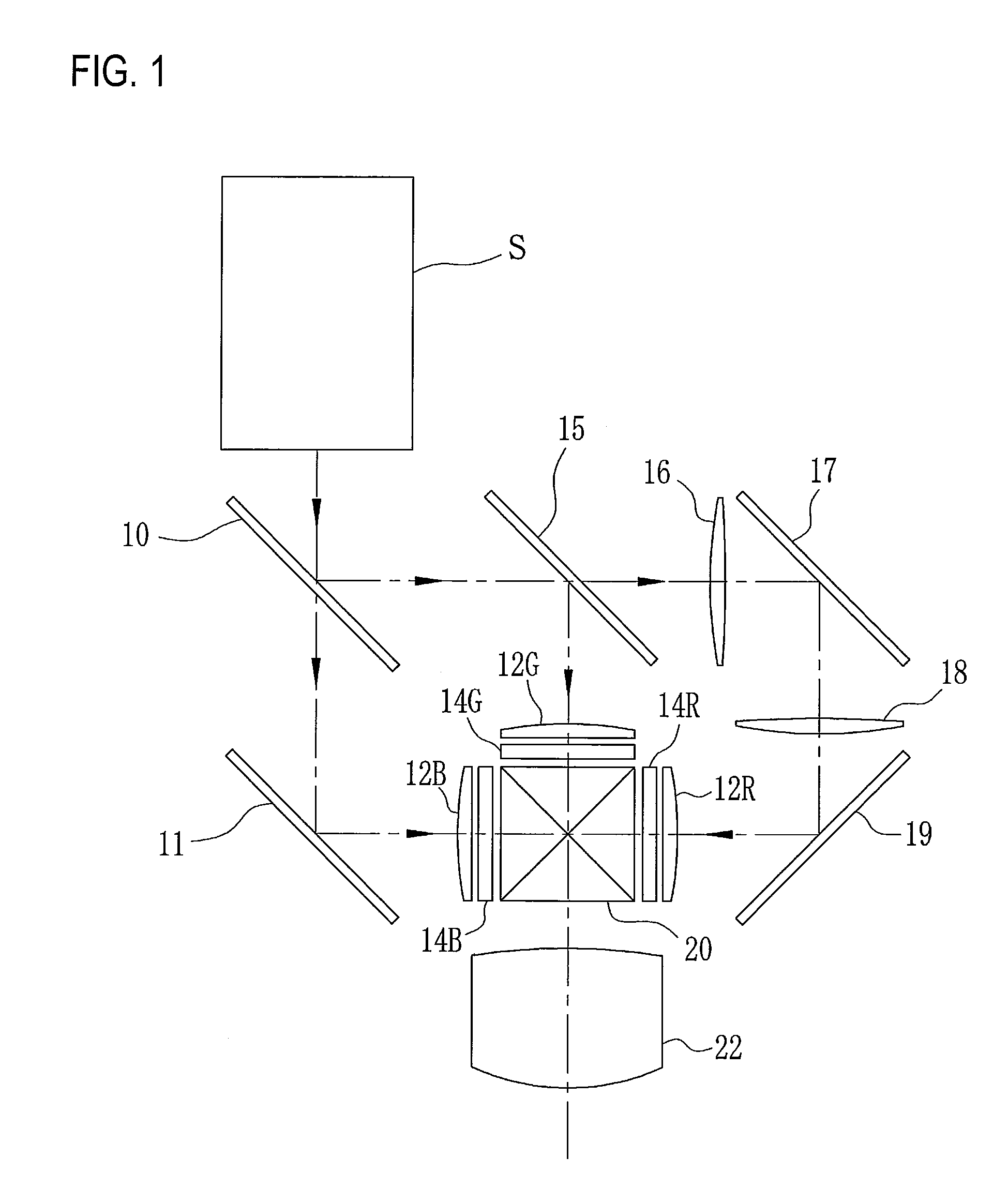
[0030]An optical system of a liquid crystal projector is schematically configured as shown in FIG. 1 including a light source device S. As shown in FIG. 2, the light source device S includes a high-intensity light source lamp 2, such as an ultrahigh-pressure mercury lamp, and the light source lamp 2 is used together with a reflector 3. A filter 4 for cutting infrared light and ultraviolet light is provided on an illumination optical path. Non-polarized illumination light beams in a visible range in which various polarized light beams are mixed are incident on a first microlens array 5 as substantially parallel beams. The first microlens array 5 is obtained by arranging plural microlenses in a rectangular matrix so as to follow the rectangular shape of a liquid crystal display panel, and forms a pseudo light source corresponding to the number of microlenses equivalently on a second microlens array 6 having the same structure.
[0031]The illumination light emitted from the pseudo light ...
PUM
| Property | Measurement | Unit |
|---|---|---|
| inside angle | aaaaa | aaaaa |
| angle | aaaaa | aaaaa |
| center wavelength | aaaaa | aaaaa |
Abstract
Description
Claims
Application Information
 Login to View More