
Rapid Acting Insulin Analogues
a fast-acting, insulin-like technology, applied in the direction of peptide/protein ingredients, extracellular fluid disorder, metabolic disorder, etc., to achieve the effect of promoting the monomeric form of insulin
- Summary
- Abstract
- Description
- Claims
- Application Information
AI Technical Summary
Benefits of technology
Problems solved by technology
Method used
Image

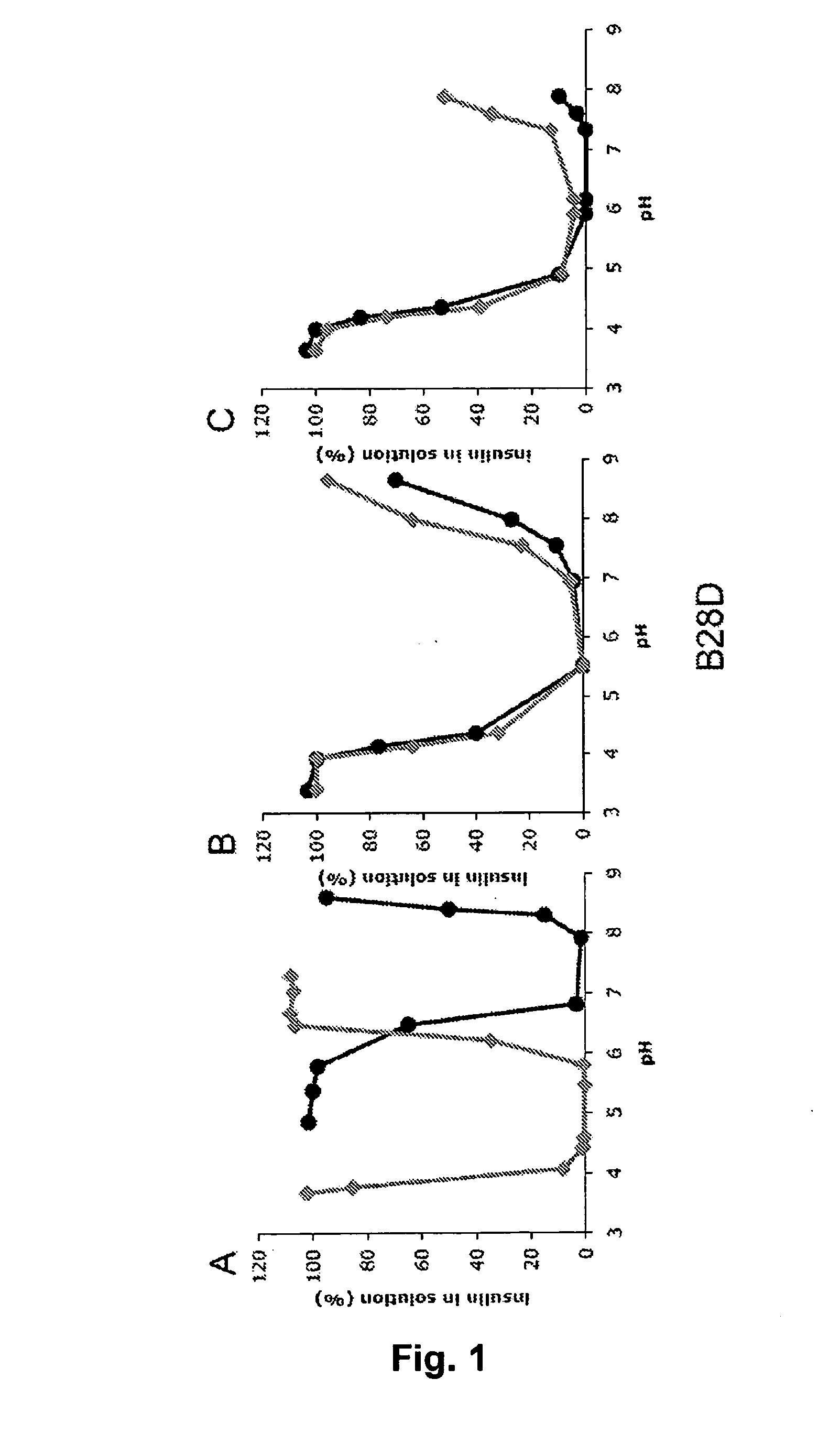
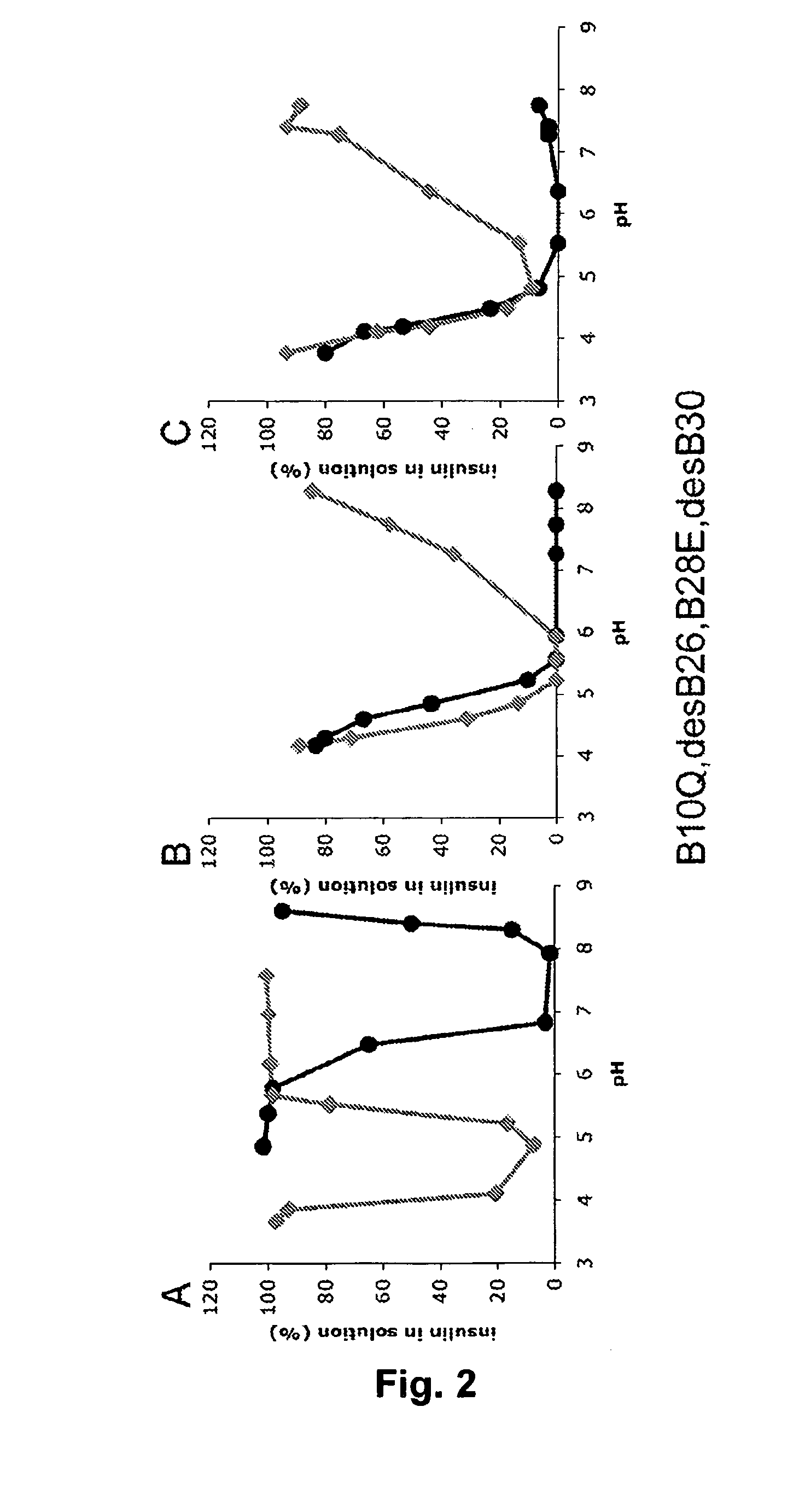
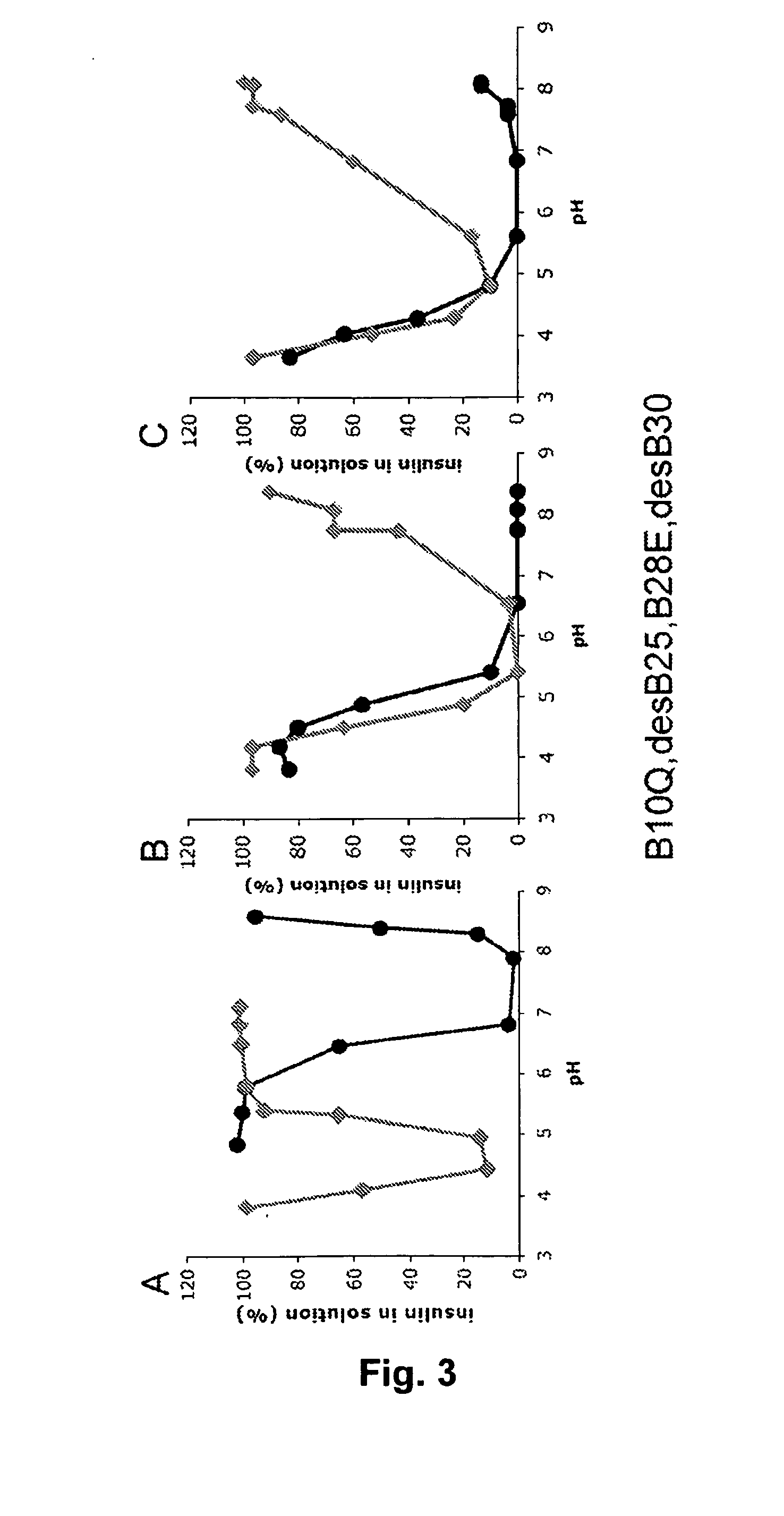
Examples
example 1
Equilibrium Solubility of Insulin Formulations
[0151]Stock solutions of a fast acting insulin analogue or of a mixture of a fast acting insulin analogue and a long acting insulin (insulin glargine) containing either Zn2+, phenol and glycerol concentrations close to marketed products or 120 mM NaCl were prepared and the pH was adjusted to the desired value corresponding to the alkaline endpoint of the pH-solubility profile. From these stock solutions samples were withdrawn, the pH adjusted to the desired value in the pH 3-8 range, and 0.3 ml samples were incubated at 23° C. for at least 4 days. After centrifugation (20,000 g for 20 minutes at 23 C) of each sample, pH was measured and the solubility was determined by quantification of insulin contents in the supernatant by Reverse Phase HPLC analysis on a XTerra RP8 Guard column (Waters), 50×20 mm, 5 micron particle size, eluted at 2 mL / minute at 35° C. or on a Gemini 3u C18 110A column (Phenomenex), 50×2.0 mm, 3 micron particle size e...
example 2
Glucose Utilization of Preparations of B10Q, desB26, B28E, desB30 Human Insulin and Insulin Glargine
[0154]The glucose utilization effect following a subcutaneous injection of the insulin preparations of the present invention were characterized using a pig clamp model as described in Kurtzhals & Ribel, Diabetes 44, 1381-1385, (1995).
[0155]FIG. 5 compares glucose utilization in pigs following subcutaneous injection with either separate injections of 0.6 mM B10Q, desB26, B28E, desB30, 19 mM phenol, 19 mM m-cresol, 1.6% glycerol, pH=3.2 (a total of 90 nmol of the insulin analogue) and insulin glargine (a total of 210 nmol insulin glargine) or with a single injection of a premixed 30:70 (molar basis) preparation of the two above mentioned insulins (a total of 300 nmol of the two insulin analogues). The glucose utilization following injection of a mixed preparation compared to that following separate injections are indistinguishable within the experimental uncertainty.
example 3
[0156]The PK properties of a number of insulin analogues of the present invention in different formulations was characterized by the disappearance rate from the subcutaneous depot following subcutaneous injections in pigs. T50% is the time when 50% of the A14 Tyr(125I) insulin has disappeared from the site of injection as measured with an external γ-counter (Ribel et al., The Pig as a Model for Subcutaneous Absorption in Man. In: M. Serrano-Rtios and P. J. Lefebre (Eds): Diabetes (1985) Proceedings of the 12th congress of the International Diabetes Federation, Madrid, Spain, 1985 (Excerpta Medica, Amsterdam (1986), 891-896). The T50% values of a number of insulin analogues of the present invention is presented in table 1 and examples of disappearance curves are illustrated in FIG. 6. Serving as reference insulin aspart (B28D human insulin) in a NovoRapid® formulation has been included in all studies.
[0157]The test results are shown in Table 1 where[0158](1) refers to Biochemical met...
PUM
| Property | Measurement | Unit |
|---|---|---|
| pH | aaaaa | aaaaa |
| concentration | aaaaa | aaaaa |
| concentration | aaaaa | aaaaa |
Abstract
Description
Claims
Application Information
 Login to View More