
Treatment of length dependent neuropathy
a neuropathy and length-dependent technology, applied in the field of treatment of length-dependent neuropathy, can solve the problems of idiopathic length-dependent small fiber neuropathy, no known treatment, and progression of neuropathy
- Summary
- Abstract
- Description
- Claims
- Application Information
AI Technical Summary
Benefits of technology
Problems solved by technology
Method used
Image

Examples
example 1
Formulation of Neuclon™ (Clonidine) 0.10% Topical Gel
[0030]Neuclon™ (clonidine) 0.1% Topical Gel contains 0.1 mg of clonidine hydrochloride per 1.0 gram gel. The gel is formulated at pH 8.0 in order to maximize the amount of clonidine freebase in the product. Clonidine hydrochloride has a pKa of 8.2. The formulation is shown in Table 1.
TABLE 1Formulation of Neuclon ™ (clonidine) 0.1% Topical GelIngredient% (w / w)Clonidine hydrochloride USP0.1%Benzyl alcohol NF1.0%Carbopol 980 NF0.6%Sodium hydroxide NFadjust to pH 8Hydrochloric acid NFadjust to pH 8 (if necessary)Purified water USPqs ad 100%
example 2
Treatment of Patients with Painful Diabetic Neuropathy
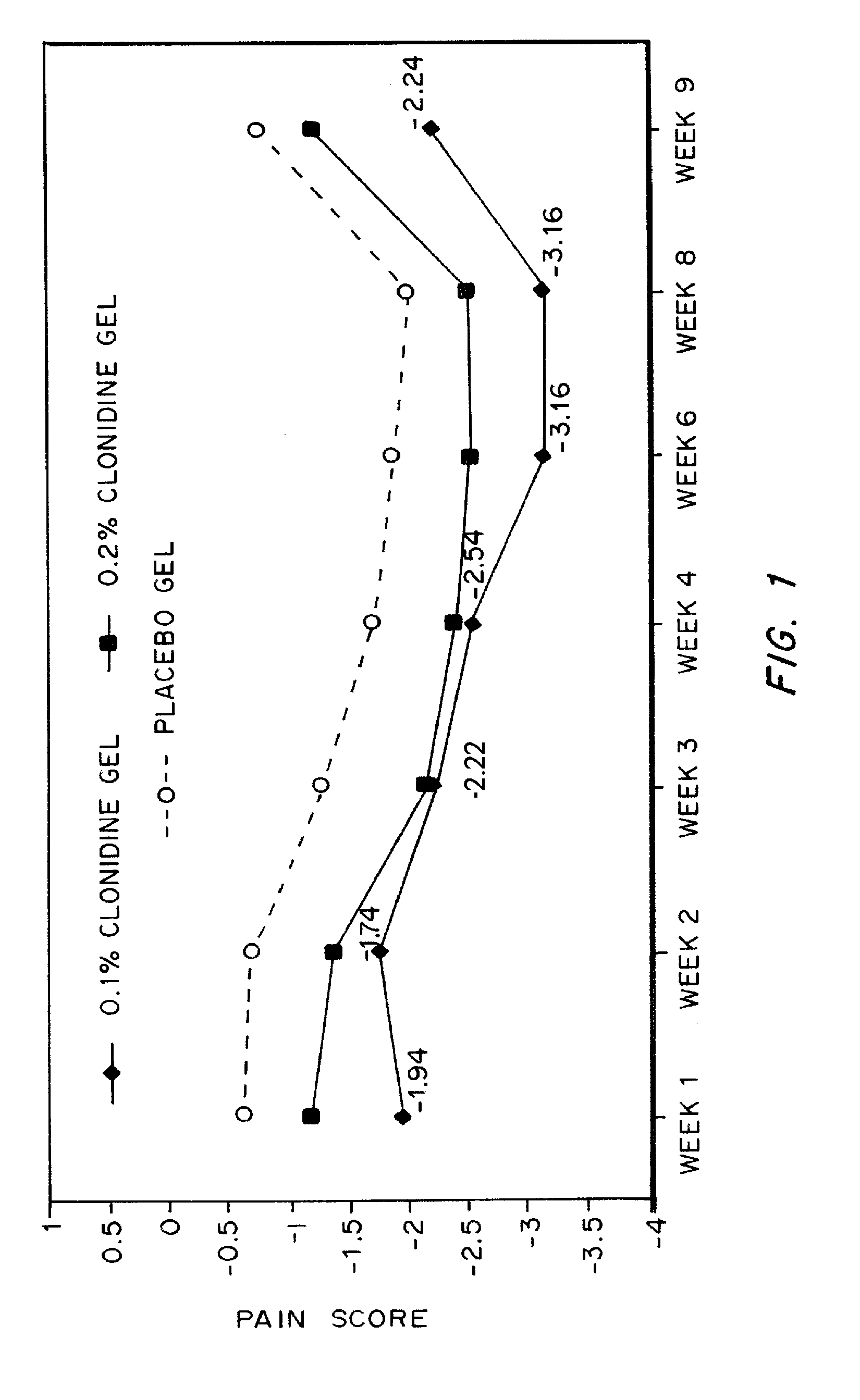
[0031]The objective of this study was to test the analgesic effects of 0.1% and 0.2% topical clonidine gel compared to a placebo gel in patients with chronic, lower extremity, painful diabetic neuropathy.
[0032]Materials and Methods
[0033]One hundred sixty-six (166) adult patients with chronic, lower extremity, painful diabetic neuropathy who met the study admission criteria were enrolled in this multicenter study. Diabetic patients with a clinical diagnosis of neuropathy pain had to have an average daily pain score of 5 or greater on the 11-point Numerical Graphic Pain Scale (NGPS). Patients were allowed to continue using other medications for neuropathic pain, provided dosing with these medications was unchanged for 30 days prior to enrolment and during the study.
[0034]Patients were randomized to either 0.1% or 0.2% topical clonidine gel or placebo gel for this blinded, parallel design, 10-week study. Drug treatment lasted for 8 ...
example 3
Single Dose Pharmacokinetic Study with 0.1% Clonidine Gel
[0045]Materials and Methods
[0046]Six volunteers applied single doses of 0.1% clonidine gel up to a maximum of 2 mg clonidine HCl per day. Clonidine plasma concentration analysis was conducted and consisted of a validated gas chromatography / mass spectroscopy method with a quantitative limit of 0.025% ng / ml.
[0047]Results
[0048]Clonidine plasma concentration analysis in the group of six volunteers showed all samples to be below the limit of quantitation. Therefore, single doses, even as large as 2.0 mg / day of 0.1% topical clonidine gel are insufficiently absorbed to have any antihypertensive effect or be of any clinical consequence.
PUM
| Property | Measurement | Unit |
|---|---|---|
| pKa | aaaaa | aaaaa |
| concentrations | aaaaa | aaaaa |
| concentrations | aaaaa | aaaaa |
Abstract
Description
Claims
Application Information
 Login to View More