

Organosolv biorefining of whole sugar cane
a technology of organic solvent and sugar cane, which is applied in the direction of biochemistry apparatus, saccharides production, biochemistry apparatus and processes, etc., can solve the problems of increasing the capital cost and technical complexity of the mill, significant losses in sugar yield, and yield loss
- Summary
- Abstract
- Description
- Claims
- Application Information
AI Technical Summary
Benefits of technology
Problems solved by technology
Method used
Image

Examples
Embodiment Construction
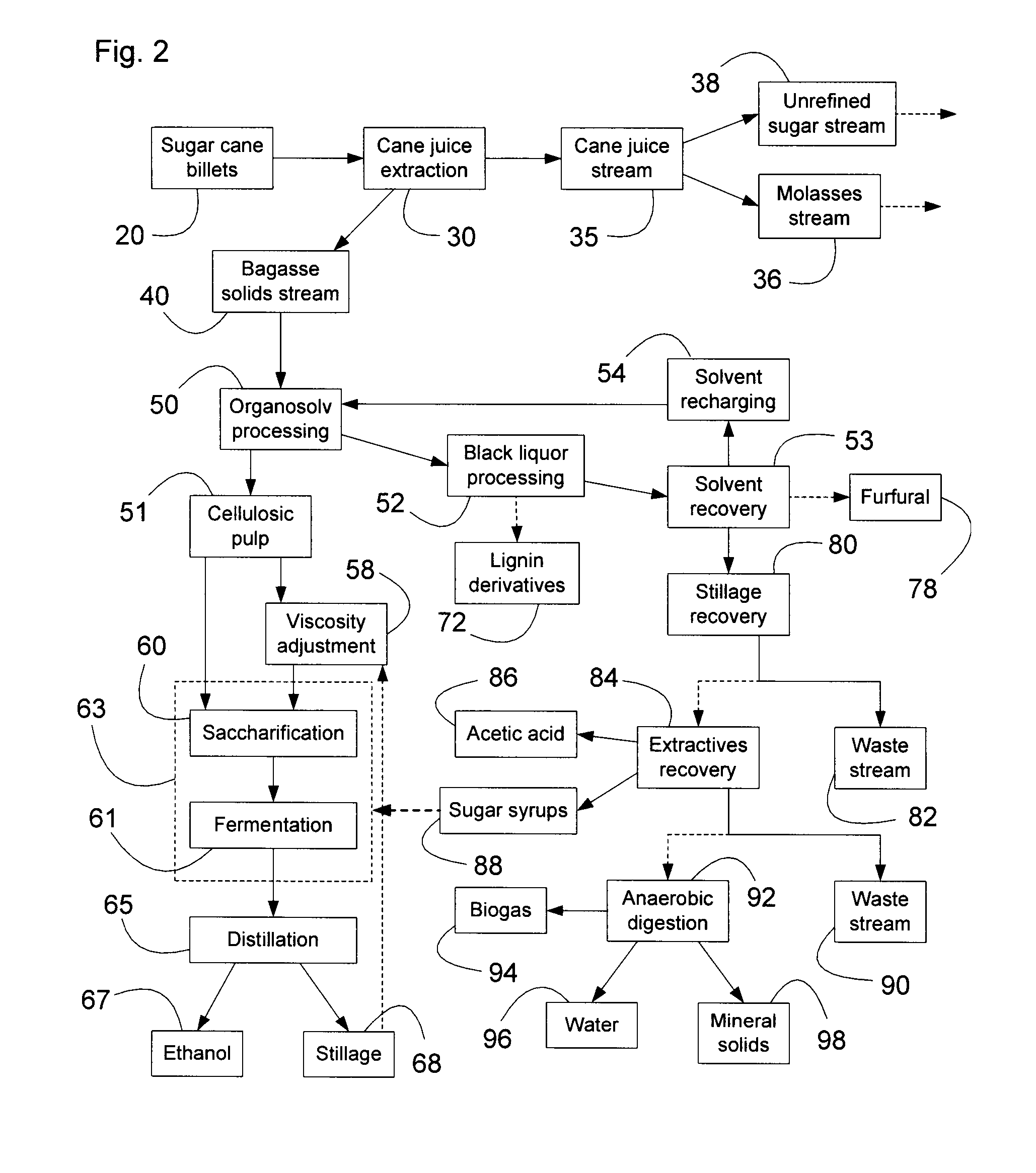
[0014]The exemplary embodiments of the present invention relate to biorefinery systems and integrated processes for processing whole sugar cane to concurrently produce: (a) a raw sugar stream and bagasse solids materials, and (b) cellulosic ethanol from the bagasse materials.
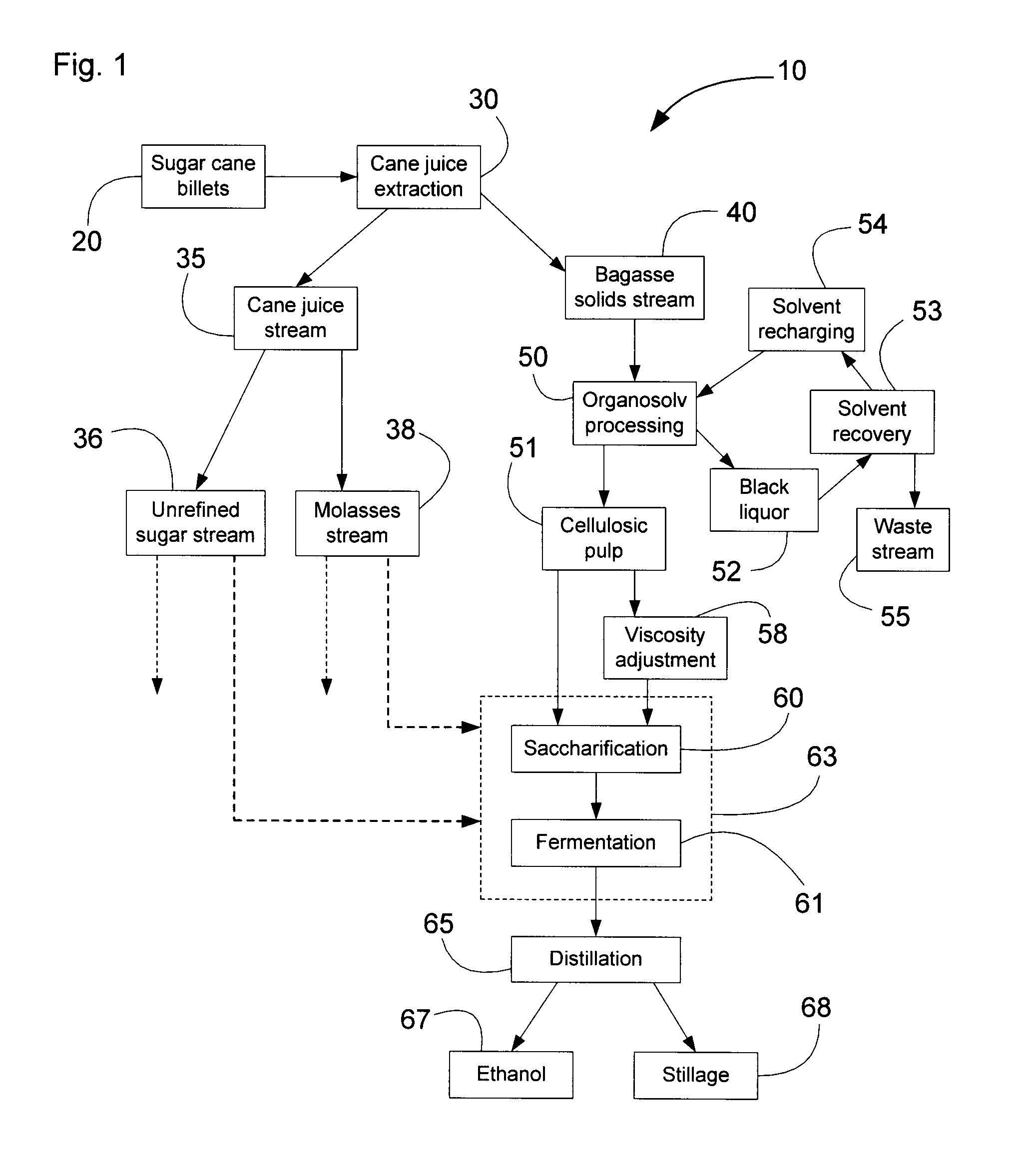
[0015]FIG. 1 shows an exemplary whole sugar cane processing system 10 for concurrently producing an unrefined sugar stream and ethanol according to an embodiment of the present invention. Sugar cane billets 20 are fed into cane juice extraction equipment 30 for crushing, washing and separation into a cane juice stream 35 and a bagasse solids stream 40. The cane juice stream 35 may be separated into an unrefined sugar stream 36 and a molasses stream 38 which are separately collected for further processing. The bagasse solids stream 40 is transferred into suitable organosolv processing equipment 50 wherein it is commingled with a suitable organic solvent selected for organosolv processing of the bagasse solids to ...
PUM
| Property | Measurement | Unit |
|---|---|---|
| temperatures | aaaaa | aaaaa |
| pressures | aaaaa | aaaaa |
| organic | aaaaa | aaaaa |
Abstract
Description
Claims
Application Information
 Login to View More