
Methods and compositions for inhibiting vinyl aromatic monomer polymerization
a technology of aromatic monomers and compositions, which is applied in the direction of organic chemistry, fuels, and thickeners, can solve the problems of unsatisfactory polymerization, loss of desired monomer end-product, and increase of undesired polymerization rate, and achieve the effect of inhibiting polymerization
- Summary
- Abstract
- Description
- Claims
- Application Information
AI Technical Summary
Benefits of technology
Problems solved by technology
Method used
Image

Examples
examples
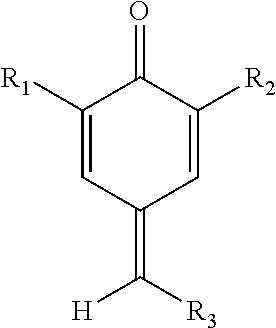
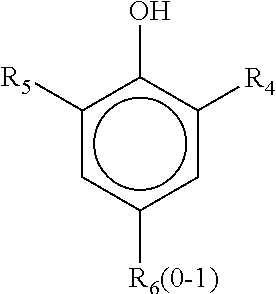
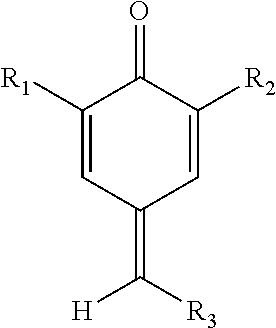
[0043]The effect of a combined treatment of QM (Quinone Methide) and 2,6-di-tert butyl phenol on the thermal polymerization of styrene at 115-120° C. was evaluated by comparing polymer formation utilizing the following procedure.
[0044]A 250 ml RB flask-equipped with an Ar gas inlet, water cooled condenser and sample outlet was charged with 110 ml of styrene and the candidate polymerization inhibitor(s). [600 ppm (w / v)]. The flask was purged with Argon for 10 minutes. The flask was then immersed into an oil-bath thermostatically controlled at 115-120° C. and heated with purging Ar continuously. Once the temperature reached 115° C., the stop clock was started and this time was considered as time zero. About 5 ml of the sample was removed from the flask at varying time intervals for up to 4 hours and measured precisely before pouring into about 40 ml methanol to precipitate out the styrene polymer. The precipitated polystyrene was filtered with a gas membrane filter that was pre-weighe...
PUM
| Property | Measurement | Unit |
|---|---|---|
| temperature | aaaaa | aaaaa |
| temperature | aaaaa | aaaaa |
| temperatures | aaaaa | aaaaa |
Abstract
Description
Claims
Application Information
 Login to View More