Check patentability & draft patents in minutes with Patsnap Eureka AI!

Co-processor for complex arithmetic processing, and processor system

Active Publication Date: 2013-11-28
NEC CORP
View PDF1 Cites 4 Cited by
  • Summary
  • Abstract
  • Description
  • Claims
  • Application Information

AI Technical Summary

Benefits of technology

The invention allows one system to quickly and easily do different processes in multiple radio communication methods. This makes it more efficient and flexible.

Problems solved by technology

Therefore, there is a problem that the space overhead of circuits is very high.
Further, there is also a problem that the flexibility for modification or extension of processing is low.
However, in this case, there is a problem that although it is relatively easy to address the change in a part of processing parameters in the arithmetic expression, it is difficult to be compatible with radio communication methods such as CDMA (Code Division Multiple Access) and OFDM (Orthogonal Frequency Division Multiplexing), whose fundamental processing algorithms of demodulation are different from each other.
Further, it is also difficult to be able to modify arithmetic processing data units, the repeat count of arithmetic processing, the detailed order of arithmetic operations, the order of processing between processing engines (dedicated hardware circuits), and the like.
Configuring them so as to be able to be modified, there cause a problem of complicating the configuration of connections between dedicated hardware circuits, after all, which leads to an increase in the space overhead, and a problem that it is not possible to address the extension of specifications, which will be expected in the future like change in the order of processing within the processing engine.
Therefore, there is a problem that it is difficult to be able to address modifications of the fundamental processing algorithm and the order of arithmetic operations, and the like.
Therefore, the typical signal processing processor requires processing instructions (arithmetic cycles) more than those required by dedicated hardware which can execute these processes in a pipelined parallel manner, so that there is a problem that the number of processing cycles significantly increases.
Further, although the flexibility for processing modification is ensured, access latency from a processor to a memory leads to the performance overhead, for example.
Therefore, after all, there is also a problem that it is difficult to speed up.
On the other hand, it is required to raise a clock frequency in the case of increasing the speed, so that there is a problem that the power consumption increases.

Method used

the structure of the environmentally friendly knitted fabric provided by the present invention; figure 2 Flow chart of the yarn wrapping machine for environmentally friendly knitted fabrics and storage devices; image 3 Is the parameter map of the yarn covering machine
View more

Image

Smart Image Click on the blue labels to locate them in the text.
Viewing Examples
Smart Image
  • Co-processor for complex arithmetic processing, and processor system
  • Co-processor for complex arithmetic processing, and processor system
  • Co-processor for complex arithmetic processing, and processor system

Examples

Experimental program
Comparison scheme
Effect test

first exemplary embodiment

Configuration Example

[0050]As shown in FIG. 1, a processor system 100 according to this exemplary embodiment includes a processor 10 for control (Processor Core), and a co-processor 11 for complex arithmetic processing (hereinafter, sometimes abbreviated as “co-processor”) which is connected to the processor 10. The processor system 100 includes, as external interfaces, a processor control interface for performing boot control, input of interrupt signals and the like, an instruction memory interface for accessing an instruction memory 101, a local memory interface for accessing a local memory (data memory) 102, a DSP interface for performing control access to external peripherals (not shown), and a shared memory interface for performing stream access to a shared memory (not shown). Moreover, the processor system 100 also includes a pilot data interface which is used for continuously inputting thereto known pilot signals (reference signals) generated by a pilot generator 70. Note tha...

operation example

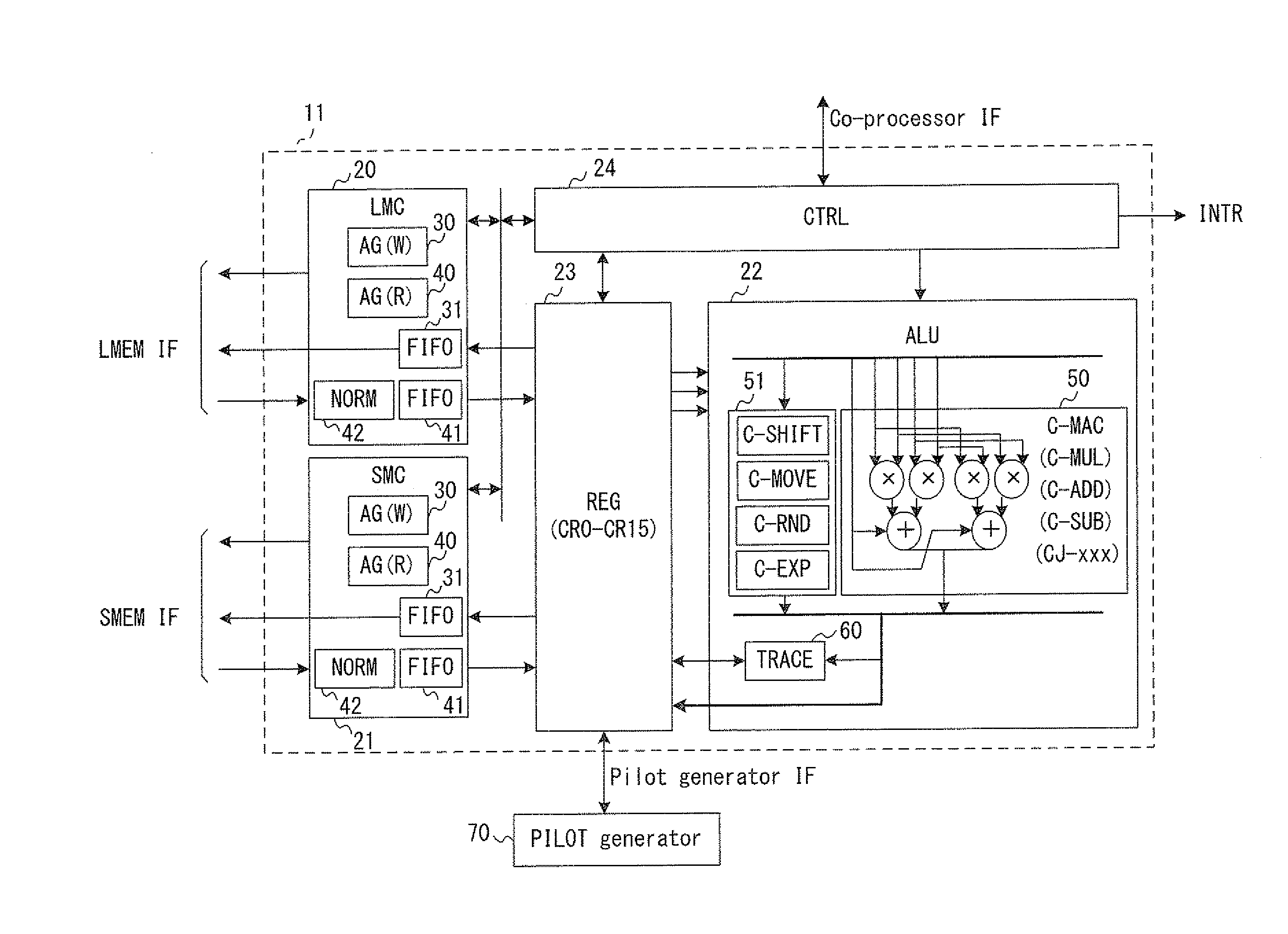
[0062]Next, operations of this exemplary embodiment will be described in detail with reference to FIGS. 1, 2, 3A, 3B, and 4 to 9. Note that in the following explanation, specific configurations of the memory controllers 20 and 21, the ALU 22, and the register file (REG) 23 will be also clearly understood.

[0063]Fundamental operations of the processor system 100 are shown in FIG. 1. As shown in the figure, when the processor 10 for control is booted by use of the processor control interface or the interruption interface, the processor 10 fetches operation codes out of the instruction memory 101, and executes processor processing while accessing the local memory (data memory) 102. Moreover, the processor 10 for control also accesses the external shared memory and peripheral blocks.

[0064]The processor 10 for control uses co-processor instructions as the operation codes in order to control the co-processor 11 to execute complex arithmetic processing. When the co-processor instruction is ...

example of application

[0159]FIG. 10 shows a configuration example of a radio communication system in a case where the above-mentioned processor system 100 is applied as an example to modulation / demodulation modules (MODEM) which can be compatible with a plurality of radio communication methods including Wireless LAN (IEEE 802.11a) method, WiMAX (IEEE 802.16e) method and the like standardized in IEEE.

[0160]This radio communication system includes a modem module (MODEM) 200, an RF (Radio Frequency) interface module 204, a search module (Search) 205, and a codec module (CODEC) 206. The modem module (MODEM) 200 performs modulation for data to be transmitted and demodulation for received data. The search module (Search) 205 performs establishment of synchronization with an opposed communication device and timing search therefor. The codec module (CODEC) 206 performs encoding for the data to be transmitted and decoding for the received data.

[0161]Further, this radio communication system includes a general proc...

the structure of the environmentally friendly knitted fabric provided by the present invention; figure 2 Flow chart of the yarn wrapping machine for environmentally friendly knitted fabrics and storage devices; image 3 Is the parameter map of the yarn covering machine
Login to View More

PUM

No PUM Login to View More

Abstract

In order to enable to quickly and efficiently execute, by one system, various modulation / demodulation / synchronous processes in a plurality of radio communication methods, a co-processor (22) for complex arithmetic processing, which forms a processor system (100), includes a complex arithmetic circuit (22) that executes for complex data a complex arithmetic operation required for radio communication in accordance with an instruction from a primary processor (10), and a memory controller (20, 21) that operates in parallel with the complex arithmetic circuit and accesses a memory. A trace circuit provided in the complex arithmetic circuit (22) monitors arithmetic result data for first complex data series sequentially read from the memory, and detects a normalization coefficient for normalizing the arithmetic result data.

Description

TECHNICAL FIELD[0001]The present invention relates to a co-processor for complex arithmetic processing and a processor system. In particular, the present invention relates to a technique to execute various complex arithmetic processes required for radio communication.BACKGROUND ART[0002]In a radio communication system, it is generally required to perform modulation / demodulation for transmitted and received data. In other words, it is necessary at the transmitting side to perform, for data signals to be transmitted, modulation such as PSK (Phase Shift Keying, e.g., BPSK (Binary PSK), QPSK (Quadrature PSK) or 8PSK) or QAM (Quadrature Amplitude Modulation, e.g., 16QAM, 64QAM or 256QAM), spreading, and the like. On the other hand, it is necessary at the receiving side to perform, for received data signals, synchronous processing, demodulation, despreading, and the like.[0003]These processes are intended mainly for radio symbol units (complex IQ signals), and thus it is required to execu...

Claims

the structure of the environmentally friendly knitted fabric provided by the present invention; figure 2 Flow chart of the yarn wrapping machine for environmentally friendly knitted fabrics and storage devices; image 3 Is the parameter map of the yarn covering machine
Login to View More

Application Information

Patent Timeline
no application Login to View More
IPC IPC(8): G06F9/30
CPCG06F9/3001G06F7/4806G06F9/3013G06F9/30145G06F9/3877H04B1/7115G06F7/57
Inventor TAKEUCHI, TOSHIKIIGURA, HIROYUKI
Owner NEC CORP
Features
  • R&D
  • Intellectual Property
  • Life Sciences
  • Materials
  • Tech Scout
Why Patsnap Eureka
  • Unparalleled Data Quality
  • Higher Quality Content
  • 60% Fewer Hallucinations
Social media
Patsnap Eureka Blog
Learn More