Method for hydrogenating polymer and hydrogenated polymer thereof
a technology of hydrogenated polymer and polymer, which is applied in the field of hydrogenating polymer and hydrogenated polymer thereof, can solve the problems of high structure instability, and high cost of pt catalyst, and achieve the effects of improving the flexibility of the polymer chain, facilitating the synthesizing of polymer, and promoting the application value of produ
- Summary
- Abstract
- Description
- Claims
- Application Information
AI Technical Summary
Benefits of technology
Problems solved by technology
Method used
Image

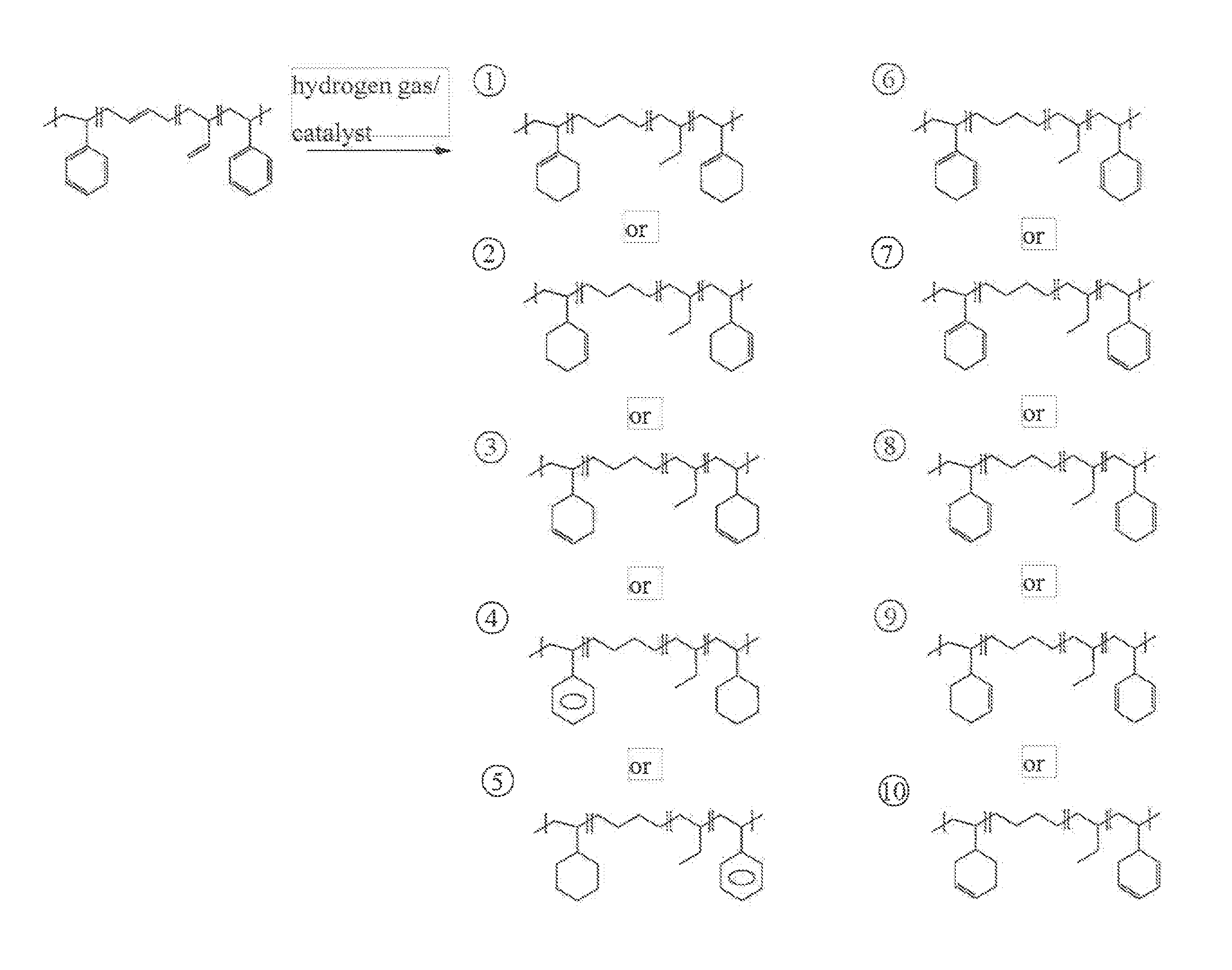
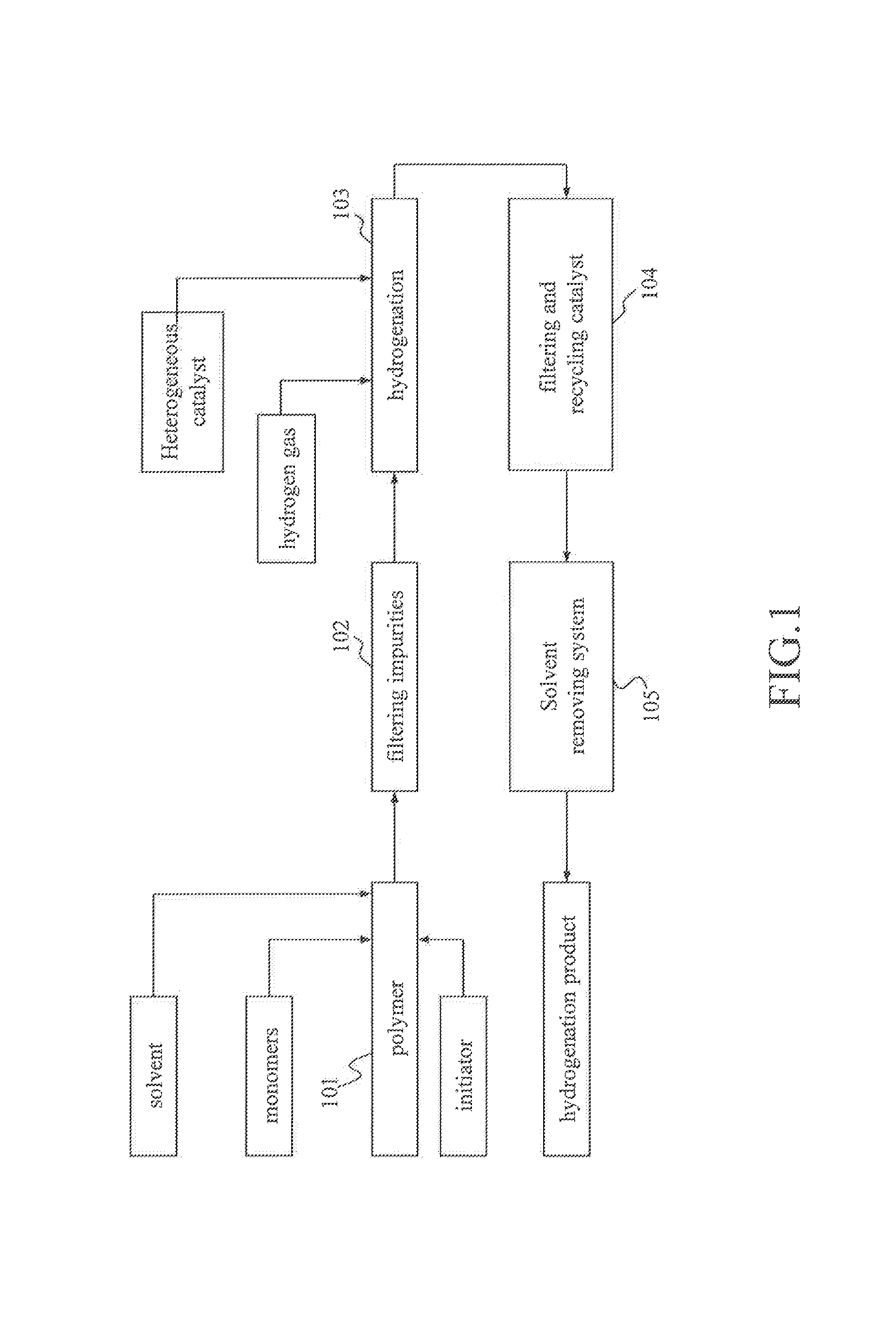
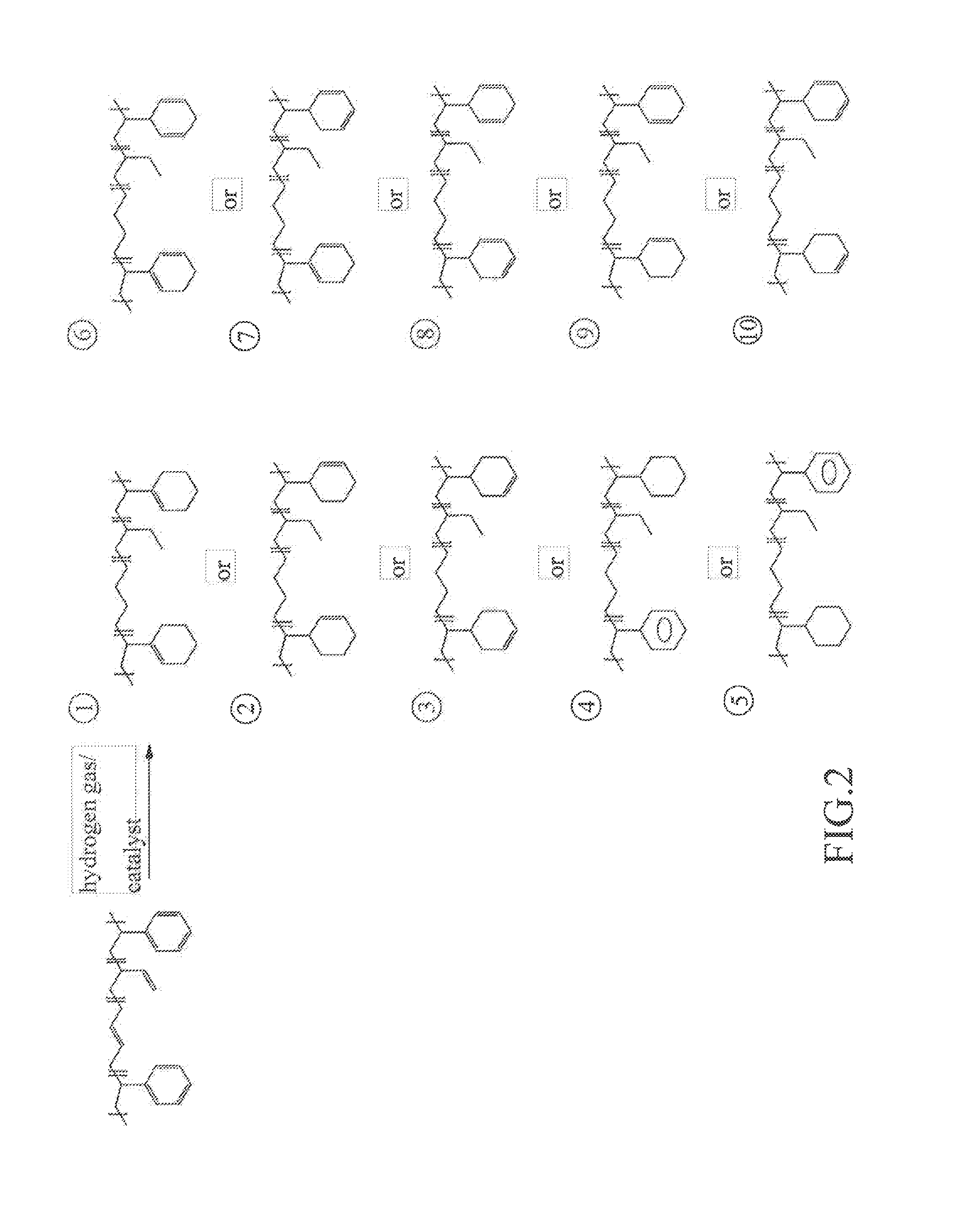
Examples
example 1
Hydrogenated Triblock Copolymer
[0025]The solvent used in the polymerization process of the embodiment is cyclohexane, wherein a small amount of tetrahydrofuran is added to adjust polarity and n-butyl lithium acts as the initiator. Monomers used in polymerization can be styrene, butadiene, or isoprene. Solvent and monomers can be purified by activated alumina. Polymerization is carried out in an autoclave equipped with an agitator. The process steps are described as following:
[0026]Step 1.1: adding 1,100 grams of cyclohexane and 4 grams of tetrahydrofuran.
[0027]Step 1.2: increasing the temperature to 50° C. by heating.
[0028]Step 1.3: adding 58.2 grams of styrene.
[0029]Step 1.4: adding 6.5 grams of an initiator to initiate reaction.
[0030]Step 1.5: continuing the reaction for 30 minutes.
[0031]Step 1.6: adding 77.6 grams of butadiene.
[0032]Step 1.7: continuing the reaction for 60 minutes.
[0033]Step 1.8: adding 58.2 grams of styrene.
[0034]Step 1.9: continuing the reactio...
example 6
Hydrogenated Polystyrene
[0047]The solvent used in the polymerization process of the embodiment is cyclohexane, wherein a small amount of tetrahydrofuran is added to adjust polarity and n-butyl lithium acts as the initiator. Monomer used in polymerization is styrene. Solvent and monomers can be purified by activated alumina, Polymerization is carried out in an autoclave equipped with an agitator. The process steps are described as following:
[0048]Step 1.1: adding 1,100 grams of cyclohexane and 1 gram of tetrahydrofuran.
[0049]Step 1.2: increasing the temperature to 45° C. by heating.
[0050]Step 1.3: adding 150 grams of styrene.
[0051]Step 1.4: adding 4.61 grams of an initiator to initiate reaction.
[0052]Step 1.5: continuing the reaction for 30 minutes.
[0053]Step 1.6: adding 0.2 grams of methanol as a terminator to end the reaction.
[0054]Executing the steps described above can obtain a polymer solution of about 1,250 grams, which includes polystyrene having the weight-av...
PUM
| Property | Measurement | Unit |
|---|---|---|
| Fraction | aaaaa | aaaaa |
| Fraction | aaaaa | aaaaa |
| Fraction | aaaaa | aaaaa |
Abstract
Description
Claims
Application Information
 Login to View More
 - R&D
- Intellectual Property
- Life Sciences
- Materials
- Tech Scout
- Unparalleled Data Quality
- Higher Quality Content
- 60% Fewer Hallucinations
Browse by: Latest US Patents, China's latest patents, Technical Efficacy Thesaurus, Application Domain, Technology Topic, Popular Technical Reports.
© 2025 PatSnap. All rights reserved.Legal|Privacy policy|Modern Slavery Act Transparency Statement|Sitemap|About US| Contact US: help@patsnap.com