

Piezoelectric Sensor for the Detection and Characterization of at Least One Biochemical Element
a piezoelectric sensor and biochemical element technology, applied in the direction of material analysis, material analysis using sonic/ultrasonic/infrasonic waves, instruments, etc., can solve the problems of not being able to characterise fluid media, not being able to characterise biochemical elements contained in fluids, and not being able to achieve the characterisation of fluid biochemical elements, etc., to achieve the effect of reducing the resonant frequency of such
- Summary
- Abstract
- Description
- Claims
- Application Information
AI Technical Summary
Benefits of technology
Problems solved by technology
Method used
Image

Examples
example
Grafting of Amino Acids on a Polymer Matrix
[0095]In organic-inorganic hybrid materials, the organic lattice usually consists of a crosslinked polymer on which it is possible for example to graft amino acids (for example mono-, di- and tri-peptides on a copolymer).
[0096]The grafting can be carried out by the a priori synthesis of a copolymer. It is possible to use three different amino acids: alanine (R═-Me), glycine (R═—H) and serine (R═—CH2—OHJ).
[0097]The polymer can be produced by copolymerisation of acrylic acid (AAc) with N-isopropylacrylamide (NIPAM) using a radical initiator (azobisisobutyronitrile), in dimethylformamide (DMF). It is purified by double precipitation in diethlyl ether; then dried in an oven.
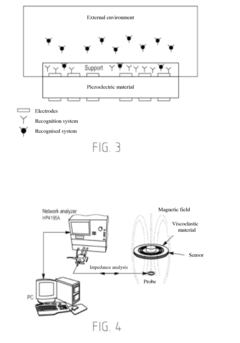
[0098]The sensor is excited by a probe, circular and weakly coupled. This probe is also used for measuring the response of the sensor. In the case of a weak coupling between the probe and the sensor, their interactions are dependent on the surface of the probe and the magnet...
PUM
 Login to View More
 Abstract
Description
Claims
Application Information
 Login to View More