
Heterologous expression of glycine n-acyltransferase proteins
a technology of acyl-coa and acyl-coa, which is applied in the field of heterologous expression of glycine n-acyl-transferase proteins, can solve the problems of fluctuation of cost associated with petrochemical feedstocks and other limitations of related art, and achieve the effect of facilitating the conversion of acyl-coa
- Summary
- Abstract
- Description
- Claims
- Application Information
AI Technical Summary
Benefits of technology
Problems solved by technology
Method used
Image

Examples
example 1
Identification and Characterization of Glycine-Specific Adenylation Domains
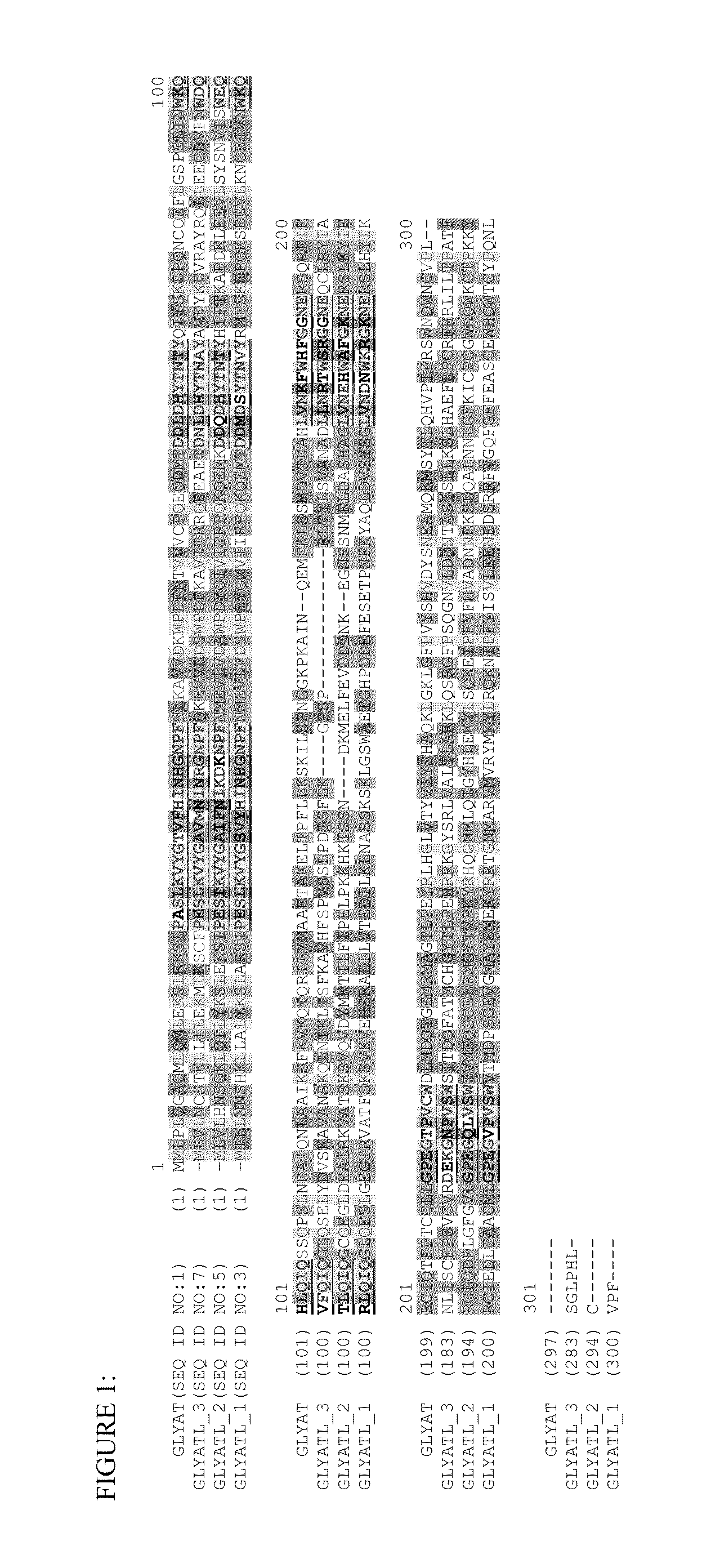
[0110]A class of glycine N-acyltransferase proteins are selected from the polypeptides encoded by the following gene sequences of acyl-CoA:glycine N-acyltransferase (GLYAT; NM_005838; SEQ ID NO:1), glycine N-acyltransferase-like 1(GLYATL 1; NM_001220494.2; SEQ ID NO:3), glycine N-acyltransferase-like 2 (GLYATL 2; NM_145016; SEQ ID NO:5), glycine N-acyltransferase-like 3 (GLYATL 3; NM_001010904.1; SEQ ID NO:7). This group of glycine N-acyltransferase proteins were identified and obtained from Genbank (Benson, D., Karsch-Mizrachi, I., Lipman, D. J., Ostell, J., and Wheeler, D. L. (2005). GenBank. Nucleic Acids Res. 33, D34-D38.doi: 10.1093 / nar / gki063). Table 1 lists the glycine N-acyltransferase proteins and the aralkyl acyl-CoA:amino acid-N-acyltransferase protein motif domain (that also includes the aralkyl acyl-CoA:amino acid N-acyltransferase, C-terminal region) that were identified from the analysis and se...
example 2
Codon Optimization of Native Glycine N-Acyltransferase Gene Sequences
[0111]Next, the native coding sequences of Glyat and GlyatL2 were codon optimized for expression in prokaryotic microorganisms. Analysis of the Glyat and GlyatL2 nucleic acid coding sequence revealed the presence of several sequence motifs that were believed to be detrimental to optimal expression, as well as a non-optimal codon composition for expression of the protein. Thus, an achievement of the present disclosure is design of a bacterial optimized gene encoding Glyat and GlyatL2 to generate a DNA sequence that can be optimally expressed in bacterial sp., and in which the sequence modifications do not hinder translation or create mRNA instability.
[0112]One may thus use a variety of methods to produce a gene as described herein. An example of one such approach is further illustrated in PCT App. WO 97 / 13402. Thus, synthetic genes that are functionally equivalent to the Glyat and GlyatL2 gene of the subject disclos...
example 3
Assembly of Glycine N-Acyltransferase Constructs
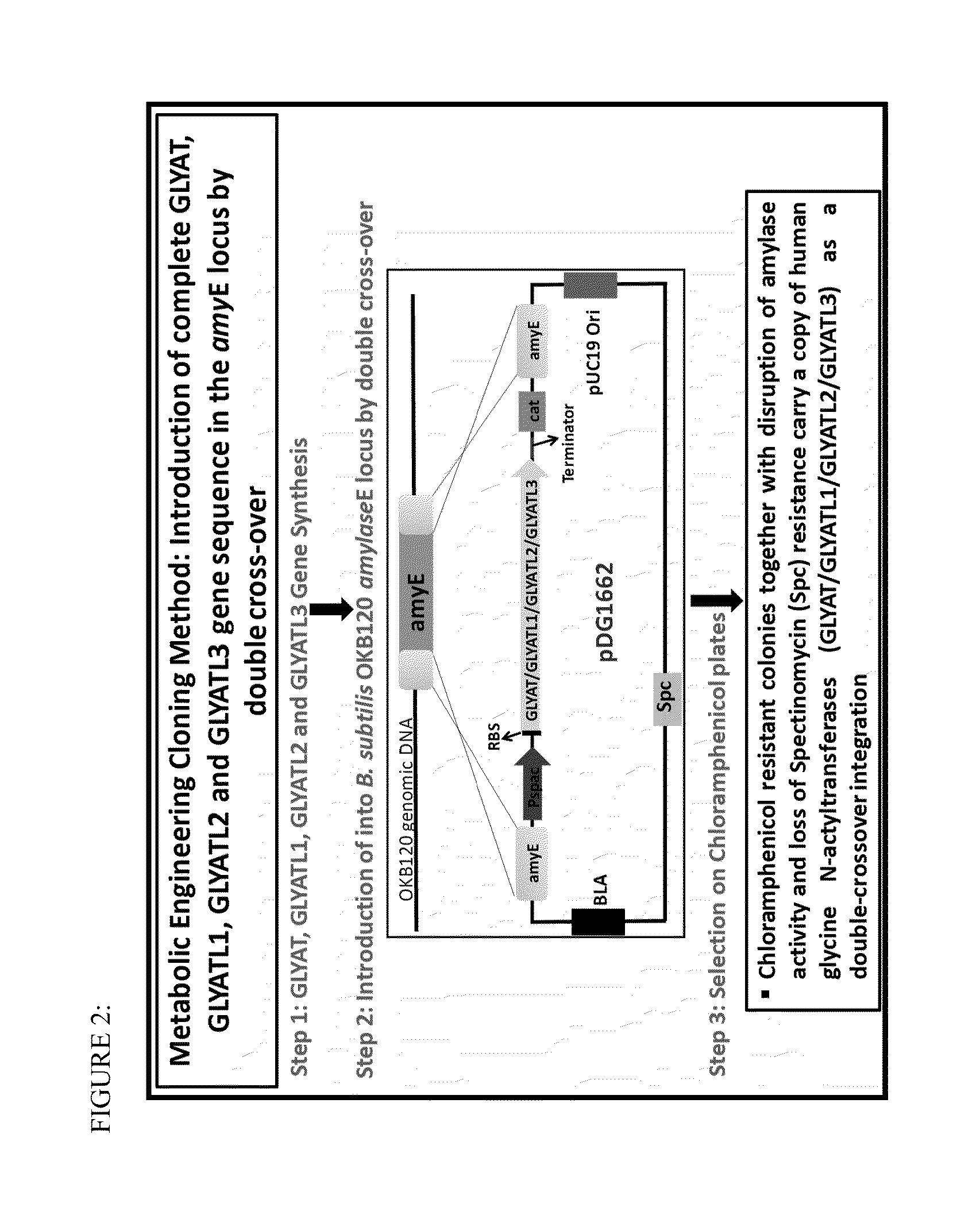
[0116]The glycine N-acyltransferase coding sequences were synthesized and assembled under the expression of the inducible promoter, Pspac (SEQ ID NO:16) and ribosome binding sequence (SEQ ID NO:17) and terminated by a termination sequence (SEQ ID NO:18). In addition, the constructs contained native B. subtilis genomic DNA flanking sequences on both ends of the construct. The 5′ end of the gene expression cassette contained the 5′ amyE gene sequence from B. subtilis, and the 3′ end of the gene expression cassette contained the 3′ amyE gene sequence from B. subtilis. The flanking genomic DNA fragments were identical to genomic DNA sequences of the a-amylase gene (amyE) from B. subtilis, and were incorporated into the constructs for integration within the genomic locus. The constructs and flanking genomic DNA were cloned into the pDGI662 plasmid (Bacillus Genetic Stock Center, Biological Sciences 556, 484 W. 12th Ave, Columbus, Ohio 43210...
PUM
| Property | Measurement | Unit |
|---|---|---|
| Fraction | aaaaa | aaaaa |
| Polymer chain length | aaaaa | aaaaa |
Abstract
Description
Claims
Application Information
 Login to View More