Methods for preparing brexpiprazole, key intermediates thereof and salts thereof
Inactive Publication Date: 2016-09-22
SHANGHAI INST OF MATERIA MEDICA CHINESE ACAD OF SCI +1
View PDF3 Cites 6 Cited by
Summary
Abstract
Description
Claims
Application Information
AI Technical Summary
This helps you quickly interpret patents by identifying the three key elements:
Problems solved by technology
Method used
Benefits of technology
Benefits of technology
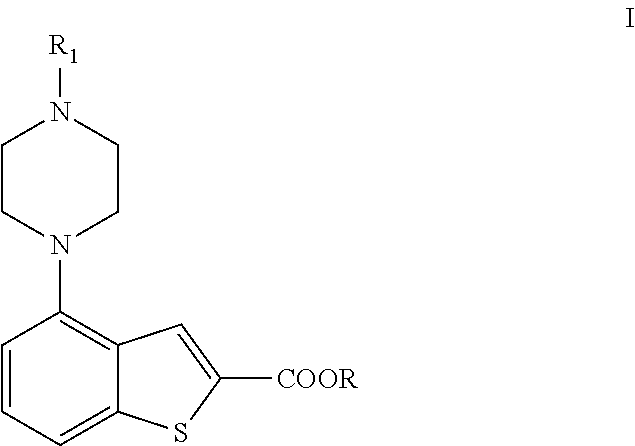
The present invention provides a method for removing protecting groups from a compound using cheap and readily available reagents. This method is simple and safe, and avoids the need for expensive and potentially dangerous reagents. The use of acetyl, propionyl, benzoyl, haloacetyl, phthalanoyl, or alkoxycarbonyl-based amino-protecting groups is preferred, especially when R1 is formyl, acetyl, or tert-butoxycarbonyl. The method is cost-effective, requires no further steps, and is suitable for mass production. This invention saves time, reduces production costs, improves yields, and enhances product quality.
Problems solved by technology
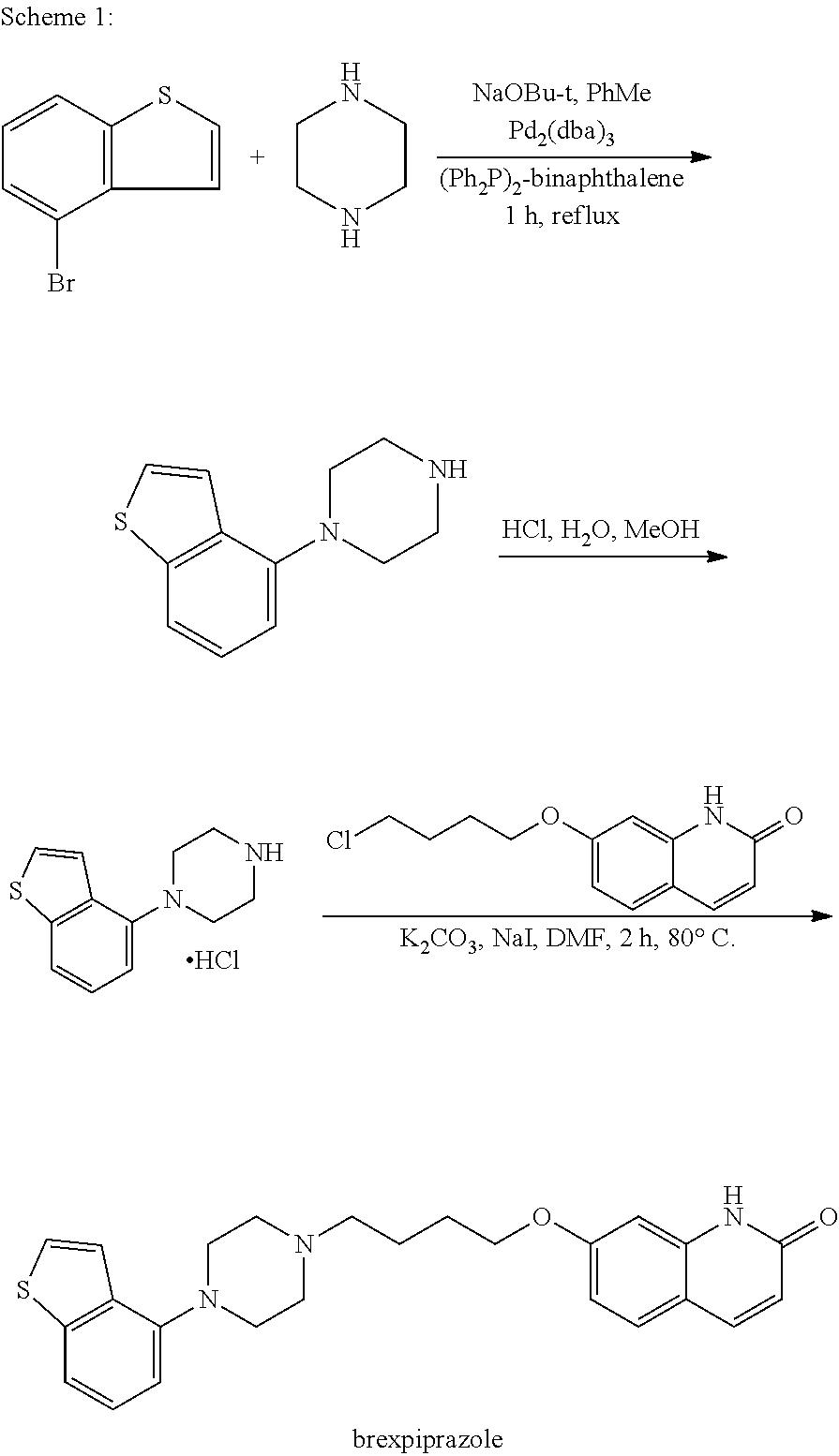
A preparation route of brexpiprazole is disclosed in the PCT application WO2006112464 A1 by Otsuka Pharmaceutical Co., Ltd. as shown in Scheme 1, the disadvantage of this route is that by-products that cannot be easily separated are produced in the first step of the reaction, intermediates with high purity cannot be easily obtained even by column chromatography.
Thus it suffered from reduced purity and yield of the final product brexpiprazole.
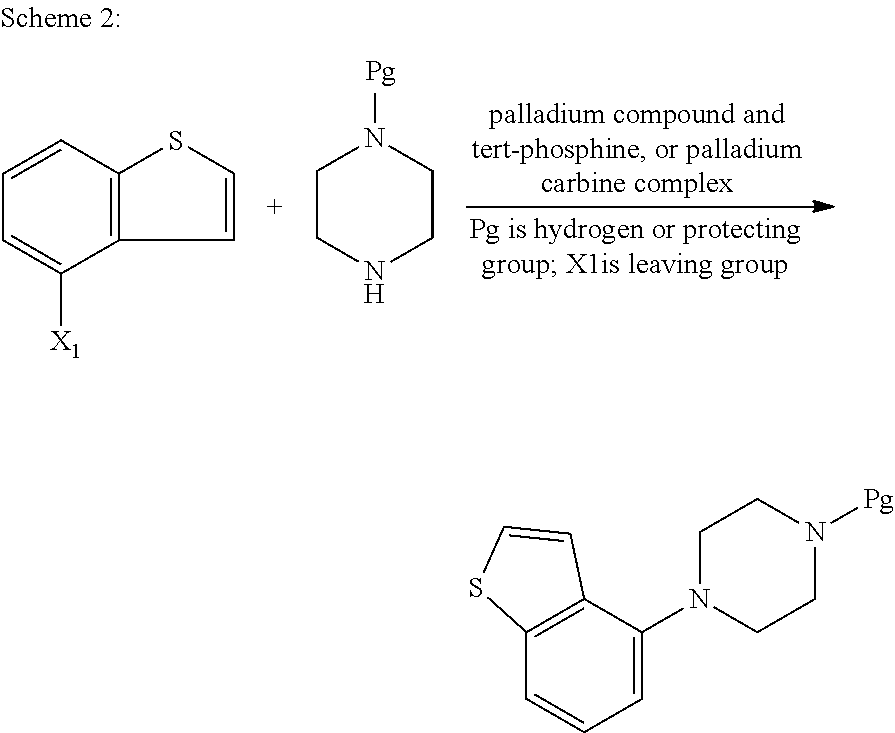
Then, another preparation route of this reaction is disclosed in the PCT application WO2013015456 A1 by Otsuka Pharmaceutical Co., Ltd. as shown in Scheme 2, the reagents used in the route are relatively expensive, so the disadvantage of the route is costly, environmental-ly unfriendly and not suitable for industrial production.
There are disadvantages of highcost, formation of impurities hard to separate for the above preparation method.
Method used
the structure of the environmentally friendly knitted fabric provided by the present invention; figure 2 Flow chart of the yarn wrapping machine for environmentally friendly knitted fabrics and storage devices; image 3 Is the parameter map of the yarn covering machine
View more
Image
Smart Image Click on the blue labels to locate them in the text.
Viewing Examples
Smart Image
Click on the blue label to locate the original text in one second.
Reading with bidirectional positioning of images and text.
Synthesis of 4-(3-chloro-2-formylphenyl)piperazine-1-carbaldehyde
[0050]
[0051]2-chloro-6-fluorobenzaldehyde (500 mg, 3.15 mmol), 1-formyl piperazine (396 mg, 3.47 mmol) and potassiumcarbonate (2.18 g, 15.77 mmol) were added to DMF (5 mL) under a nitrogenatmosphere at room temperature. The mixture was stirred at 80° C. for 4 hours, cooled, added with water (20 mL) and extracted with ethyl acetate (3×5 mL). The organic layer was dried over anhydroussodiumsulfate and concentrated. The resulting solid was slurried in petroleumether (50 mL) for 1 h, filtered to give a pale yellow solid (588 mg, yield 70%).
Synthesis of 2-(4-acetylpiperazin-1-yl)-6-chlorobenzaldehyde
[0053]
[0054]2-chloro-6-fluorobenzaldehyde (500 mg, 3.15 mmol), 1-acetyl piperazine (444 mg, 3.47 mmol) and potassiumcarbonate (2.18 g, 15.77 mmol) were added to DMF (5 mL) under a nitrogenatmosphere at room temperature. The mixture was stirred at 80° C. for 4 hours, cooled and filtered. Water (20 mL) was added thereto, then the mixture was extracted with ethyl acetate (3×5 mL). The organic layer was dried over anhydroussodiumsulfate and concentrated. The resulting solid was slurried in petroleumether (50 mL) for 1 h, filtered to obtain a pale yellow solid (588 mg, yield 70%).
the structure of the environmentally friendly knitted fabric provided by the present invention; figure 2 Flow chart of the yarn wrapping machine for environmentally friendly knitted fabrics and storage devices; image 3 Is the parameter map of the yarn covering machine
Login to View More
PUM
Login to View More
Abstract
The present invention relates to the methods for preparing brexpiprazole, the analogs, key intermediates, and salts thereof, specifically, the present invention relates to a new method for preparing brexpiprazole, the analogs, key intermediates, and salts thereof, and the key intermediates, and salts thereof provided during the preparation. The preparation method has a mild reaction condition, stable intermediate, easy operation, and uses cheap and easy-to-get reagents, thus it saves the synthesis cost, shortens the production cycle, improves the yield and product quality, and is suitable for mass production.
Description
FIELD OF THE INVENTION[0001]The present invention belongs to the field of pharmaceutical chemistry, particularly, relates to the methods for preparing brexpiprazole, the analogs, key intermediates, and salts thereof, also relates to novel compounds provided during the preparation.BACKGROUND OF THE INVENTION[0002]Brexpiprazole (Brexpiprazole, Code: OPC-34712) is a new generation of anti-psychotic drug candidates developed by Otsuka Pharmaceutical Co., Ltd., it takes effect on several receptors, i.e., it is the dopamine D2 receptorpartial agonist (improving positive and negative symptoms, cognitive disorder and depressive symptoms), 5-HT2A receptorantagonist (improving negative symptoms, cognitive function disorder, symptoms of depression, insomnia), al adrenergicreceptor antagonists (improving the positive symptoms of schizophrenia), 5-hydroxytryptamine uptake / reuptake inhibitors (improving depressive symptoms), a 5-HT1A partial agonist (having anxiolytic and antidepressant activi...
Claims
the structure of the environmentally friendly knitted fabric provided by the present invention; figure 2 Flow chart of the yarn wrapping machine for environmentally friendly knitted fabrics and storage devices; image 3 Is the parameter map of the yarn covering machine
Login to View More
Application Information
Patent Timeline
Application Date:The date an application was filed.
Publication Date:The date a patent or application was officially published.
First Publication Date:The earliest publication date of a patent with the same application number.
Issue Date:Publication date of the patent grant document.
PCT Entry Date:The Entry date of PCT National Phase.
Estimated Expiry Date:The statutory expiry date of a patent right according to the Patent Law, and it is the longest term of protection that the patent right can achieve without the termination of the patent right due to other reasons(Term extension factor has been taken into account ).
Invalid Date:Actual expiry date is based on effective date or publication date of legal transaction data of invalid patent.


 Login to View More
  Login to View More