This helps you quickly interpret patents by identifying the three key elements:
Problems solved by technology
Method used
Benefits of technology
Benefits of technology
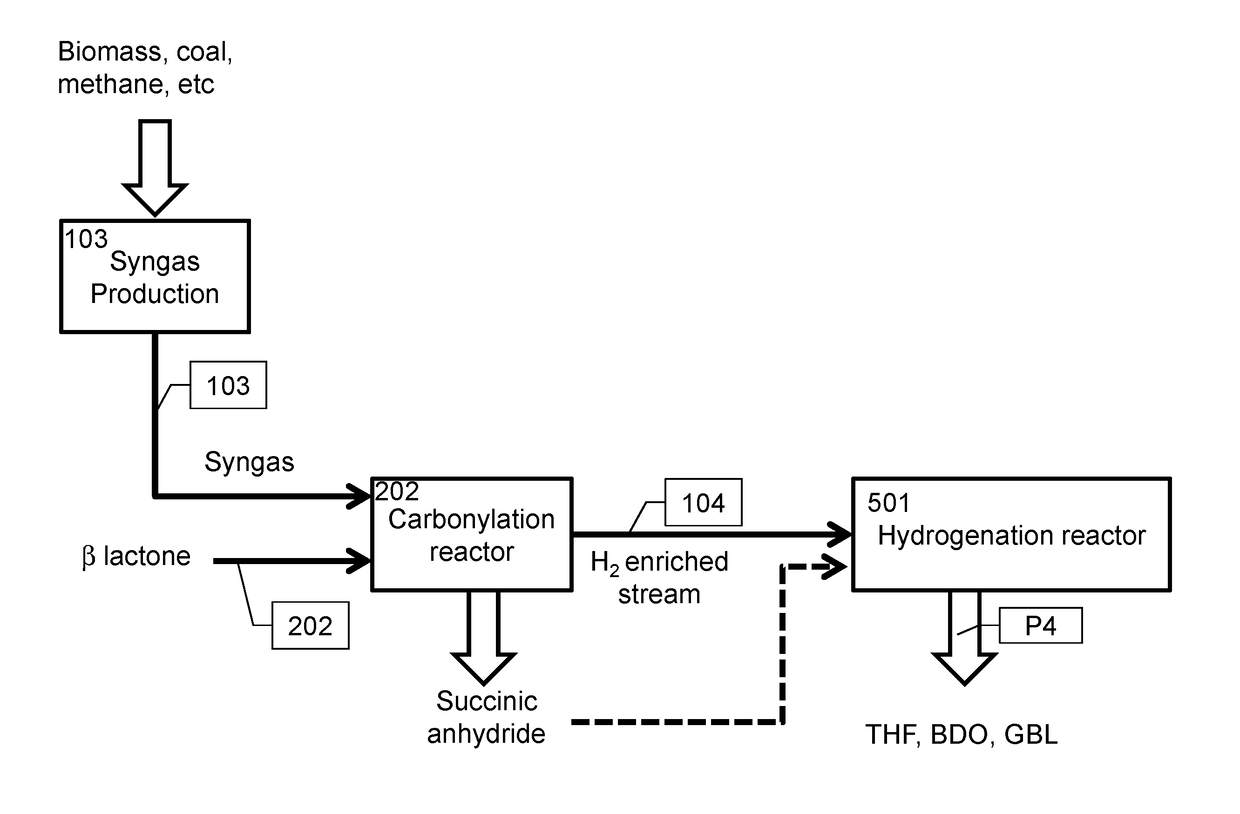
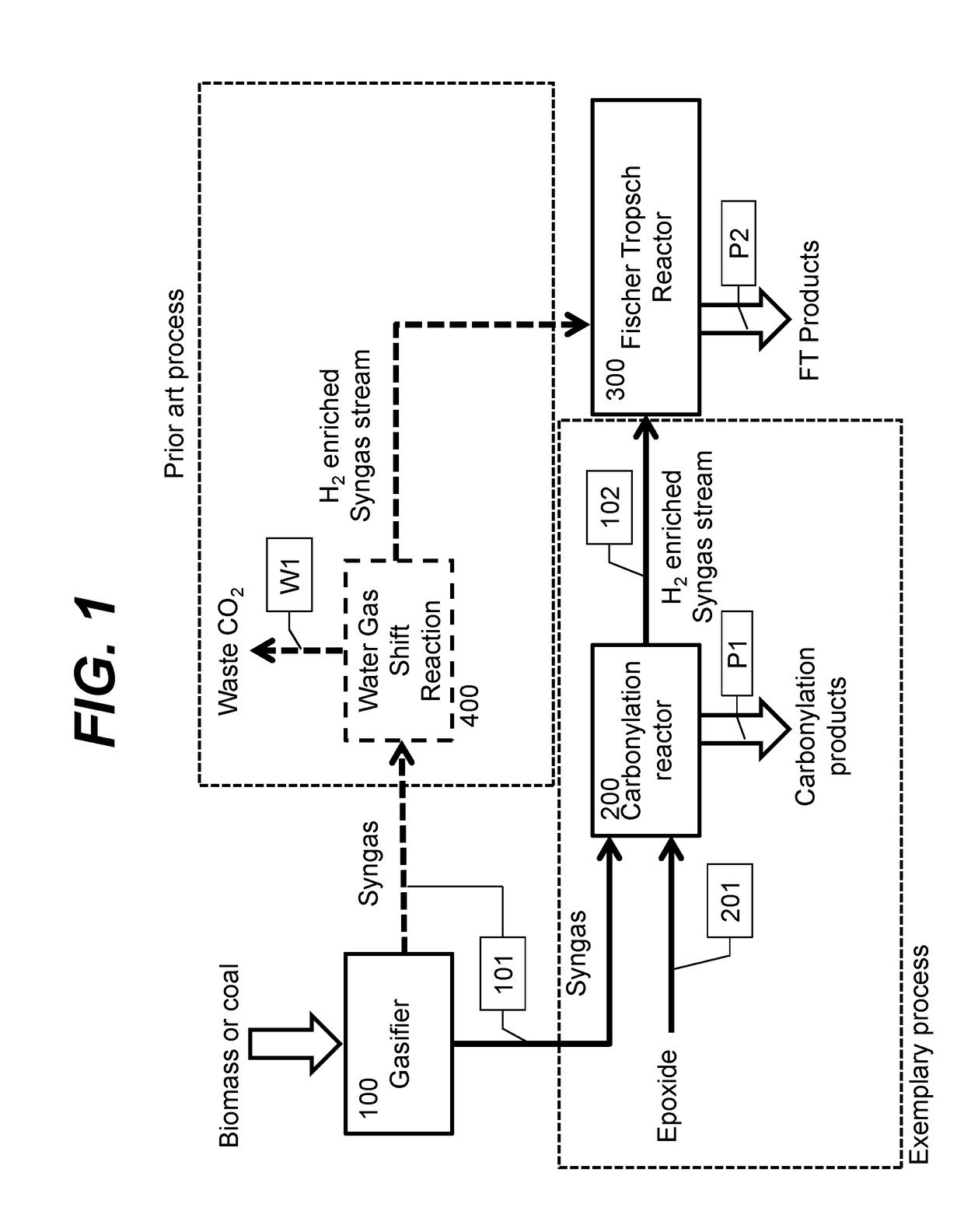
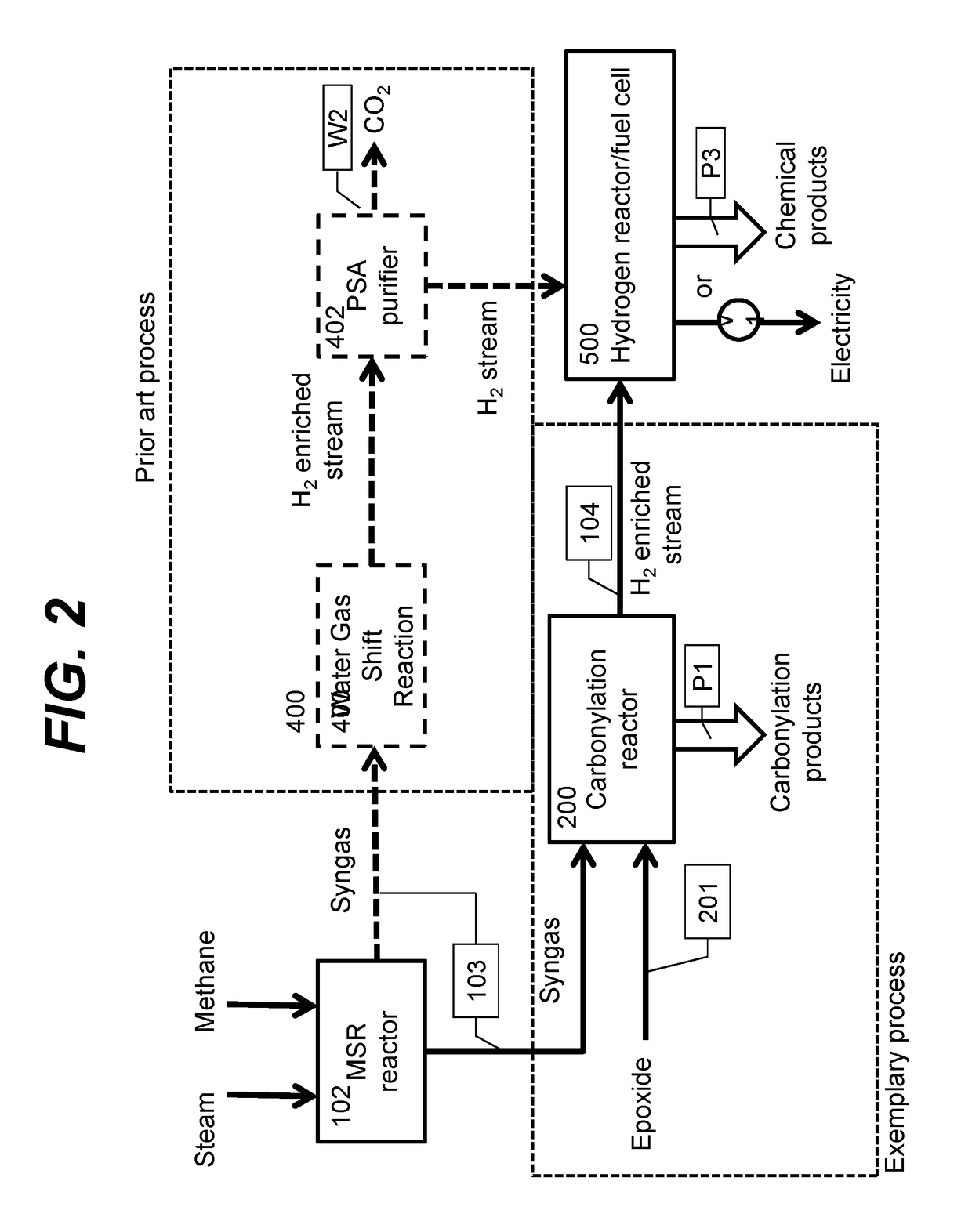
The methods and systems in this patent address the challenge of efficiently producing bio-based chemicals from coal or biomass. By using syngas streams containing hydrogen, carbon monoxide, and varying amounts of carbon dioxide, epoxidecarbonylation can selectively produce valuable chemical precursors. This is economically and environmentally preferable to releasing excess carbon dioxide as CO2. The integrated processes provide improved carbon efficiency for processes based on coal or biomass gasification or steam methane reforming.
Problems solved by technology
However, a drawback to gasification technology is that it is relatively inefficient in terms of the percentage of the carbon input to the gasifier that is actually incorporated into end products.
The resulting CO2 (22 kg CO2 per kg of H2 produced) is emitted to the atmosphere and erodes the carbon efficiency and environmental benefit of biomass gasification technologies.
Furthermore, existing methods used to produce bio-based BPL and SA at scale rely on the availability of bio-based supplies of C3 feedstocks such as propene, which are not economically competitive with fossil sources.
It is also a challenge to determine which feedstocks were used to produce a given batch of beta-propiolactone or succinic anhydride, as once the chemicals are produced, any sample of BPL or SA is largely indistinguishable.
Method used
the structure of the environmentally friendly knitted fabric provided by the present invention; figure 2 Flow chart of the yarn wrapping machine for environmentally friendly knitted fabrics and storage devices; image 3 Is the parameter map of the yarn covering machine
View more
Image
Smart Image Click on the blue labels to locate them in the text.
Viewing Examples
Smart Image
Click on the blue label to locate the original text in one second.
Reading with bidirectional positioning of images and text.
Smart Image
Examples
Experimental program
Comparison scheme
Effect test
embodiment 1
2. The method of embodiment 1, wherein the syngasstream has a molarhydrogen to CO ratio between 0.5:1 and 1.2:1 and the upgraded gas stream has a hydrogen to CO ratio of at least 1.9:1.
3. The method of embodiment 1, wherein the second chemical process comprises Fischer Tropsch synthesis.
4. The method of embodiment 1, wherein the second chemical process comprises reaction on a fuel cell.
5. The method of embodiment 1, wherein the second chemical process comprises hydrogenation.
6. The method of embodiment 1, wherein the epoxide carbonylation product is selected from the group consisting of: optionally substituted beta lactone, optionally substituted succinic anhydride, and a polyester resulting from alternating polymerization of CO and the epoxide.
7. The method of embodiment 1, wherein the epoxide is ethyleneoxide.
embodiment 7
8. The method of embodiment 7, wherein the carbonylation product is beta propiolactone.
9. The method of embodiment 7, wherein the epoxide carbonylation product is succinic anhydride and the upgraded gas stream has a molar hydrogen to CO ratio greater than 5:1.
embodiment 9
10. The method of embodiment 9, wherein and the upgraded gas stream has a hydrogen to CO ratio greater than 10:1, greater than 20:1, greater than 50:1, greater than 100:1, or greater than 1,000:1.
11. The method of embodiment 9, wherein the upgraded gas stream is substantially free of carbon monoxide.
12. Beta-propiolactone produced by carbonylation of ethylene oxide having a pMC of zero, as defined by ASTM D6866, using carbon monoxide having a pMC greater than zero, as defined by ASTM D6866.
13. Beta-propiolactone produced by carbonylation of ethylene oxide having a pMC greater than zero, as defined by ASTM D6866, using carbon monoxide having a pMC of zero, as defined by ASTM D6866.
the structure of the environmentally friendly knitted fabric provided by the present invention; figure 2 Flow chart of the yarn wrapping machine for environmentally friendly knitted fabrics and storage devices; image 3 Is the parameter map of the yarn covering machine
Login to View More
PUM
Login to View More
Abstract
The integrated processes herein provide improved carbon efficiency for processes based on coal or biomass gasification or steam methane reforming. Provided are also ethyleneoxidecarbonylation products such as beta-propiolactone and succinic anhydride having a bio-based content between 0% and 100%, and methods for producing and analyzing the same.
Description
CROSS-REFERENCE TO RELATED APPLICATIONS[0001]This application claims priority to U.S. Provisional Patent Application No. 62 / 116,109, filed Feb. 13, 2015, which is incorporated herein by reference in its entirety.FIELD[0002]The present disclosure relates generally to the integrated production of chemicals, and more specifically to integrated processes that provide improved carbon efficiency for processes based on coal or biomass gasification or steam methane reforming. The present disclosure also relates to ethyleneoxidecarbonylation products, such as beta-propiolactone and succinic anhydride having a bio-based content, and methods for producing and analyzing thereof.BACKGROUND[0003]Interest in finding sustainable methods to produce energy and chemicals continues to increase in the face of concerns that anthropogenic carbon emissions are responsible for global climate change. Among the options being considered is the use of biomass to feed chemical production via gasification. This...
Claims
the structure of the environmentally friendly knitted fabric provided by the present invention; figure 2 Flow chart of the yarn wrapping machine for environmentally friendly knitted fabrics and storage devices; image 3 Is the parameter map of the yarn covering machine
Login to View More
Application Information
Patent Timeline
Application Date:The date an application was filed.
Publication Date:The date a patent or application was officially published.
First Publication Date:The earliest publication date of a patent with the same application number.
Issue Date:Publication date of the patent grant document.
PCT Entry Date:The Entry date of PCT National Phase.
Estimated Expiry Date:The statutory expiry date of a patent right according to the Patent Law, and it is the longest term of protection that the patent right can achieve without the termination of the patent right due to other reasons(Term extension factor has been taken into account ).
Invalid Date:Actual expiry date is based on effective date or publication date of legal transaction data of invalid patent.



 Login to View More
  Login to View More